YTC Valve Positioners: The Ultimate Technical User Guide
1. YTC Product Line Overview: Matching the Model to the Application
YTC categorizes its positioners primarily by pneumatic output and input signal type. Understanding the nomenclature is critical for B2B purchasing. Here is the breakdown of the core series currently dominating the market.
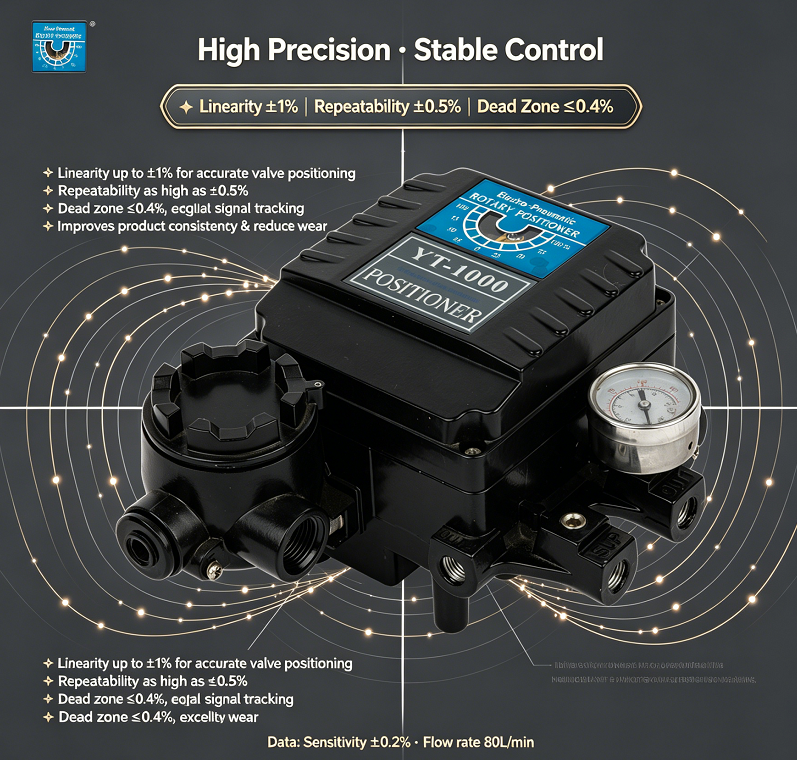
The Workhorse: YT-1000 Series (Linear & Rotary)
This is the most widely installed series globally. It is a conventional electro-pneumatic positioner that converts a 4-20mA DC signal into a pneumatic pressure output. It is known for its exceptional vibration resistance and simple cam adjustment for linear/rotary action.
-
Best For: General process control in chemical plants, paper mills, and power generation.
-
Input Signal: 4-20mA DC (Standard), Split range available.
-
Stroke Range: 10~150mm (Linear) / 0~90° (Rotary).
The Smart Choice: YT-3300 Series (HART Communication)
For plants utilizing the HART protocol, the YT-3300 is the go-to. It allows for remote monitoring, diagnostics, and configuration via a handheld communicator or DCS. It features a 2-wire system and offers significantly lower air consumption than analog models.
-
Best For: Critical control loops requiring predictive maintenance and data logging.
-
Protocol: HART 7.0.
-
Diagnostics: Valve signature analysis, friction calculation.
The Compact Solution: YT-1200 Series
This is an electro-pneumatic positioner designed specifically for "small bore" and rack-and-pinion actuators. It is lightweight, features a built-in pressure gauge manifold, and is extremely easy to mount.
-
Best For: OEM skid packages and compact valve assemblies.
-
Features: 1/4" NPT ports, Direct/Reverse action.
Intrinsically Safe & Explosion Proof: YT-2500 / YT-2600
For oil & gas and petrochemical applications, safety is paramount. YTC offers Ex ia IIC T6 and Ex d IIC T6 certified models, ensuring reliable operation in Zone 0 and Zone 1 hazardous areas.
2. Technical Specifications & Comparison Table
For procurement engineers, the datasheet is law. Below is a comparative table of the flagship models. Use this to filter your selection based on supply voltage, air consumption, and environmental limits.
| Specification | YT-1000 (Analog) | YT-1200 (Compact) | YT-3300 (Smart HART) | YT-2500 (Ex-proof) |
|---|---|---|---|---|
| Input Signal | 4-20mA DC | 4-20mA DC | 4-20mA DC (HART) | 4-20mA DC |
| Supply Pressure | 1.4~7.0 kgf/cm² (20~100 psi) | 1.4~7.0 kgf/cm² | 1.4~7.0 kgf/cm² | 1.4~7.0 kgf/cm² |
| Stroke Range | 10~150mm / 0~90° | 10~40mm / 0~90° | 10~150mm / 0~90° | 10~150mm / 0~90° |
| Air Consumption | ≤ 3 L/min (Sup=1.4 kgf) | ≤ 2 L/min | ≤ 0.5 L/min (Smart saving) | ≤ 3 L/min |
| Linearity | ±1.0% F.S. | ±1.0% F.S. | ±0.5% F.S. | ±1.0% F.S. |
| Hysteresis | ±0.5% F.S. | ±0.5% F.S. | ±0.3% F.S. | ±0.5% F.S. |
| Sensitivity | ±0.2% F.S. | ±0.2% F.S. | ±0.1% F.S. | ±0.2% F.S. |
| Ex Classification | Ex nA / Ex d (Optional) | Ex nA | Ex ia IIC T6 | Ex d IIC T6 / Ex ia |
| Ambient Temp | -30°C to +85°C | -20°C to +80°C | -30°C to +80°C | -40°C to +85°C |
| Output Pressure | 0~10 kgf/cm² | 0~10 kgf/cm² | 0~10 kgf/cm² | 0~10 kgf/cm² |
3. Wiring and Installation (4-20mA Loop Setup)
Incorrect wiring is the number one cause of "dead positioners" out of the box. YTC units are designed with standard terminal blocks, but you must observe proper polarity.
Standard 2-Wire Connection (YT-1000/1200/3300):
-
Terminal (+): Connect to the positive output of the DCS/Controller (4-20mA+).
-
Terminal (-): Connect to the negative input (Return signal).
-
Ground: Chassis ground must be connected to avoid RF interference, especially in VFD-heavy environments.
Wiring Best Practices:
-
Shielded Cable: Always use twisted-pair shielded cable. Ground the shield only at the controller side (DCS) to prevent ground loops.
-
Voltage Drop: Ensure the loop power supply is between 24V DC and 36V DC. Calculate the voltage drop across the positioner (typically < 10V for YT-3300) to ensure the DCS card can drive the loop.
-
Air Supply Quality: Do not apply pneumatic pressure before checking the air supply. YTC positioners require ISO 8573-1 Class 3 air quality (Dew point: -20°C, Particle size: < 5µ, Oil content: < 1mg/m³). Dirty air will clog the internal I/P converter nozzle, leading to "hunting" oscillations.
4. Calibration Procedure (Zero & Span)
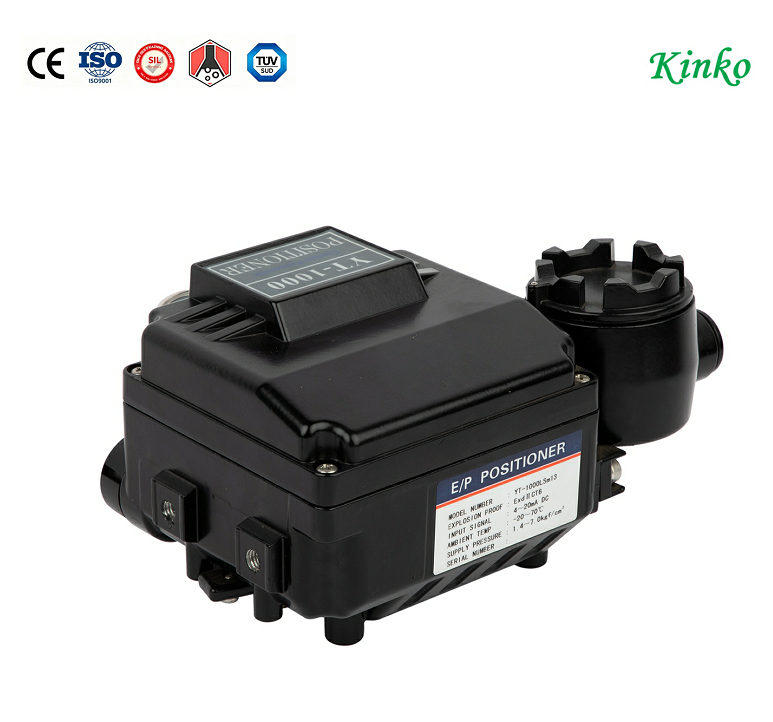
While the YT-3300 allows for auto-calibration via a communicator, the YT-1000 requires mechanical setup. Here is the "Fifteen-Minute" calibration method for field engineers.
Tools Required: 4-20mA signal generator, Digital Multi-meter, Hex wrenches.
-
Input Signal (Zero): Supply a 4mA signal to the positioner.
-
Zero Adjustment: Locate the "Zero" adjustment screw (usually a slotted or hex screw on the front panel). Turn it until the actuator just begins to move from the fully closed position, then back it off slightly until it rests firmly at the mechanical stop.
-
Input Signal (Span): Supply a 20mA signal.
-
Span Adjustment: Locate the "Span" adjustment screw. Turn it to adjust the stroke length so that the valve reaches 100% open (or full stroke) exactly at 20mA.
-
Feedback Linkage: Ensure the feedback lever arm is at a 90° angle to the actuator shaft at 50% stroke (12mA). This provides the best linearity.
-
Verification: Ramp the signal down to 4mA, up to 20mA, and check the mid-point (12mA). The valve should sit at 50%. Repeat the Zero and Span process until linearity is achieved.
5. Troubleshooting Common YTC Issues
Even the best equipment faces operational challenges. Here are the top three issues and their fixes.
Issue A: The valve is "Hunting" (Oscillating)
-
Cause: The gain is set too high, or the air supply pressure is fluctuating.
-
Fix: Reduce the internal pilot valve gain (if adjustable). Install an air filter regulator directly upstream of the positioner.
Issue B: No Response to 4-20mA Signal
-
Cause: No current at the terminals.
-
Fix: Check the loop wiring. Use a multimeter in series to measure the mA signal. If the signal is present but the positioner doesn't respond, check the terminal block for broken soldering.
Issue C: Valve does not reach Full Stroke
-
Cause: The feedback cam is installed at the wrong angle.
-
Fix: Loosen the cam and rotate it 180 degrees to switch between Direct Acting (Air-to-Close) and Reverse Acting (Air-to-Open).
6. Maintenance Schedule for Longevity
To maximize MTBF (Mean Time Between Failures), Kinko recommends the following schedule:
-
Monthly: Check the air filter regulator for moisture and debris. Drain the water trap.
-
Quarterly: Inspect the I/P converter nozzle and flapper for dust. Clean with isopropyl alcohol.
-
Annually: Perform a full re-calibration (Zero/Span) to account for mechanical wear in the valve linkage.
Ivan (Mobile:+86-18968769287)
WhatsApp:+86-13579991606
Wechat:+86-18968769287
Website:www.kinko-flow.com
ZHEJIANG KINKO FLUID EQUIPMENT CO.,LTD
