How Valve Positioners Improve Control Accuracy
The Physics of the Feedback Loop
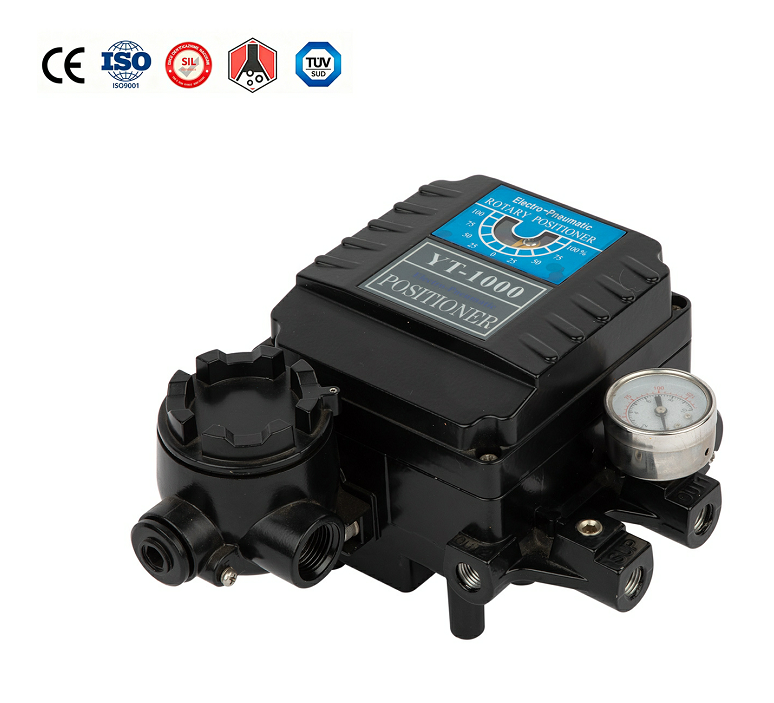
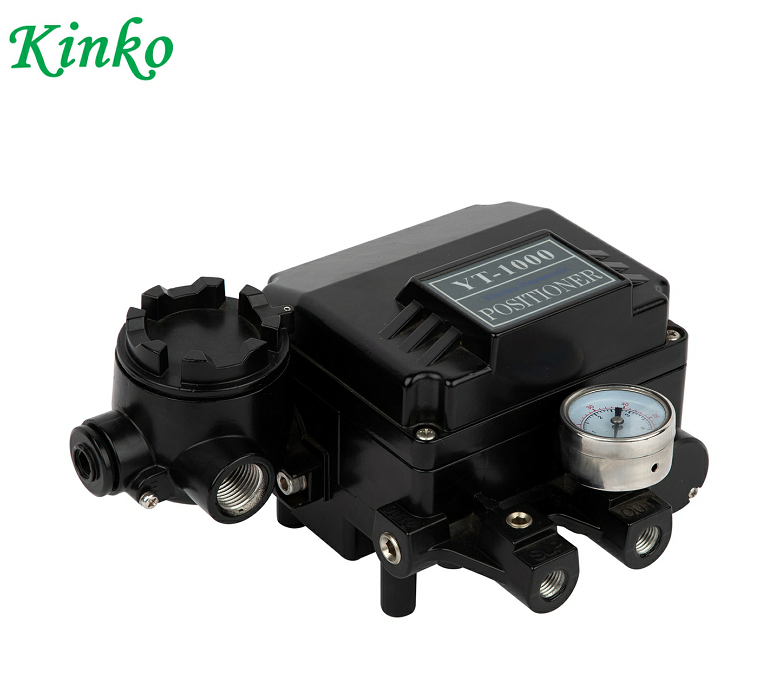
Every YTC positioner operates on a force-balance (analog) or microprocessor-controlled (digital) principle.
-
Input Signal Applied: The DCS sends a 4-20mA signal to the positioner's coil or CPU.
-
Mechanical Feedback: A feedback lever connected to the valve stem moves as the valve opens.
-
Error Detection: The positioner compares the target position (input signal) against the actual position (feedback lever).
-
Pneumatic Correction: If the valve has not reached the target, the positioner's pilot valve (or I/P converter) increases or decreases the output pressure to the actuator diaphragm until the error is zero.
This happens millions of times per day, continuously correcting for:
-
Packing Friction: As graphite or PTFE packing ages, it creates stiction (static friction). The positioner boosts pneumatic pressure to overcome this stiction and precisely position the plug.
-
Process Differential Pressure: When the fluid pressure across the valve seat changes, it exerts a force on the plug that tries to push it off position. The positioner counteracts this by modulating actuator pressure in real time.
-
Supply Pressure Drops: If your plant air header drops from 6 bar to 5 bar, the positioner automatically compensates to maintain the required output pressure.
Quantifying Accuracy: What the Numbers Mean
Returning to the spec table in Section 2, you will notice three critical accuracy metrics. Here is what they mean for your control loop:
| Metric | YT-1000 Specification | Real-World Impact |
|---|---|---|
| Linearity (±% F.S.) | ±1.0% | The valve position will deviate no more than 1% from the ideal straight line across the full stroke. For a 150mm stroke, that is a maximum error of 1.5mm. |
| Hysteresis (±% F.S.) | ±0.5% | The difference in position when approaching a setpoint from the opening direction versus the closing direction. Low hysteresis ensures that the valve returns to the exact same position regardless of direction of approach. |
| Sensitivity (±% F.S.) | ±0.2% | The smallest change in input signal that the positioner can detect and respond to. A 0.2% sensitivity means a change of just 0.032mA in a 16mA span will trigger a correction. |
Smart Positioners (YT-3300): Taking Accuracy to the Next Level
While analog YT-1000 units provide excellent mechanical control, the YT-3300 series with HART communication adds a layer of adaptive control that pushes accuracy beyond ±0.5%.
-
Auto-Calibration: The YT-3300 performs a self-diagnostic stroke test, automatically adjusting its internal PID (Proportional-Integral-Derivative) gains to match the specific actuator size and valve characteristics.
-
Friction Compensation: The microprocessor continuously analyzes the valve's response curve and applies a "dither" signal (a high-frequency, low-amplitude oscillation) to break static friction, ensuring immediate response to small setpoint changes.
-
Dynamic Gain Control: The positioner can be configured to use different gain settings depending on whether the valve is near the fully closed position (where tight shutoff is critical) or in the middle of its travel (where smooth throttling is needed).
The Chain of Accuracy: A Practical Example
Consider a temperature control loop in a chemical reactor. The DCS calculates that the coolant valve must be 47.5% open to maintain the setpoint.
-
Without Positioner (Spring-Only): The 12.72mA signal is converted to a pressure of approximately 7.5 psi. However, packing friction requires an extra 1 psi to overcome static resistance. The valve only moves to 45% open. The reactor overheats. The DCS compensates by overcorrecting, causing oscillations. Result: ±5% control deviation.
-
With YTC YT-3300 Positioner: The 12.72mA signal is received. The feedback lever reports the valve is at 45%. The microprocessor immediately calculates the error and increases the output pressure until the feedback lever confirms 47.5%. The response takes less than 300 milliseconds. Result: ±0.5% control deviation.
Troubleshooting Accuracy-Related Issues
When your YTC positioner is not delivering the expected accuracy, refer to these targeted diagnostics:
| Symptom | Likely Root Cause | Corrective Action |
|---|---|---|
| Poor Linearity (Error increases at mid-stroke) | Incorrect cam selection or the feedback lever is not at 90° at 50% stroke. | Verify the cam is matched to the actuator type (linear vs. rotary). Reinstall the feedback lever at a 90° angle to the actuator shaft at 12mA. |
| Excessive Hysteresis (Different positions on opening vs. closing) | Loose mechanical connections or worn linkages. | Tighten all coupling bolts. Replace any worn pivot pins or bushings in the feedback assembly. |
| Slow Response / Lag (Valve cannot keep up with fast setpoint changes) | The orifice in the pilot valve is partially blocked, or the supply pressure is too low. | Remove the pilot valve and clean the nozzle with a fine wire (0.3mm) and compressed air. Increase supply pressure to the maximum rated value (7.0 kgf/cm²) for faster stroking. |
| Hunting (Continuous Oscillation) | The gain is too high, causing overshoot and correction cycles. | Switch to a lower gain setting via the adjustment screw (YT-1000) or reduce the "Proportional Band" value in the YT-3300's configuration menu via the HART communicator. |
Best Practices for Maximizing Accuracy
To ensure your YTC positioner delivers its rated accuracy for the full lifespan of the valve package:
-
Mounting Rigidity: The positioner mounting bracket must be absolutely rigid. Any vibration or flex in the bracket introduces a mechanical error in the feedback loop.
-
Direct versus Reverse Action: Ensure the positioner's action setting matches the valve fail-safe configuration. If the actuator is "Air-to-Open" (fail close), you need a "Direct" acting positioner. If it is "Air-to-Close" (fail open), you need "Reverse" action. Incorrect settings result in the positioner fighting the spring, causing non-linearity.
-
Supply Pressure Regulation: Always install a high-quality air filter regulator (AFR) immediately upstream of the positioner. A 0.5 bar fluctuation in supply pressure translates directly to a force fluctuation on the actuator diaphragm. YTC recommends a regulator with a relieving feature to vent trapped air for precise control.
-
Periodic Calibration Verification: For the YT-1000, perform a 3-point calibration (4mA, 12mA, 20mA) every six months. For the YT-3300, use the HART communicator to run the "Valve Signature" test and trend the friction levels over time. An increasing friction trend is your early warning sign that packing needs adjustment.
Summary
The valve positioner is the guardian of process accuracy. The YTC product line—from the robust analog YT-1000 to the intelligent YT-3300—provides the precision required to maintain product quality, energy efficiency, and plant safety. By understanding the physics of the feedback loop, selecting the correct accuracy metrics, and following the troubleshooting matrix above, you ensure that your final control element performs exactly as the DCS demands—every time.
Ivan (Mobile:+86-18968769287)
WhatsApp:+86-13579991606
Wechat:+86-18968769287
Website:www.kinko-flow.com
ZHEJIANG KINKO FLUID EQUIPMENT CO.,LTD
