When Should You Use a Manual Angle Seat Valve for On/Off Control?
1. What Is a Manual Angle Seat Valve?
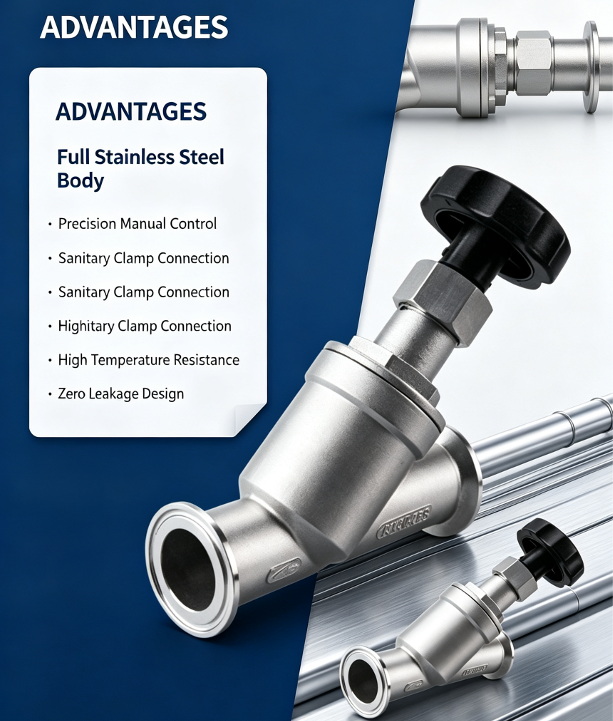
A manual angle seat valve is a pneumatically actuated or manually operated valve with a distinctive 90° (or 45°) angled body design. The "manual" version uses a handwheel or lever to directly drive the stem and seat, providing simple, reliable on/off control without requiring electrical or pneumatic signals.
Key design feature: The angled seat design allows for high flow capacity (Cv) with minimal pressure drop, while the self-draining body prevents fluid stagnation—making it ideal for liquid, steam, and gas services.
2. When Should You Choose Manual Over Pneumatic/Electric?
Not every on/off valve needs automation. Manual angle seat valves are the preferred choice in the following 5 scenarios:
Scenario 1: Infrequent Operation (Less Than 10 Cycles/Day)
If a valve is opened/closed only a few times per shift—for line startup, shutdown, or batch changeovers—automation adds unnecessary cost and complexity.
-
Manual advantage: No solenoids, positioners, or wiring required. Lower upfront cost and minimal maintenance.
-
Typical applications: Drain lines, sampling points, bypass loops, and manual isolation before instrument taps.
Scenario 2: No Power or Instrument Air Available On-Site
In remote locations, skid-mounted packages, or temporary installations, pneumatic or electric supply may not be available or cost-prohibitive to install.
-
Manual advantage: Completely independent of utilities. A handwheel or lever is all you need.
-
Typical applications: Field gas wells, water treatment kiosks, mobile tanker loading/unloading.
Scenario 3: High-Temperature or Dirty Media (Steam, Slurry, Fibrous Fluids)
Angle seat valves have a self-lapping, self-cleaning seat design. When manually operated, the linear lifting motion shears through deposits, making them resistant to clogging.
-
Manual advantage: No pilot solenoids to clog; manual force can break through light scale or solids.
-
Typical applications: Steam tracing lines, pulp and paper stock, chemical reactor drains, and cooling tower sluice lines.
Scenario 4: Emergency Override or Bypass for Automated Valves
When a pneumatically controlled angle seat valve is installed in a critical loop, a manual bypass valve alongside it ensures that operators can maintain process flow during instrument air failure, controller malfunction, or power outage.
-
Manual advantage: Provides a mechanical fallback (fail-safe bypass) independent of the control system.
-
Typical applications: Heat exchanger bypass, pump recirculation lines, and pressure relief valve isolation.
Scenario 5: Low-Budget Maintenance Sparing
For plants with limited spare parts inventory, manual angle seat valves offer a simple, robust design with minimal wearing parts (mainly the seat seal and stem packing).
-
Manual advantage: Can be repaired in-line without specialized calibration tools or software.
-
Typical applications: Non-critical utility services where cost per valve is the primary procurement driver.
3. Performance Comparison: Manual vs. Automated Angle Seat Valves
| Feature | Manual Angle Seat Valve | Pneumatic Angle Seat Valve | Electric Angle Seat Valve |
|---|---|---|---|
| Actuation | Handwheel / Lever | Single/Double-acting cylinder | Electric motor + gearbox |
| Power required | None | Instrument air (4~8 bar) | 24V DC / 110V AC / 230V AC |
| Control signal | None | 3/2 or 5/2 solenoid valve | 4-20mA or dry contact |
| Stroking speed | Operator-dependent (slow) | Fast (<1 second) | Medium (5~15 seconds) |
| Ideal cycle frequency | Low (<10/day) | High (>50/day) | Medium (10~50/day) |
| Maintenance complexity | Low (packing + seat) | Medium (cylinder seals + pilot) | High (motor + gearbox) |
| Initial cost | Lowest | Medium | Highest |
| Best application | Manual bypass, infrequent ops | High-cycle automated loops | Remote control without air supply |
4. Key Technical Parameters to Specify
When selecting a manual angle seat valve, pay close attention to these critical specifications:
| Parameter | Typical Range / Options | Selection Tip |
|---|---|---|
| Body material | CF8M (316 SS), CF3M (316L), WCB (carbon steel), Bronze | Use 316SS for corrosive/steam; WCB for general water/air |
| Seat material | PTFE, PEEK, RTFE, Metal (Stellite) | PTFE for general; PEEK for high-temp/abrasive; Metal for >200°C |
| End connections | Threaded (NPT/BSPP), Flanged (ANSI 150/300), Tri-clamp, Socket weld | Threaded for small sizes (DN15~DN50); Flanged for >DN50 |
| Size range | DN15 ~ DN100 (1/2" ~ 4") | Larger sizes (>DN80) may require gear operator for manual torque reduction |
| Pressure rating | PN16, PN25, PN40, ANSI 150/300 | Match process pressure; ANSI 300 for steam >10 bar |
| Temperature range | -20°C ~ +220°C (PTFE seat); -20°C ~ +400°C (metal seat) | PTFE soft seat for tight shut-off; metal seat for high-temp steam |
| Flow coefficient (Cv) | Up to 120 (for DN80) | Select based on required flow rate and allowable pressure drop |
| End connection standard | ISO 5211 mounting pad (optional) | Allows future upgrade to pneumatic actuator without modifying piping |
5. Installation & Operation Best Practices
-
Flow direction: Always install with flow under the seat (closing direction) for longer seat life and tighter shut-off. The arrow on the body indicates recommended orientation.
-
Mounting: Handwheel can be mounted in any angle (360° rotation). Ensure clearance for full handwheel rotation.
-
Packing adjustment: Tighten the gland nut slightly if stem leakage appears. Over-tightening increases operating torque—adjust in 1/8-turn increments.
-
Cycle torque: For sizes ≥DN65, consider a gear operator to reduce manual effort, especially for high-pressure differential services.
6. Typical Application Examples
| Industry | Application | Why Manual Angle Seat Wins |
|---|---|---|
| Food & Beverage | CIP (Clean-In-Place) supply isolation | Self-draining body prevents bacteria growth |
| Pharmaceutical | Pure steam sampling points | High-temp rating + 316L body |
| Chemical | Reactor bottom drain | Self-cleaning seat resists polymer build-up |
| Oil & Gas | Filter change-over isolation | No power required at remote wellheads |
| Power | Boiler blowdown lines | Handles hot water/steam with metal seat option |
| Water/Wastewater | Sludge recirculation bypass | Passes fibrous solids without clogging |
7. When NOT to Use a Manual Angle Seat Valve
Avoid manual versions if:
-
Frequent cycling (>50 operations/day) – operator fatigue and inconsistent positioning lead to seat wear.
-
Remote or inaccessible location – operators cannot reach the valve physically (use pneumatic/electric instead).
-
Precise throttling control – angle seat valves are designed for on/off only; for throttling, use a globe or rotary control valve.
-
Very high torque >200 Nm – manual operation becomes impractical; switch to pneumatic with positioner.
Conclusion: A Purpose-Built Solution for Simple, Reliable Isolation
The manual angle seat valve is not outdated—it remains the go-to choice for:
-
Infrequent on/off isolation
-
Remote sites without utility power or air
-
High-temperature steam and dirty fluids
-
Cost-sensitive maintenance sparing
-
Emergency manual bypass around automated loops
It offers the simplicity of a ball valve with the flow efficiency and self-cleaning properties that only an angled seat geometry provides.
Ivan (Mobile:+86-18968769287)
WhatsApp:+86-13579991606
Wechat:+86-18968769287
Website: www.kinko-flow.com
ZHEJIANG KINKO FLUID EQUIPMENT CO.,LTD
