What Is an FRL Unit & Why It’s Essential for Pneumatics
What Is an FRL Unit?
An FRL unit is a modular assembly of three pneumatic components combined into a single system. It is typically installed immediately upstream of critical pneumatic instruments and actuators.
| Component | Function | Why It Matters |
|---|---|---|
| Filter | Removes solid particles (dust, rust, pipe scale) and separates liquid water and oil from the compressed air stream. | Prevents clogging of the positioner's I/P converter nozzle and pilot valve. Extends valve packing life. |
| Regulator | Reduces and stabilizes the incoming plant air pressure to a precise, adjustable setpoint. | Ensures consistent actuator thrust and positioner response. Compensates for upstream pressure fluctuations. |
| Lubricator | Adds a controlled mist of oil into the air stream to lubricate moving internal parts of pneumatic actuators and cylinders. | Reduces friction and wear in the actuator piston or diaphragm stem. (Note: Many modern positioners and instruments require dry, oil-free air—lubricators are often omitted in instrument air applications.) |
FRL units are available as individual components (separate filter, regulator, and lubricator connected by piping) or as combined modular units (stacked together with integral connections). Modular units are preferred for instrument panels due to their compact footprint and reduced leak points.
Why an FRL Unit Is Essential for Your Pneumatic System
Without an FRL, your compressed air supply is a cocktail of contaminants and instability. Here is what happens in each scenario:
1. Contaminant Protection (The Filter)
Industrial compressed air contains:
-
Solid particles: Rust from pipes, dust from intake, and wear debris from the compressor.
-
Liquid water: Condensation from compressed air cooling after the compressor discharge.
-
Oil aerosols: Carryover from lubricated rotary screw compressors.
The Consequence: The YTC positioner's I/P converter has a nozzle clearance measured in microns. A single 5-micron particle lodged in the nozzle causes the positioner to "hunt" (oscillate) or freeze completely. The filter removes particles down to 5 microns (standard) or 0.01 microns (coalescing filters), protecting your expensive instruments.
The Requirement: YTC positioners require air quality meeting ISO 8573-1 Class 3 (Particles < 5µ, Dew point -20°C, Oil content < 1 mg/m³). A properly sized filter is non-negotiable.
2. Pressure Stabilization (The Regulator)
Plant air headers typically operate at 6-8 bar (87-116 psi). However, these pressures fluctuate as other users in the plant start and stop. A positioner expects a stable, constant supply pressure—typically 4-6 bar (58-87 psi) for most spring-return actuators.
The Consequence: A ±0.5 bar fluctuation in supply pressure translates directly to a force fluctuation on the actuator diaphragm. The valve position drifts, the DCS overcorrects, and the process oscillates. The regulator locks the supply pressure to a precise setpoint, isolating your control loop from header fluctuations.
Critical Feature: Use a relieving-type regulator. When downstream pressure exceeds the setpoint (due to actuator back-pressure), the regulator vents the excess to atmosphere. Non-relieving regulators trap pressure, preventing the actuator from fully closing.
3. Lubrication (The Lubricator - Use with Caution)
Lubricators add oil mist to the air to lubricate pneumatic cylinders, impact tools, and some actuators.
Critical Warning: Many modern control valves use packing that does not require lubrication (e.g., PTFE, graphite). Additionally, YTC positioners and I/P converters are factory-calibrated for dry air and do not require—or tolerate—oil mist. Oil can:
-
Swell elastomer diaphragms and seals.
-
Attract dust, creating a sludge that blocks nozzles.
-
Interfere with positioner feedback sensors.
Best Practice: For instrument air applications supplying YTC positioners, omit the lubricator entirely. Use only a Filter-Regulator (FR) unit. Reserve lubricators for plant air tools and cylinder applications where lubrication is explicitly required.
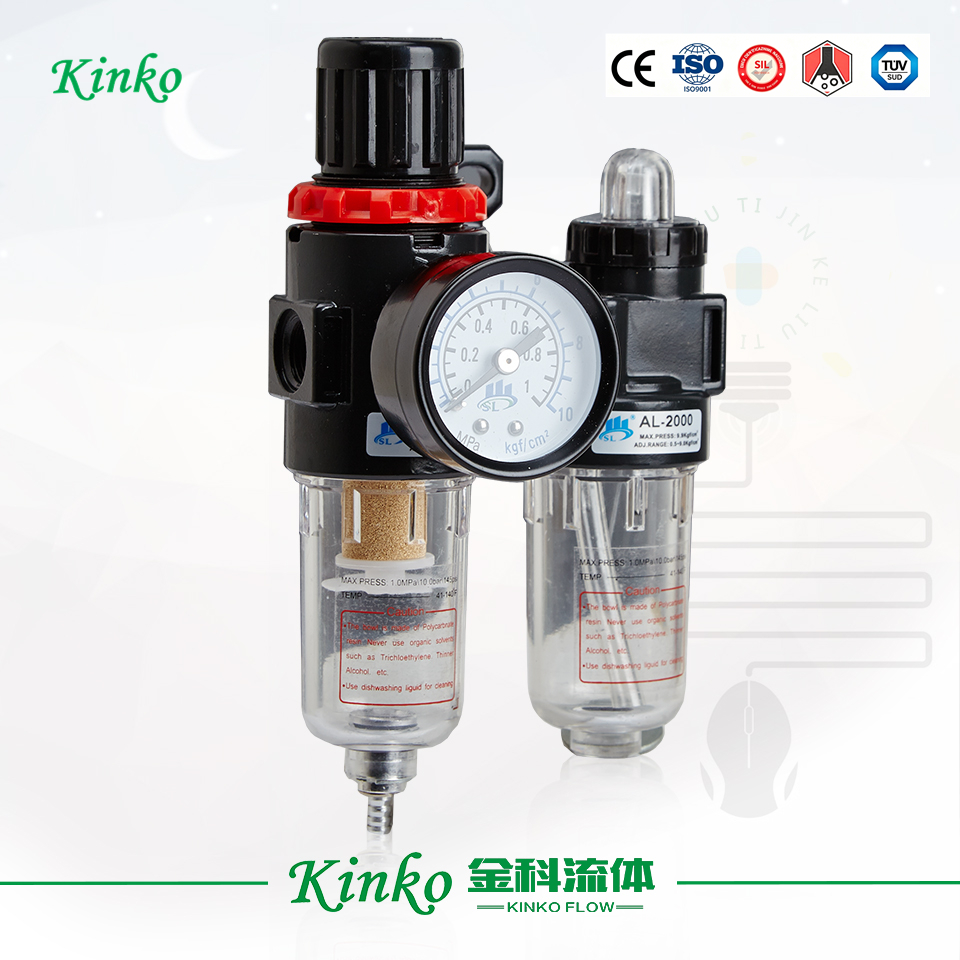
Types of FRL Configurations
| Configuration | Components | Best Application |
|---|---|---|
| Filter + Regulator (FR) | Filter and regulator combined. No lubricator. | Instrument air for positioners, I/P converters, and control valves. Recommended for YTC positioners. |
| Filter + Regulator + Lubricator (FRL) | Full three-component assembly. | Pneumatic tools, cylinders, and actuators with dynamic seals requiring oil lubrication. |
| Filter only | Single filter element. No regulation or lubrication. | Pre-filtration before a dryer or as a roughing filter. |
| Regulator only | Single pressure-reducing valve. | General pressure control where air quality is already assured. |
Selecting the Right FRL for Your YTC Positioner
When specifying an FRL for your positioner package, consider these factors:
| Selection Factor | Recommendation |
|---|---|
| Port Size | Match the FRL port size to your positioner supply port (typically 1/4" NPT for YT-1000/1200/3300 series). |
| Flow Capacity (Cv) | The FRL must deliver sufficient flow (SCFM or L/min) to stroke the actuator at the required speed. For most control valve actuators (< 10L volume), a Cv of 0.5-1.0 is sufficient. |
| Filter Element Micron Rating | 5-micron nominal for standard service. Use 0.01-micron coalescing filter for oil-removal in lubricated compressor systems. |
| Regulator Range | Choose a regulator with a pressure range that covers your actuator's maximum rating (e.g., 0.5-7.0 kgf/cm² or 7-100 psi). |
| Bowl Type | Metal bowl for high-temperature or hazardous areas (Ex-rated). Polycarbonate bowl for general-purpose indoor use (visible condensate level). |
| Drain Type | Automatic drain for unattended operation. Manual drain for periodic maintenance (more reliable in dirty air). |
Installation Best Practices for FRL Units
-
Mount as Close as Possible: Position the FRL within 30 cm (12 inches) of the YTC positioner's SUP port. This minimizes the dead volume of unregulated pipe between the regulator and the positioner.
-
Install a Shut-Off Valve Upstream: Allows maintenance of the FRL without depressurizing the entire plant air header.
-
Vertical Mounting: Install the FRL vertically with the bowl at the bottom. This allows condensate to drain properly and prevents liquid carryover into the downstream line.
-
Pressure Gauge: Install a pressure gauge on the regulated outlet port. This provides a visual check that the regulator is set correctly.
-
Purge Before Connection: Before connecting the FRL outlet to the positioner, open the downstream valve and blow air for 30 seconds to flush any debris from the regulator body.
FRL Maintenance Schedule
To ensure your YTC positioner receives pristine air, follow this maintenance plan:
| Frequency | Task |
|---|---|
| Weekly | Check the filter bowl for accumulated water and debris. Drain manually if no automatic drain is installed. |
| Monthly | Inspect the filter element. If visibly dirty or discolored, replace it. |
| Quarterly | Verify regulator setpoint with a calibrated gauge. Adjust if drift is detected. |
| Annually | Replace the filter element (regardless of visual condition). Disassemble and clean the regulator internals. |
| As Needed | If the positioner exhibits hunting or slow response, check the FRL first—it is often the root cause. |
Common FRL Mistakes and Their Consequences
| Mistake | Consequence | Prevention |
|---|---|---|
| Using a lubricator upstream of a positioner | Oil mist contaminates I/P converter; positioner fails prematurely | Use FR (no lubricator) for instrument air loops |
| No FRL installed at all | Debris clogs positioner nozzle within weeks; valve fails to respond | Always install at least an FR unit per positioner |
| FRL mounted too far from positioner | Regulated pressure drops across long tubing; valve response is sluggish | Mount within 30cm; use oversized tubing if distance exceeds 1m |
| Polycarbonate bowl in hazardous area | Bowl can shatter in explosion or solvent exposure | Use metal bowl with sight glass for Ex-rated areas |
| Regulator non-relieving type | Actuator cannot exhaust; valve fails to close fully | Specify relieving-type regulator for spring-return actuators |
| Forgetting to drain the bowl | Water enters positioner, corrodes internal parts and freezes in winter | Install automatic drain or schedule weekly manual draining |
Ivan (Mobile:+86-18968769287)
WhatsApp:+86-13579991606
Wechat:+86-18968769287
Website:www.kinko-flow.com
ZHEJIANG KINKO FLUID EQUIPMENT CO.,LTD
