Types of Valve Positioners and Their Applications
YTC Product Line Overview: Matching the Model to the Application
YTC categorizes its positioners primarily by pneumatic output and input signal type. Understanding the nomenclature is critical for B2B purchasing.
YT-1000 Series (Analog Workhorse): The most widely installed series globally. Converts a 4-20mA DC signal into pneumatic output. Known for exceptional vibration resistance and simple cam adjustment. Best for: General process control in chemical plants, paper mills, and power generation. Stroke: 10~150mm (Linear) / 0~90° (Rotary).
YT-3300 Series (Smart HART): For plants utilizing HART protocol. Allows remote monitoring, diagnostics, and configuration via handheld communicator or DCS. Features lower air consumption than analog models. Best for: Critical control loops requiring predictive maintenance. Protocol: HART 7.0. Diagnostics: Valve signature analysis, friction calculation.
YT-1200 Series (Compact): Designed specifically for small bore and rack-and-pinion actuators. Lightweight, features built-in pressure gauge manifold, easy to mount. Best for: OEM skid packages and compact valve assemblies.
YT-2500 / YT-2600 (Intrinsically Safe & Explosion Proof): For oil & gas and petrochemical applications. Ex ia IIC T6 and Ex d IIC T6 certified models ensure reliable operation in Zone 0 and Zone 1 hazardous areas.
Technical Specifications & Comparison Table
For procurement engineers, the datasheet is law. Below is a comparative table of the flagship models. Use this to filter your selection based on supply voltage, air consumption, and environmental limits.
| Specification | YT-1000 (Analog) | YT-1200 (Compact) | YT-3300 (Smart HART) | YT-2500 (Ex-proof) |
|---|---|---|---|---|
| Input Signal | 4-20mA DC | 4-20mA DC | 4-20mA DC (HART) | 4-20mA DC |
| Supply Pressure | 1.4~7.0 kgf/cm² | 1.4~7.0 kgf/cm² | 1.4~7.0 kgf/cm² | 1.4~7.0 kgf/cm² |
| Stroke Range | 10~150mm / 0~90° | 10~40mm / 0~90° | 10~150mm / 0~90° | 10~150mm / 0~90° |
| Air Consumption | ≤ 3 L/min | ≤ 2 L/min | ≤ 0.5 L/min | ≤ 3 L/min |
| Linearity | ±1.0% F.S. | ±1.0% F.S. | ±0.5% F.S. | ±1.0% F.S. |
| Hysteresis | ±0.5% F.S. | ±0.5% F.S. | ±0.3% F.S. | ±0.5% F.S. |
| Sensitivity | ±0.2% F.S. | ±0.2% F.S. | ±0.1% F.S. | ±0.2% F.S. |
| Ex Classification | Ex nA / Ex d (Opt) | Ex nA | Ex ia IIC T6 | Ex d IIC T6 / Ex ia |
| Ambient Temp | -30°C to +85°C | -20°C to +80°C | -30°C to +80°C | -40°C to +85°C |
| Output Pressure | 0~10 kgf/cm² | 0~10 kgf/cm² | 0~10 kgf/cm² | 0~10 kgf/cm² |
Calibration Procedure (Zero & Span)
While the YT-3300 allows for auto-calibration via a communicator, the YT-1000 requires mechanical setup.
Tools Required: 4-20mA signal generator, Digital Multi-meter, Hex wrenches.
-
Input Signal (Zero): Supply a 4mA signal. Adjust the "Zero" screw until the valve just begins to move, then back it off slightly to the mechanical stop.
-
Input Signal (Span): Supply a 20mA signal. Adjust the "Span" screw so the valve reaches 100% stroke exactly at 20mA.
-
Feedback Linkage: Ensure the feedback lever arm is at a 90° angle to the actuator shaft at 50% stroke (12mA) for best linearity.
-
Verification: Ramp the signal 4mA → 20mA → 4mA. Check the 12mA mid-point (should be 50%). Repeat Zero and Span until linearity is achieved.
How Valve Positioners Improve Control Accuracy
Without a positioner, a spring-and-diaphragm actuator is an open-loop system. Friction in the packing, fluctuating supply pressure, and dynamic fluid forces introduce positional errors. The YTC positioner eliminates these through a continuous closed-loop feedback system.
The Feedback Loop Physics:
-
DCS sends a 4-20mA target signal.
-
Feedback lever reports actual valve position.
-
Positioner compares target vs. actual (error detection).
-
Pilot valve increases or decreases output pressure until error = zero.
This correction happens millions of times per day, compensating for packing friction, differential pressure changes, and supply pressure drops.
Accuracy Metrics Explained:
| Metric | YT-1000 Spec | Real-World Impact |
|---|---|---|
| Linearity | ±1.0% | Max deviation of 1.5mm on a 150mm stroke |
| Hysteresis | ±0.5% | Same position regardless of approach direction |
| Sensitivity | ±0.2% | Responds to just 0.032mA change |
YT-3300 Smart Advantage: Adds auto-calibration, friction compensation (dither signal), and dynamic gain control—pushing accuracy beyond ±0.5% with predictive diagnostics.
Troubleshooting Accuracy Issues:
| Symptom | Root Cause | Fix |
|---|---|---|
| Poor linearity | Incorrect cam or feedback lever angle | Reinstall lever at 90° at 50% stroke |
| Excessive hysteresis | Loose mechanical connections | Tighten all coupling bolts |
| Slow response | Blocked pilot nozzle or low supply pressure | Clean nozzle; increase supply to 7.0 kgf/cm² |
| Hunting (oscillation) | Gain too high | Reduce gain or increase deadband |
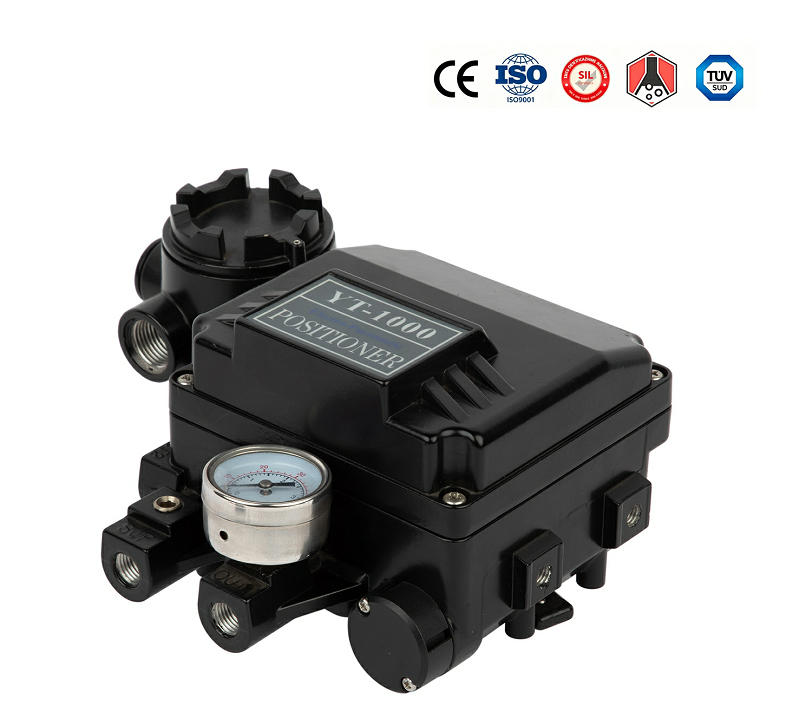
Types of Valve Positioners and Their Applications
Selecting the right positioner depends on your control loop requirements, environment, communication infrastructure, and budget.
Pneumatic Positioners (Analog Air-to-Air):
Accept a 3-15 psi pneumatic input signal. No electricity required. Intrinsically safe by design. Robust and reliable in harsh environments. Ideal for: Remote wellhead control, water treatment, offshore platforms, and explosive dust environments.
Electro-Pneumatic Positioners (Analog 4-20mA):
Convert 4-20mA DC signal to pneumatic output. Industry standard interface. Good accuracy (±1.0%) at moderate cost. Available with explosion-proof certifications. Ideal for: Chemical processing, power generation, pulp & paper, and general-purpose control loops. YTC Equivalent: YT-1000 Series.
Smart/Digital Positioners with HART:
Microprocessor-based devices with HART digital overlay on 4-20mA. Superior accuracy (±0.5%). Auto-calibration, remote diagnostics, valve signature analysis, predictive maintenance alerts. Lower air consumption. Ideal for: Refining, petrochemical, LNG, nuclear power, and large chemical complexes with asset management systems. YTC Equivalent: YT-3300 Series.
Foundation Fieldbus / Profibus Positioners:
Fully digital communication (eliminates analog 4-20mA). Multi-drop capability (up to 32 devices per segment). Rich diagnostic data and integrated PID function blocks. Ideal for: LNG terminals, mega-scale chemical facilities, offshore platforms, and greenfield digital plants. YTC Equivalent: YT-3400 (FF) / YT-3500 (Profibus PA).
Application Selection Quick Guide:
| Facility Type | Recommended Positioner | Rationale |
|---|---|---|
| Brownfield refinery (analog) | YT-1000 | Direct replacement; minimal wiring changes |
| Greenfield chemical plant | YT-3300 Smart HART | Future-proof; predictive maintenance |
| Sour gas / high H₂S | YT-2500 Ex-proof | Ex d IIC T6 certification required |
| High-vibration compressor | YT-1000 with heavy bracket | Analog units tolerate vibration better |
| Water treatment (small bore) | YT-1200 Compact | Space-constrained; simple and cost-effective |
Installation Best Practices & Commissioning Checklist
Pre-Installation Verification:
-
Confirm model, Ex rating, and port size against purchase order.
-
Verify actuator compatibility (output flow capacity).
-
Check ambient temperature rating for site conditions.
-
Test instrument air quality (must meet ISO 8573-1 Class 3).
Mechanical Mounting (Critical for Linearity):
-
For linear actuators: Feedback lever must be at 90° to actuator stem at 50% stroke.
-
For rotary actuators: Connecting rod must be parallel to actuator body at 50% travel.
-
Mounting bracket must be rigid (steel or stainless steel). Use thread-locking compound on bolts.
Pneumatic Plumbing Rules:
-
Install an Air Filter Regulator (AFR) immediately upstream (within 30cm).
-
Purge supply lines for 30 seconds before connecting to positioner.
-
Use PTFE tape sparingly—leave first two threads bare to prevent sealant ingress.
Electrical Wiring:
-
Use twisted-pair shielded cable. Ground shield only at DCS end.
-
Verify loop voltage: 8-30V DC (YT-1000) / 10-32V DC (YT-3300).
-
For HART: Ensure loop resistance of 230-600Ω for communication.
Commissioning Sequence:
-
Pneumatic startup: Apply air supply (no electrical signal). Check for leaks at OUT and EXH ports.
-
Signal verification: Apply 4mA. Valve should move to zero position. If wrong direction, switch Direct/Reverse action.
-
Auto-calibration (YT-3300): Use HART communicator to run "Auto Stroke Calibration." Verify at 4mA, 12mA, 20mA.
-
Manual calibration (YT-1000): Adjust Zero (4mA) and Span (20mA) screws iteratively until 12mA = 50% stroke.
Common Installation Mistakes to Avoid:
| Mistake | Consequence | Prevention |
|---|---|---|
| Feedback lever not at 90° at mid-stroke | Non-linear response | Set at 12mA before tightening |
| No AFR installed | I/P nozzle clogged with debris | Install AFR within 30cm upstream |
| Shield grounded at both ends | Ground loops / erratic signal | Ground shield only at DCS end |
| Insufficient loop voltage | Positioner won't initialize | Verify 10-32V DC at terminals |
Maintenance Schedule for Longevity
To maximize MTBF (Mean Time Between Failures), follow this schedule:
-
Monthly: Check air filter regulator for moisture and debris. Drain water trap.
-
Quarterly: Inspect I/P converter nozzle and flapper for dust. Clean with isopropyl alcohol.
-
Annually: Perform full re-calibration (Zero/Span) to account for mechanical wear in valve linkage.
-
For YT-3300: Run "Valve Signature" test quarterly via HART to trend friction increase—early warning for packing adjustment needs.
Ivan (Mobile:+86-18968769287)
WhatsApp:+86-13579991606
Wechat:+86-18968769287
Website:www.kinko-flow.com
ZHEJIANG KINKO FLUID EQUIPMENT CO.,LTD
