What Is an Angle Seat Valve & How Does It Work?
What Is an Angle Seat Valve?
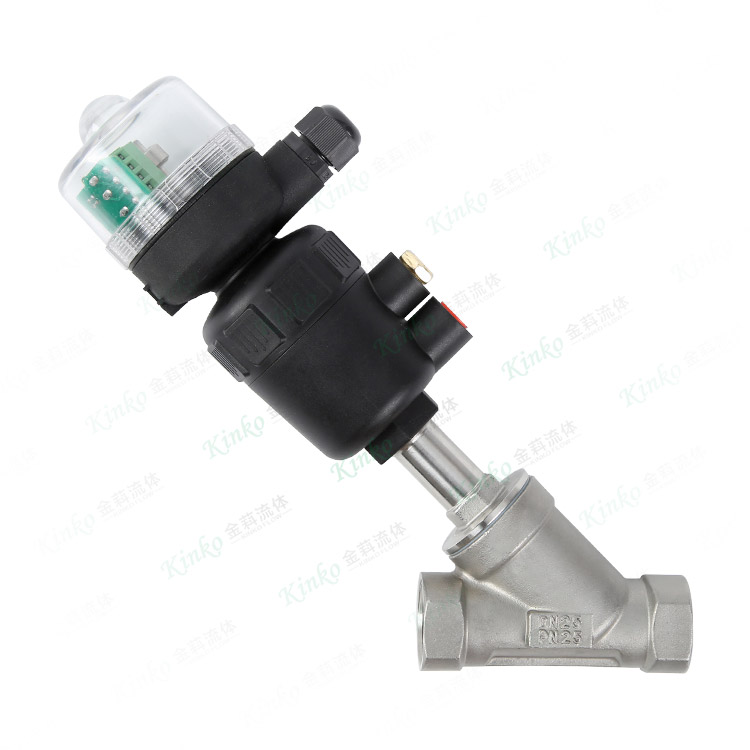
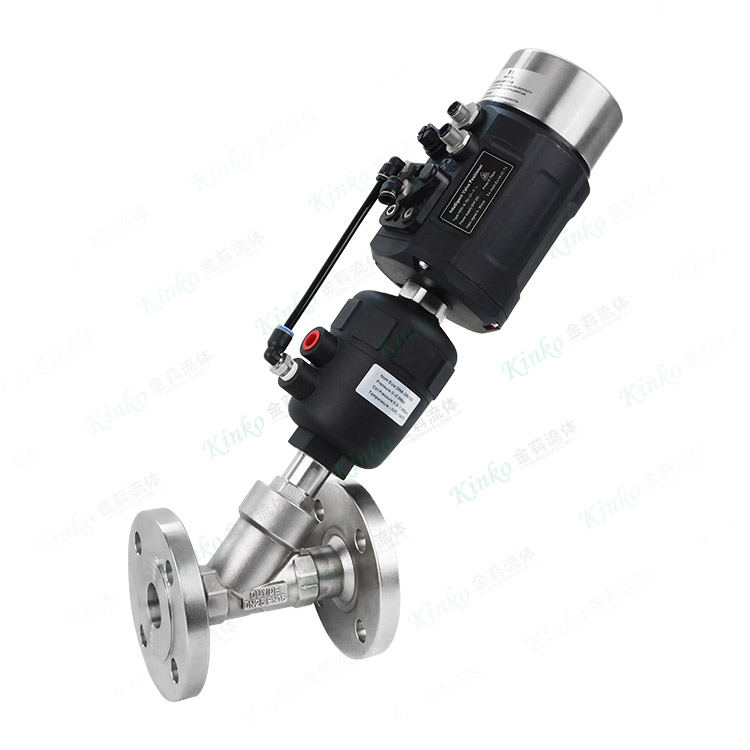
An angle seat valve is a pneumatically actuated, two-way shut-off valve with a distinctive angled body design—typically 90° or 45° between the inlet and outlet ports.
Unlike a straight-through globe valve (where fluid must change direction twice), the angle seat valve's geometry creates a single change of direction. This reduces turbulence, pressure drop, and water hammer while allowing higher flow rates (Cv values) than comparable sized straight valves.
Key visual identifier: The valve body forms an "L" or a shallow angle, with the actuator mounted at approximately 30° to 45° relative to the flow path.
How Does an Angle Seat Valve Work?
The operating principle is simple but effective. An angle seat valve uses a pneumatic piston actuator to lift a valve stem connected to a seat seal. When the actuator receives compressed air, it lifts the seal off the seat, allowing flow. When air is exhausted, a spring returns the seal to the closed position.
Step-by-Step Operation:
| Step | Action | Valve State |
|---|---|---|
| 1 | No compressed air to actuator | Spring holds seal against seat → Valve closed |
| 2 | Air pressure applied to actuator piston | Piston lifts stem and seal away from seat → Valve opens |
| 3 | Flow passes through angled body | Media travels from inlet to outlet with minimal pressure drop |
| 4 | Air pressure exhausted | Spring force returns piston, stem, and seal to closed position → Valve closes |
Control options:
-
Normally closed (NC): Spring closes valve; air opens it (most common)
-
Normally open (NO): Spring opens valve; air closes it
-
Double-acting: Air both opens and closes (no spring; used for very high cycle rates)
Main Internal Components of an Angle Seat Valve
Understanding the parts helps with maintenance planning and spare parts stocking.
| Component | Material Options | Function |
|---|---|---|
| Valve body | Stainless steel (CF8/CF8M), brass | Contains flow path; threaded or flanged connections |
| Seat seal | PTFE, FKM, EPDM, NBR | Seals against the valve seat when closed |
| Valve stem / spindle | Stainless steel (304, 316) | Transfers actuator motion to the seal |
| Piston actuator | Aluminum, stainless steel, PA (nylon) | Converts air pressure into linear motion |
| Return spring | Spring steel (zinc or epoxy coated) | Provides fail-safe closing (NC configuration) |
| Seat / orifice | Stainless steel (integral to body) | Provides sealing surface for the seal |
Flow Characteristics: Why Cv Matters for Procurement
Angle seat valves offer linear flow characteristics—flow rate is roughly proportional to valve stroke. However, their real advantage is high flow capacity (Cv) relative to pipe size.
Typical Cv Values (Stainless Steel, Normally Closed, 10 bar max):
| Valve Size (DN / NPS) | Orifice Diameter (mm) | Cv (Flow Coefficient) | Max Operating Pressure (bar) |
|---|---|---|---|
| DN15 (1/2") | 13 | 4.0 – 5.5 | 16 |
| DN20 (3/4") | 17 | 7.0 – 9.0 | 16 |
| DN25 (1") | 22 | 11.0 – 14.0 | 16 |
| DN32 (1-1/4") | 30 | 18.0 – 22.0 | 16 |
| DN40 (1-1/2") | 35 | 25.0 – 30.0 | 16 |
| DN50 (2") | 46 | 40.0 – 48.0 | 16 |
| DN65 (2-1/2") | 62 | 65.0 – 75.0 | 10 |
| DN80 (3") | 76 | 90.0 – 105.0 | 10 |
Note: Actual Cv depends on body material, seal type, and manufacturer tolerances. Always request certified flow curves from Kinko for critical applications.
Why this matters for B2B buyers: A DN25 (1") angle seat valve can have a Cv of 12–14, while a DN25 globe valve typically offers Cv of 5–7. You can often use a smaller, less expensive angle seat valve to achieve the same flow rate.
Key Advantages of Angle Seat Valves
| Advantage | Explanation |
|---|---|
| High flow rate | Single direction change reduces pressure drop by 30–50% compared to globe valves |
| Fast cycling | Short stroke length (typically 6–15 mm) allows cycle times under 0.5 seconds |
| Self-draining | Angled body prevents fluid trapping; ideal for sanitary and food applications |
| Low water hammer | Smooth flow path reduces sudden pressure spikes |
| Clean bore | No cavities or pockets where media can stagnate |
| Long seal life | PTFE seals with self-lubricating properties last 1–2 million cycles |
| Fail-safe | Spring-return design provides safe closure on air loss |
Common Industrial Applications
Angle seat valves are found wherever clean or slightly contaminated fluids need on/off control with high flow and fast response.
| Industry | Typical Media | Why Angle Seat Valve Is Preferred |
|---|---|---|
| Steam generation | Saturated steam, superheated steam (up to 180°C) | Heat-resistant PTFE seals; self-draining to prevent condensate hammer |
| Water treatment | Water, wastewater, chemicals | High Cv reduces pump energy costs |
| Food & beverage | CIP fluids, dairy, beer, juices | Sanitary design; no dead legs for bacteria growth |
| Textile & dyeing | Hot water, steam, dyes | Fast cycling for machine timing |
| Pharmaceutical | WFI (water for injection), pure steam | Cleanable; meets sanitary standards |
| Pneumatic conveying | Air, powder, granules | Straight-through flow reduces clogging |
| Industrial laundry | Steam, hot water, detergent | High cycle life (millions of cycles) |
Angle Seat Valve vs. Other Valve Types
When should you choose an angle seat valve over alternative technologies?
| Comparison | Angle Seat Valve | Ball Valve | Globe Valve | Diaphragm Valve |
|---|---|---|---|---|
| Flow capacity (Cv) | Very high | High | Low to medium | Medium |
| Pressure drop | Low | Very low | High | Medium |
| Cycle life | 1–3 million cycles | 100k–500k cycles | 50k–200k cycles | 500k–1 million cycles |
| Cleanability | Excellent (self-draining) | Good (but cavity exists) | Poor | Excellent |
| Throttling capability | Poor (on/off only) | Fair (characterized ball) | Excellent | Fair to good |
| Temperature range | -10°C to +180°C (PTFE) | -20°C to +200°C | -20°C to +200°C | -10°C to +120°C (EPDM) |
| Typical cost | Medium | Low to medium | Medium | High |
| Best for | On/off, high cycle, steam | General purpose isolation | Precise throttling | Hygienic / corrosive media |
Kinko recommendation: Use an angle seat valve for high-cycle on/off applications with clean or slightly dirty media, especially steam, hot water, or CIP fluids. Use a ball valve for infrequent isolation. Use a globe valve for throttling.
Selection Criteria for B2B Procurement
When specifying an angle seat valve from Kinko, provide these parameters:
| Selection Parameter | Typical Values / Options |
|---|---|
| Valve size | DN15 to DN80 (1/2" to 3") |
| End connections | Threaded (BSP, NPT), flanged (PN16/PN40), clamp (sanitary) |
| Body material | Stainless steel 304, Stainless steel 316, Brass |
| Seal material | PTFE (standard, up to 180°C), FKM (high temp oil), EPDM (water/steam), NBR (oil) |
| Actuator type | Normally closed (NC), normally open (NO), double-acting |
| Actuator size | 40mm, 50mm, 63mm, 80mm, 100mm (piston diameter) |
| Pilot air pressure | 4 – 8 bar (typically 5 – 6 bar) |
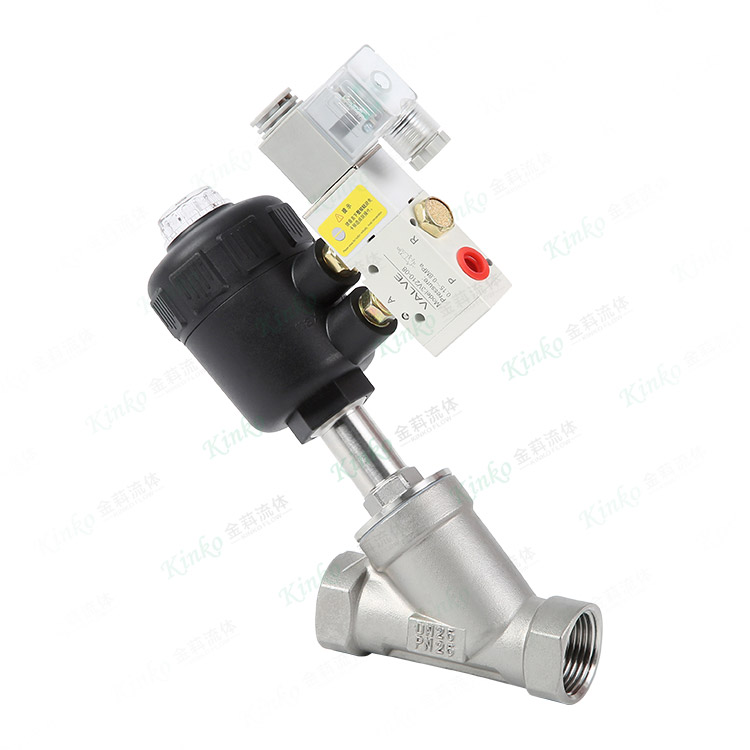
| Control voltage | 24V DC, 110V AC, 220V AC (for solenoid pilot valve) |
| Max media temperature | Up to 180°C (PTFE seal), up to 130°C (EPDM/FKM) |
| Ambient temperature | -10°C to +60°C (standard), -20°C to +80°C (low temp options) |
| Optional features | Position indicator, limit switches, manual override, NAMUR solenoid mounting |
Installation Tips for Angle Seat Valves
To maximize service life, follow these Kinko guidelines:
| Step | Recommendation |
|---|---|
| Orientation | Install with actuator between 0° (vertical) and 90° (horizontal). Avoid actuator pointing down to prevent moisture ingress. |
| Flow direction | Follow body arrow. Usually flow goes under the seat (pushes seal closed) for NC valves. |
| Piping support | Support heavy piping near valve. Do not allow pipe weight to hang on valve body. |
| Air supply | Use clean, dry, lubricated air (40 micron filtration minimum). Add FRL unit before solenoid valve. |
| Steam service | Allow warm-up time before full steam flow to prevent thermal shock to PTFE seal. |
| Threaded connections | Use PTFE tape or pipe dope. Do not over-torque—maximum 50 Nm for DN25, 100 Nm for DN50. |
Why Kinko for Angle Seat Valves?
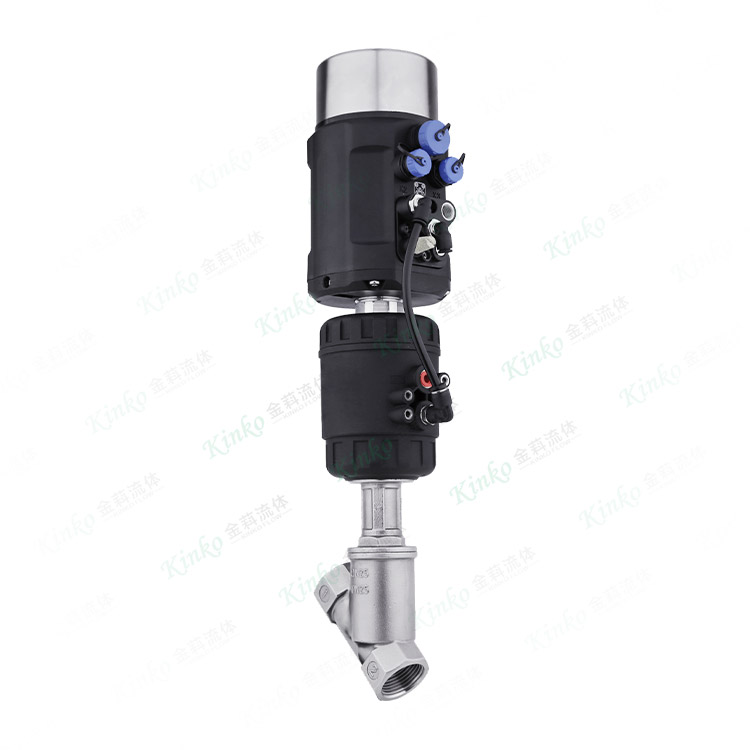
Kinko supplies complete angle seat valve packages including:
-
Valve body (stainless steel or brass)
-
Pneumatic actuator (aluminum or stainless steel)
-
Pilot solenoid valve (NAMUR mount, 24V DC / 110V AC / 220V AC)
-
Position feedback (mechanical or proximity limit switches)
All Kinko angle seat valves are tested for seat leakage and cycle life before shipment.
Conclusion
The angle seat valve is a highly efficient, fast-cycling, self-draining solution for on/off fluid control—particularly in steam, water, and sanitary applications. Its high Cv allows smaller valve sizes, saving space and cost.
For B2B buyers, understanding the operating principle, flow characteristics, and selection parameters ensures you specify the right valve for your process.
Need a quote or sizing assistance? Contact Kinko with your media, temperature, pressure, and desired flow rate. We will recommend the optimal angle seat valve configuration.
FAQ: Angle Seat Valves
Q: Can an angle seat valve be used for throttling (partial opening)?
A: Not recommended. Angle seat valves are designed for on/off service. Partial opening causes seal vibration, leading to premature wear. Use a globe valve or control ball valve for throttling.
Q: What is the maximum temperature for a PTFE-sealed angle seat valve?
A: Up to 180°C (356°F) for continuous steam service. Brief excursions to 200°C are possible but reduce seal life.
Q: How do I convert a normally closed angle seat valve to normally open?
A: You cannot easily convert a standard NC actuator. Order a NO actuator from Kinko or purchase a double-acting version with external pilot control.
Q: Why does my angle seat valve hammer or chatter when closing?
A: Water hammer occurs if flow velocity is too high or if the valve closes too quickly. Add a flow control silencer on the actuator exhaust port to slow closing speed.
Ivan (Mobile:+86-18968769287)
WhatsApp:+86-13579991606
Wechat:+86-18968769287
Website:www.kinko-flow.com
ZHEJIANG KINKO FLUID EQUIPMENT CO.,LTD
