How to Reduce Energy Consumption with Electric Actuators
Why Energy Efficiency Matters in Actuation
Industrial facilities consume substantial energy through their automation systems. Consider these factors:
| Factor | Impact |
|---|---|
| Number of actuators | Large facilities may have hundreds or thousands of actuated valves |
| Operating hours | Many processes run 24/7, 365 days per year |
| Energy source | Pneumatic systems require compressed air — one of the least efficient utilities |
| Standby consumption | Actuators consume energy even when not actively moving |
Switching from pneumatic to electric actuation, or optimizing existing electric actuators, can yield significant energy savings without compromising performance.
Electric vs. Pneumatic: Energy Efficiency Comparison
One of the most effective ways to reduce energy consumption is to understand the efficiency gap between electric and pneumatic actuation.
Energy Efficiency Comparison
| Parameter | Electric Actuator | Pneumatic Actuator |
|---|---|---|
| Energy source | Electricity directly | Compressed air |
| Energy efficiency | 70–85% | 10–25% |
| Standby consumption | Minimal (near zero when idle) | Continuous air supply required |
| Compressor losses | N/A | 80–90% of input energy lost as heat |
| Leakage losses | None | 20–40% of compressed air lost to leaks |
Key Insight: Compressed air systems are notoriously inefficient. Only about 10–25% of the electrical energy input to a compressor is delivered as usable mechanical energy at the actuator. Electric actuators, by contrast, convert 70–85% of input electrical energy into mechanical output.
Strategy 1: Right-Sizing the Actuator
Oversized actuators consume unnecessary energy — both during operation and in standby. Proper sizing is the foundation of energy-efficient actuation.
Sizing Considerations
| Factor | Energy Impact |
|---|---|
| Torque margin | +20–30% margin is typical; excessive margin wastes energy |
| Motor size | Larger motors draw more current even at partial load |
| Gear ratio | Proper gearing optimizes torque vs. speed |
Best Practice: Use actual valve torque requirements — not estimates — to select the smallest actuator that reliably operates the valve under worst-case conditions.
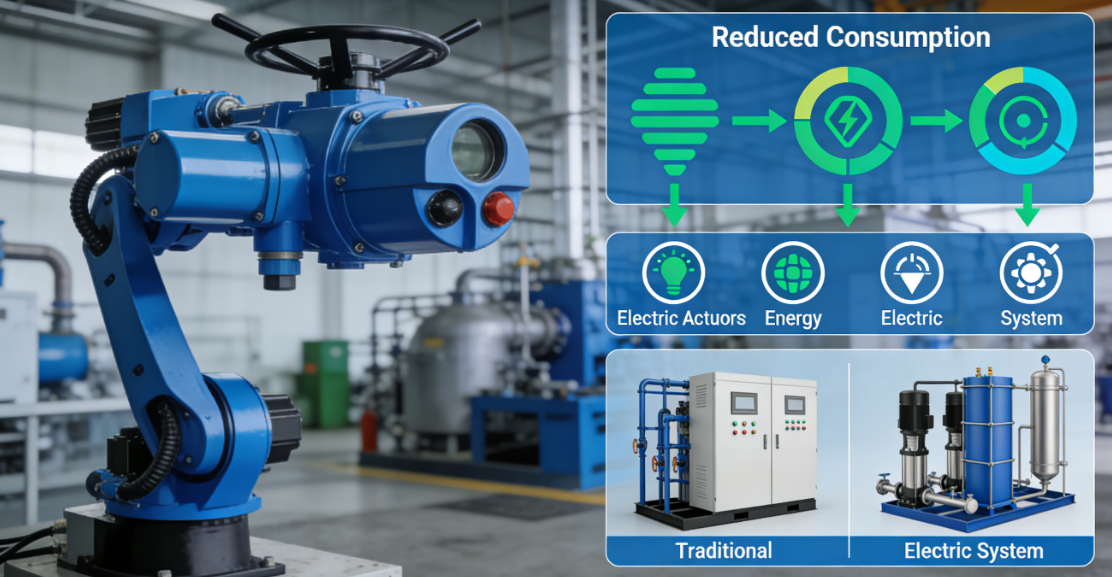
Strategy 2: Utilize Power-Off Holding
Traditional electric actuators often draw power to maintain position against process forces. Modern designs offer power-off holding capabilities.
Holding Methods Comparison
| Method | Energy Consumption | Application |
|---|---|---|
| Continuous power | High — motor or brake draws current | Older designs, basic on/off |
| Spring-return | Zero holding energy; energy used only during stroking | Fail-safe applications |
| Self-locking gear train | Zero holding energy (e.g., worm gear) | Most quarter-turn electric actuators |
| Electromagnetic brake | Minimal — only when engaged | Positioning applications |
Key Insight: Most quarter-turn electric actuators use self-locking worm gears that hold position without consuming power. This means energy is consumed only during valve movement — not during the 95–99% of time when the valve is stationary.
Strategy 3: Implement Smart Control Strategies
How an actuator is controlled significantly impacts energy consumption.
Energy-Efficient Control Approaches
| Control Strategy | Energy Benefit |
|---|---|
| On/off with duty cycle | Minimizes total operating time |
| Modulating with optimized deadband | Reduces unnecessary repositioning |
| Sleep mode / standby | Cuts power consumption when idle |
| Demand-based operation | Actuates only when process conditions require |
Deadband Optimization
For modulating actuators, deadband is the allowable error before the actuator repositions. A deadband that is too tight causes hunting — constant small movements that waste energy and increase wear.
| Deadband Setting | Energy Impact | Process Impact |
|---|---|---|
| Too tight | High — continuous repositioning | Unstable control |
| Optimized | Minimal — moves only when necessary | Stable, within tolerance |
| Too loose | Low | Process deviation may exceed limits |
Best Practice: Set deadband to the widest acceptable range for your process to minimize unnecessary movement.
Strategy 4: Leverage Position Feedback for Efficiency
Modern electric actuators equipped with position feedback enable advanced energy-saving strategies.
Feedback-Enabled Efficiency Features
| Feature | Energy Saving |
|---|---|
| Position verification | Confirms valve position without stroking |
| Partial stroke testing | Validates functionality without full travel |
| Diagnostic alerts | Identifies inefficiencies (e.g., increased torque due to wear) |
| Modbus/Profibus communication | Centralized monitoring and optimization |
Example: With position feedback, the control system knows the valve is already in the desired position — eliminating unnecessary actuation cycles.
Strategy 5: Optimize Operating Speed
Faster actuation consumes more peak power but reduces total energy per cycle. The optimal speed depends on your application.
| Speed | Energy Characteristics | Best For |
|---|---|---|
| Faster | Higher peak power, shorter duration | Frequent cycling, fast response needs |
| Slower | Lower peak power, longer duration | Infrequent operation, gentle process control |
Best Practice: Select actuation speed based on process requirements — not maximum capability. For isolation valves that cycle infrequently, slower operation reduces peak demand charges.
Strategy 6: Address Power Factor and Electrical Efficiency
For facilities with many electric actuators, power factor and electrical efficiency matter.
| Consideration | Energy Impact |
|---|---|
| Power factor | Low power factor increases apparent power and utility charges |
| Motor efficiency | High-efficiency motors (IE3/IE4) reduce losses |
| Variable frequency drives (VFDs) | Enable soft-start and speed optimization |
Note: Most small electric actuators use single-phase motors with modest power draw. For large actuators or multiple units, consider the cumulative electrical impact.
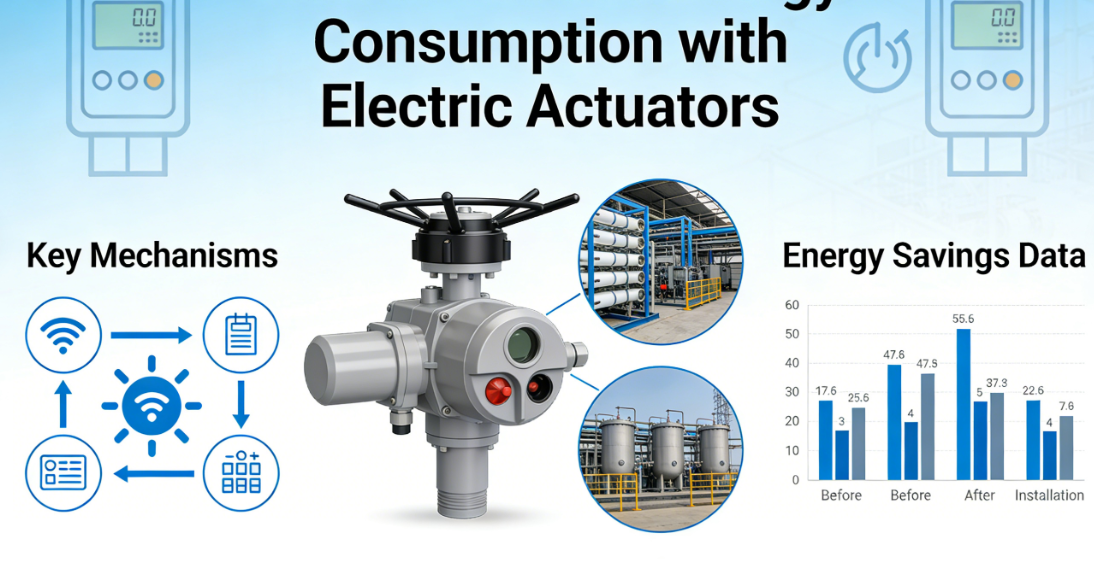
Strategy 7: Retrofit Pneumatic to Electric
Converting existing pneumatic actuators to electric is one of the highest-ROI energy efficiency measures available.
Energy Savings from Pneumatic-to-Electric Conversion
| Facility Size | Pneumatic Actuators | Estimated Annual Energy Savings (Conversion) |
|---|---|---|
| Small | 50 | $5,000–$15,000 |
| Medium | 200 | $20,000–$60,000 |
| Large | 500+ | $50,000–$150,000+ |
Savings estimates based on typical compressed air system efficiency and local energy costs.
Additional Benefits:
-
Eliminates compressed air leaks
-
Reduces compressor maintenance
-
Lowers noise levels
-
Enables precise positioning and diagnostics
Energy Consumption Comparison: Typical Scenarios
Scenario 1: Isolation Valve (Cycles 10 times/day)
| Actuator Type | Daily Energy Consumption | Annual Energy Cost* |
|---|---|---|
| Electric (on/off) | 0.05–0.10 kWh | $5–$10 |
| Pneumatic | 1.5–3.0 kWh (compressor input) | $150–$300 |
Scenario 2: Modulating Valve (Continuous positioning)
| Actuator Type | Daily Energy Consumption | Annual Energy Cost* |
|---|---|---|
| Electric (modulating) | 0.5–1.5 kWh | $50–$150 |
| Pneumatic (with positioner) | 10–25 kWh (compressor input) | $1,000–$2,500 |
*Based on $0.12/kWh industrial electricity rate; pneumatic includes compressor efficiency losses.
Summary: Energy-Saving Checklist for Electric Actuators
| Strategy | Action Item | Status |
|---|---|---|
| Right-sizing | Verify actuator torque matches valve requirements | ☐ |
| Power-off holding | Select self-locking gear trains where feasible | ☐ |
| Deadband optimization | Set widest acceptable deadband for modulating duty | ☐ |
| Speed selection | Match actuation speed to process needs | ☐ |
| Sleep mode | Enable standby power reduction features | ☐ |
| Feedback utilization | Use position feedback to avoid unnecessary cycles | ☐ |
| Pneumatic conversion | Evaluate ROI for converting compressed air actuators | ☐ |
| Motor efficiency | Specify high-efficiency motors for new installations | ☐ |
Long-Term Benefits of Energy-Efficient Actuation
Beyond direct energy cost savings, optimizing electric actuator energy consumption delivers:
-
Reduced carbon footprint — lower Scope 2 emissions
-
Lower maintenance costs — fewer cycles, less wear
-
Extended equipment life — optimized operation reduces stress
-
Improved reliability — smart controls prevent issues
-
Eligibility for incentives — many utilities offer rebates for energy efficiency upgrades
Kinko Electric Actuators: Designed for Efficiency
At Kinko, our electric actuators are engineered with energy efficiency in mind:
-
Self-locking worm gear — zero holding power consumption
-
High-efficiency motors — optimized for industrial duty cycles
-
Modulating versions — with adjustable deadband and sleep mode
-
Communication-ready — Modbus, Profibus, and analog options for smart control
-
IP67/IP68 protection — reliable operation without enclosure heating/cooling losses
Whether you're specifying new actuators or considering retrofitting pneumatic systems, our team can help you select the most energy-efficient solution for your application.
Final Thoughts
Reducing energy consumption with electric actuators is not just about choosing the right technology — it's about optimizing how you select, size, and control each actuated valve in your facility. From right-sizing and smart control strategies to converting inefficient pneumatic systems, significant savings are within reach.
Every actuator represents an opportunity to improve efficiency. By taking a systematic approach, you can reduce operating costs, enhance sustainability, and maintain reliable process control.
For assistance with actuator selection, energy audits, or retrofit planning, feel free to reach out.
Ivan (Mobile:+86-18968769287)
WhatsApp:+86-13579991606
Wechat:+86-18968769287
Website: www.kinko-flow.com
ZHEJIANG KINKO FLUID EQUIPMENT CO.,LTD
