Best Actuators for High-Pressure Industrial Applications
What Defines a High-Pressure Application?
In industrial fluid control, "high pressure" can mean different things depending on the industry and application. Generally, high-pressure applications fall into these categories:
| Pressure Range | Classification | Typical Industries |
|---|---|---|
| 100–1,000 psi (7–69 bar) | Medium-high pressure | Water treatment, HVAC, general industrial |
| 1,000–5,000 psi (69–345 bar) | High pressure | Hydraulic systems, chemical injection, steam |
High-pressure applications place unique demands on actuators, including:
-
Higher torque or thrust requirements to overcome differential pressure forces
-
Robust sealing to prevent leakage
-
Structural integrity to withstand pressure-induced stresses
-
Fail-safe functionality for emergency shutdown scenarios
Key Challenges in High-Pressure Actuation
1. Increased Torque/Thrust Requirements
The pressure differential across a valve creates forces that the actuator must overcome. As pressure increases, so does the required torque (for rotary valves) or thrust (for linear valves).
Formula (Rotary):
Torque required = Valve torque at ΔP + Safety margin
Formula (Linear):
Thrust required = (Pressure differential × Seat area) + Stem friction + Safety margin
2. Stem Seal Integrity
High-pressure applications demand robust stem sealing to prevent fugitive emissions and process leakage. This is particularly critical for:
-
Toxic or hazardous media
-
High-value fluids
-
Environmental compliance (e.g., EPA, ISO 15848)
3. Structural Demands
Actuator components — including housings, gears, and drive trains — must withstand the mechanical stresses associated with high-pressure operation without deformation or fatigue failure.
4. Safety Requirements
High-pressure failures can result in catastrophic consequences. Actuators in these applications often require:
-
Fail-safe functionality (spring-return or battery backup)
-
Explosion-proof enclosures (ATEX, IECEx)
-
SIL (Safety Integrity Level) certification for safety instrumented systems
Best Actuator Types for High-Pressure Applications
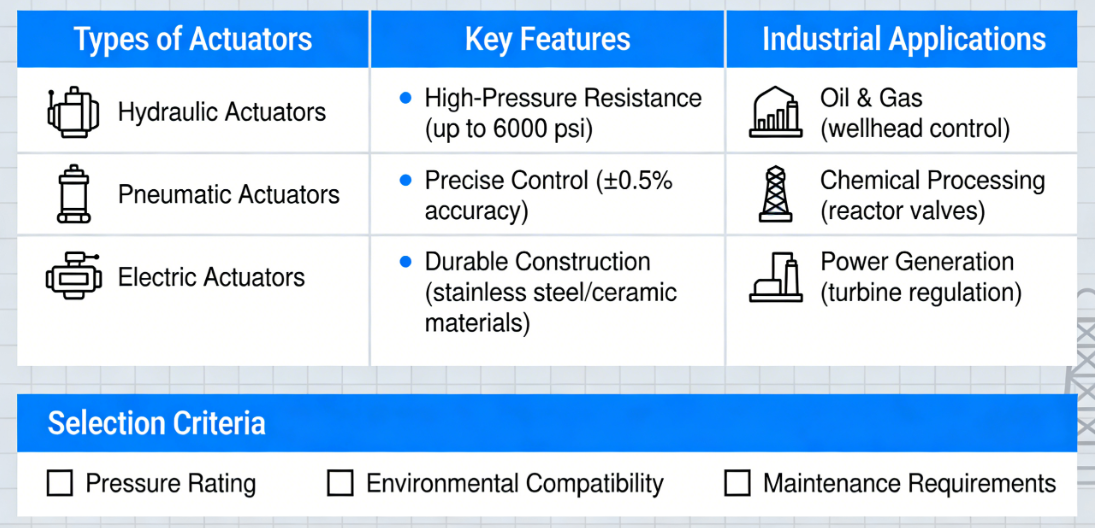
1. Pneumatic Scotch Yoke Actuators
Best for: Quarter-turn valves (ball, butterfly, plug) in high-pressure gas, oil, and chemical applications.
| Feature | Benefit |
|---|---|
| High torque output | Excellent torque at stroke ends where seating torque is highest |
| Compact design | High torque-to-size ratio |
| Fail-safe options | Spring-return available for emergency shutdown |
| Robust construction | Suitable for harsh environments |
Why it excels: The scotch yoke mechanism delivers increasing torque at the stroke ends — exactly where ball and butterfly valves need it most for tight shutoff against high pressure.
2. Hydraulic Actuators
Best for: Very high pressure applications, subsea, wellhead control, and heavy industrial processes.
| Feature | Benefit |
|---|---|
| Extremely high force | Capable of thrust/torque outputs far beyond pneumatic or electric |
| Precise control | Excellent for modulating service |
| Fail-safe options | Spring-return or accumulator-based fail-safe |
| Subsea capability | Suitable for deepwater applications |
Why it excels: Hydraulic actuators are unmatched for ultra-high pressure applications where forces exceed the practical limits of pneumatic or electric alternatives.
3. Electric Actuators with High-Torque Gearboxes
Best for: Applications requiring precise positioning, where compressed air or hydraulic power is not available.
| Feature | Benefit |
|---|---|
| Precise positioning | Ideal for modulating control |
| Energy efficiency | Only consumes power during movement |
| Diagnostic capabilities | Torque monitoring, cycle counting, predictive maintenance |
| Clean operation | No risk of fluid leaks |
Why it excels: Modern electric actuators with robust gear trains and high-efficiency motors can handle significant torque requirements while offering advanced control and diagnostic features.
4. Stainless Steel Pneumatic Rack and Pinion Actuators
Best for: High-pressure applications in corrosive environments (marine, chemical, pharmaceutical).
| Feature | Benefit |
|---|---|
| Corrosion resistance | 316 stainless steel construction withstands aggressive media |
| Reliable torque | Consistent output throughout stroke |
| Compact footprint | Fits tight spaces |
| ISO 5211 mounting | Standardized interface for easy installation |
Why it excels: In high-pressure applications where corrosion is also a concern, stainless steel actuators provide the necessary durability without compromising on torque output.
Valve Compatibility for High-Pressure Service
| Valve Type | High-Pressure Suitability | Recommended Actuator |
|---|---|---|
| Ball valve | Excellent — tight shutoff, high pressure rating | Scotch yoke (pneumatic), electric, hydraulic |
| Butterfly valve | Moderate — pressure rating varies by design | Scotch yoke, rack and pinion |
| Gate valve | Excellent — linear motion, high pressure | Linear pneumatic, hydraulic, multi-turn electric |
| Globe valve | Excellent — precise throttling under pressure | Linear pneumatic diaphragm, electric linear |
| Plug valve | Good — quarter-turn, high pressure capability | Scotch yoke, rack and pinion |
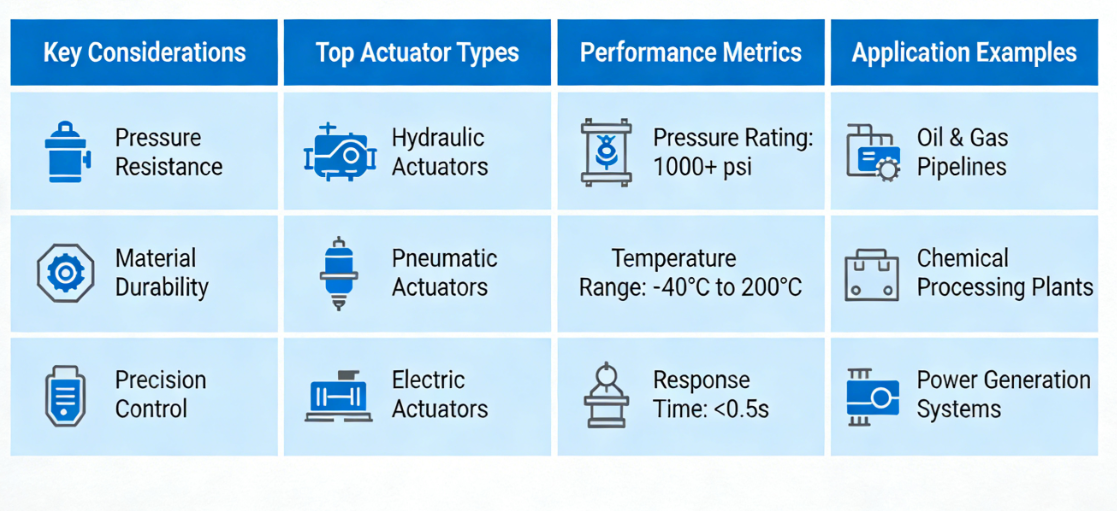
Selection Criteria for High-Pressure Actuators
1. Torque/Thrust Calculation
Accurate torque or thrust calculation is the foundation of proper actuator selection. Consider:
-
Break torque — torque required to initiate movement from closed position
-
Running torque — torque required to maintain movement
-
Seating torque — torque required to achieve tight shutoff
-
Safety margin — typically 20–30% for high-pressure applications
2. Pressure Class and Temperature
Match actuator capabilities to valve pressure class:
| Valve Pressure Class | Max Pressure (psi) | Actuator Considerations |
|---|---|---|
| Class 150 | 285 | Standard actuators typically sufficient |
| Class 300 | 740 | Higher torque/thrust required |
| Class 600 | 1,480 | Robust actuator with margin |
3. Fail-Safe Requirements
High-pressure applications often require fail-safe functionality for safety and regulatory compliance:
| Fail-Safe Type | Application | Typical Actuator |
|---|---|---|
| Spring-return | ESD (emergency shutdown) | Pneumatic scotch yoke or rack and pinion |
| Battery backup | Loss of power safety | Electric with UPS |
| Accumulator | Loss of hydraulic power | Hydraulic with pressure accumulator |
4. Environmental Protection
High-pressure applications often occur in demanding environments:
| Environment | Protection Requirement |
|---|---|
| Outdoor, weather exposed | IP67/IP68 enclosure |
| Corrosive (chemical, marine) | Stainless steel construction |
| Hazardous (flammable gases) | ATEX/IECEx explosion-proof |
| Subsea | Specialized hydraulic with deepwater certification |
5. Control and Communication
Modern high-pressure systems increasingly require integration with control systems:
-
On/off — Simple open/close for isolation
-
Modulating — Precise positioning for flow control
-
SIL certification — For safety instrumented systems
-
Communication protocols — Modbus, Profibus, Foundation Fieldbus
Actuator Comparison for High-Pressure Applications
| Parameter | Pneumatic Scotch Yoke | Pneumatic Rack & Pinion | Hydraulic | Electric (High-Torque) |
|---|---|---|---|---|
| Torque range | Very high (up to 500,000+ Nm) | Moderate (up to 10,000 Nm) | Extremely high | Moderate to high |
| Speed | Fast | Fast | Moderate | Moderate |
| Precision | Good with positioner | Good with positioner | Excellent | Excellent |
| Fail-safe | Spring-return available | Spring-return available | Accumulator | Battery backup |
| Energy source | Compressed air | Compressed air | Hydraulic power unit | Electricity |
| Maintenance | Moderate | Low | Higher (fluid management) | Low |
| Best application | Large valves, high torque | Standard quarter-turn | Ultra-high pressure, subsea | Modulating, clean environments |
Application Examples by Industry
Oil & Gas
| Application | Valve Type | Recommended Actuator |
|---|---|---|
| Wellhead control | Ball valve | Hydraulic or scotch yoke with ESD |
| Pipeline isolation | Ball valve | Pneumatic scotch yoke, spring-return |
| Gas compression | Ball valve | Electric with high-torque gearbox |
Chemical Processing
| Application | Valve Type | Recommended Actuator |
|---|---|---|
| Reactor feed | Globe valve | Linear pneumatic diaphragm |
| High-pressure transfer | Ball valve | Stainless steel scotch yoke |
| Emergency shutdown | Ball valve | Pneumatic scotch yoke with SIL rating |
Power Generation
| Application | Valve Type | Recommended Actuator |
|---|---|---|
| Boiler feedwater | Globe valve | Electric linear, high thrust |
| Steam isolation | Gate valve | Multi-turn electric or pneumatic |
| Cooling water | Butterfly valve | Rack and pinion, stainless steel |
Hydraulic Systems
| Application | Valve Type | Recommended Actuator |
|---|---|---|
| Press control | Poppet valve | Hydraulic solenoid |
| Accumulator isolation | Ball valve | Hydraulic or pneumatic scotch yoke |
Summary: High-Pressure Actuator Selection Checklist
| Factor | Consideration | Verified |
|---|---|---|
| Torque/thrust requirement | Calculated with safety margin (20–30%) | ☐ |
| Valve pressure class | Matched to actuator capability | ☐ |
| Fail-safe requirement | Spring-return, battery, or accumulator | ☐ |
| Environmental protection | IP rating, corrosion resistance, hazardous area certification | ☐ |
| Control type | On/off or modulating | ☐ |
| Communication protocol | Integration with control system | ☐ |
| SIL rating | If used in safety instrumented system | ☐ |
| Temperature range | Matched to process and ambient conditions | ☐ |
| Media compatibility | Actuator materials suitable for environment | ☐ |
Final Thoughts
High-pressure industrial applications demand actuators that combine robust construction, reliable performance, and appropriate safety features. Whether you need scotch yoke pneumatic actuators for large ball valves, hydraulic actuators for subsea service, or high-torque electric actuators for precise modulating control, selecting the right solution requires careful consideration of torque requirements, environmental conditions, and safety standards.
For assistance with actuator sizing, selection, or project specifications, feel free to reach out.
Ivan (Mobile:+86-18968769287)
WhatsApp:+86-13579991606
Wechat:+86-18968769287
Website:www.kinko-flow.com
ZHEJIANG KINKO FLUID EQUIPMENT CO.,LTD
