How to Calibrate a Pneumatic Valve Positioner
When to Calibrate
| Trigger | Action |
|---|---|
| Annual preventive maintenance | Full zero/span calibration |
| After valve or actuator maintenance | Recalibrate |
| Poor control performance (oscillation, offset) | Check and adjust |
| Valve does not reach full stroke | Immediate calibration |
| After replacing positioner or I/P converter | Full calibration |
Tools Required
| Tool | Purpose |
|---|---|
| 4-20mA signal generator | Supplies precise input signal |
| Digital multimeter | Verifies loop current |
| Pressure gauge | Measures supply/output pressure |
| Hex wrenches / screwdrivers | Adjust zero/span screws |
| HART communicator (YT-3300) | Auto-calibration |
| Stroke indicator / ruler | Measures valve travel |
Safety First: Isolate valve from process pressure. Lock out / tag out pneumatic supply. Wear safety glasses.
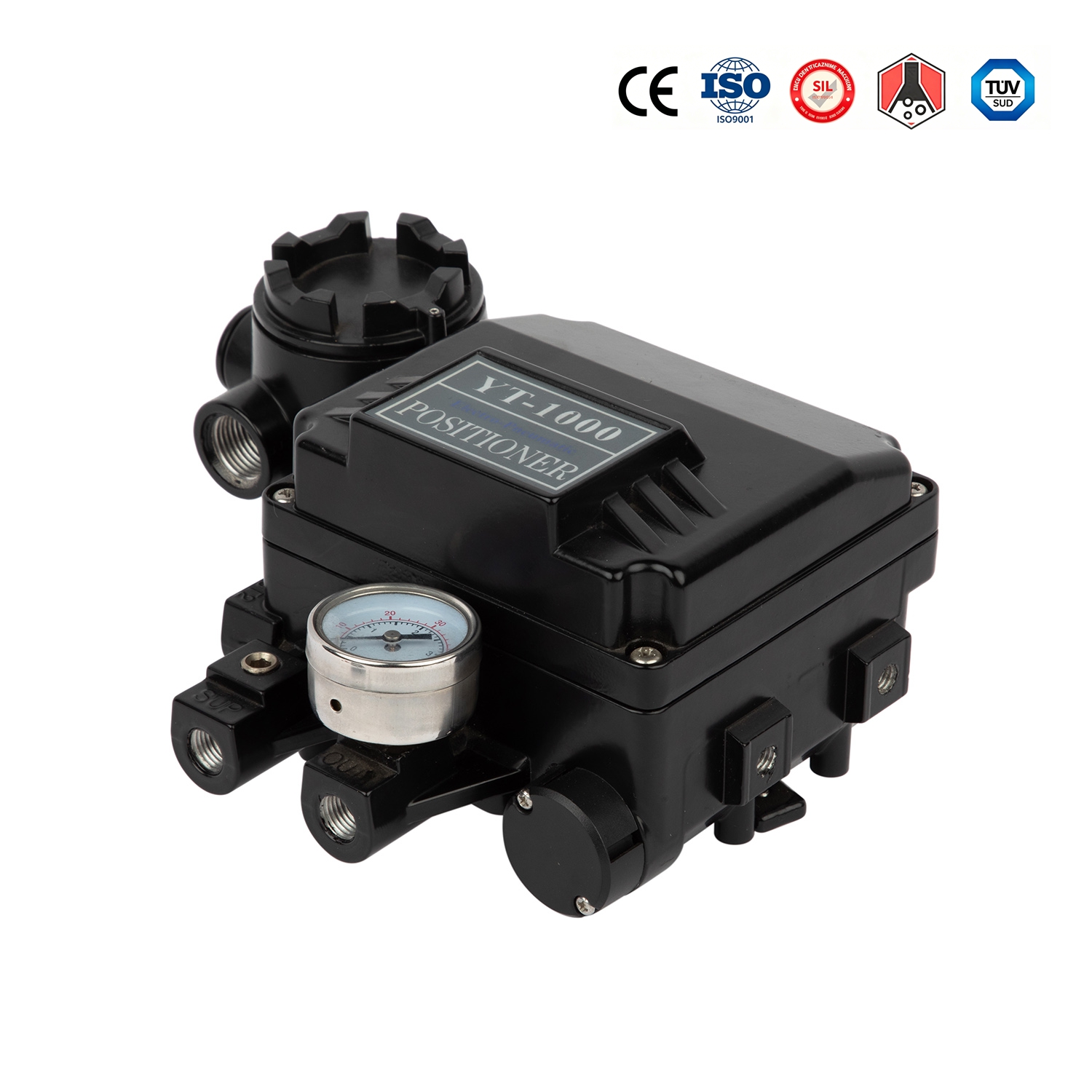
Calibration: YT-1000 Analog Positioner (Manual)
Step 1: Mechanical Preparation
-
Apply 12mA to the positioner.
-
Set actuator to 50% stroke manually.
-
Critical: Loosen feedback lever clamp and rotate lever to exactly 90° to actuator stem at 50% stroke. Tighten clamp.
Step 2: Zero Adjustment (4mA)
-
Apply exactly 4.00 mA.
-
Locate the Zero screw (marked "Z").
-
Turn Zero screw until the valve just begins to move off the stop.
-
Back off slightly until valve just rests on the mechanical stop (0%).
Step 3: Span Adjustment (20mA)
-
Apply exactly 20.00 mA.
-
Locate the Span screw (marked "S").
-
Turn Span screw until valve reaches full mechanical stop (100%).
Step 4: Verification (Iterative)
-
Apply 12.00 mA.
-
Check position—must be 50% stroke.
-
If not, repeat Zero and Span adjustments (2-3 iterations typically required).
-
Acceptance: All points within ±1.0% of ideal.
Step 5: Final Check
-
Ramp signal: 4mA → 8mA → 12mA → 16mA → 20mA.
-
Record stroke at each point.
-
Ramp back down; verify hysteresis within ±0.5%.
Calibration: YT-3300 Smart Positioner (Auto-Calibration)
Step 1: Mechanical Preparation
-
Apply 12mA (or ensure loop power ≥ 10V DC).
-
Set actuator to 50% stroke manually.
-
Critical: Set feedback lever to 90° to actuator stem at 50% stroke. Tighten clamp.
Step 2: Connect HART Communicator
-
Connect communicator in parallel across positioner terminals.
-
Ensure loop resistance is 230-600Ω.
-
Establish communication with YT-3300.
Step 3: Run Auto-Calibration
-
Navigate: Main Menu → Setup → Calibration → Auto Stroke Calibration.
-
Confirm actuator type (linear/rotary) and stroke length.
-
Press "Start" .
-
The positioner automatically:
-
Drives valve to 0% and records stop
-
Drives valve to 100% and records full stroke
-
Calculates optimal PID gains
-
Stores parameters in memory
-
-
Process takes 60-90 seconds.
Step 4: Verification
-
Command valve to: 0%, 25%, 50%, 75%, 100% via communicator.
-
Check actual position against commanded.
-
Acceptance: ±0.5% F.S. (or ±0.3% for high-precision).
Step 5: Valve Signature Test (Optional)
-
Navigate: Diagnostics → Valve Signature.
-
Run full stroke signature.
-
Record baseline for future comparison (friction, seat load, stroke time).
Calibration: YT-1200 and YT-2500
Both follow the same manual procedure as YT-1000.
| Model | Procedure |
|---|---|
| YT-1200 | Same as YT-1000 manual calibration |
| YT-2500 | Same as YT-1000; use Ex-certified tools in hazardous areas |
Direct vs. Reverse Acting
| Actuator Type | Positioner Action | 4mA Result | 20mA Result |
|---|---|---|---|
| Air-to-Open (Fail Closed) | Direct | Closed (0%) | Open (100%) |
| Air-to-Close (Fail Open) | Reverse | Open (100%) | Closed (0%) |
To Change Action:
-
YT-1000: Move action lever from "D" to "R". Recalibrate.
-
YT-3300: Change "Action" parameter via HART. Re-run auto-calibration.
Calibration Verification Table
| Input Signal | Ideal Position | YT-1000 Tolerance | YT-3300 Tolerance |
|---|---|---|---|
| 4.00 mA | 0% | ±1.0% | ±0.5% |
| 8.00 mA | 25% | ±1.0% | ±0.5% |
| 12.00 mA | 50% | ±1.0% | ±0.5% |
| 16.00 mA | 75% | ±1.0% | ±0.5% |
| 20.00 mA | 100% | ±1.0% | ±0.5% |
Troubleshooting Calibration Issues
| Problem | Likely Cause | Solution |
|---|---|---|
| Cannot reach full stroke at 20mA | Span screw maxed; lever angle incorrect | Check 90° at 50% stroke; increase supply pressure |
| Zero drifts after calibration | Loose Zero screw; worn linkage | Apply thread-locking compound; inspect linkage |
| 12mA not at 50% | Zero/Span interaction | Iterate adjustments (YT-1000) or re-run auto-cal (YT-3300) |
| HART auto-calibration fails | Actuator volume too large; low supply pressure | Increase supply pressure; use high-flow version |
| Positioner does not respond | Signal below 4mA; wiring reversed | Verify 4-20mA at terminals; check polarity |
| Valve moves wrong direction | Action setting incorrect | Change Direct/Reverse; recalibrate |
Calibration Documentation
Record these values after calibration:
| Parameter | Recorded Value |
|---|---|
| Date of Calibration | |
| Technician Name | |
| Positioner Model & Serial | |
| Actuator Model & Size | |
| Supply Pressure (bar) | |
| Zero Position (4mA) - % stroke | |
| Span Position (20mA) - % stroke | |
| 12mA Position (50% command) - % stroke | |
| Linearity Error (max %) | |
| Hysteresis (%) | |
| Friction Level (YT-3300) | |
| Valve Signature Baseline (YT-3300) |
Ivan (Mobile:+86-18968769287)
WhatsApp:+86-13579991606
Wechat:+86-18968769287
Website: www.kinko-flow.com
ZHEJIANG KINKO FLUID EQUIPMENT CO.,LTD
