How FRL Units Control Air Quality for Pneumatic Systems
1. The Three Core Functions
| Function | Primary Role | What It Controls | Impact on System |
|---|---|---|---|
| Filter | Removes solids and liquids | Dust, rust, pipe scale, water droplets, oil aerosols | Prevents abrasion and valve sticking |
| Regulator | Stabilizes downstream pressure | Supply pressure fluctuations | Ensures consistent actuator force and speed |
| Lubricator (optional) | Delivers controlled oil mist | Atomized oil to moving parts | Reduces friction and extends seal/cylinder life |
Key takeaway: An FRL is a system of protection—missing or undersizing any function compromises the entire pneumatic loop.
2. Filter Performance
| Parameter | Standard Grade | High-Performance Grade | Why It Matters |
|---|---|---|---|
| Filtration rating | ~40 μm | ~5 μm (with coalescing) | Smaller particles prevent spool valve wear |
| Water removal efficiency | ~90% | ~99%+ | Prevents actuator and positioner corrosion |
| Drain type | Manual | Automatic + manual override | Prevents condensate carryover if forgotten |
| Pressure drop (clean) | ≤0.5 bar | ≤0.2 bar | Maintains energy efficiency |
Engineering note: For instrument-air applications (actuators and positioners), 5 μm filtration is the industry minimum—40 μm is only acceptable for general shop air.
3. Regulator Performance
| Parameter | Standard Grade | Precision Grade | Why It Matters |
|---|---|---|---|
| Regulated pressure range | Standard (e.g., 0–8 bar) | Wider range available | Match to actuator torque requirements |
| Droop (flow-induced drop) | ±1.5 bar @ rated flow | ±0.3 bar @ rated flow | Maintains thrust under variable load |
| Repeatability | ±5% | ±1% | Ensures consistent valve stroking time |
| Relief capability | Non-relieving | Relieving type | Prevents downstream pressure lock-up |
Critical point: Regulator droop is the most overlooked parameter. A regulator that drops pressure under flow causes actuators to stroke slowly or stall.
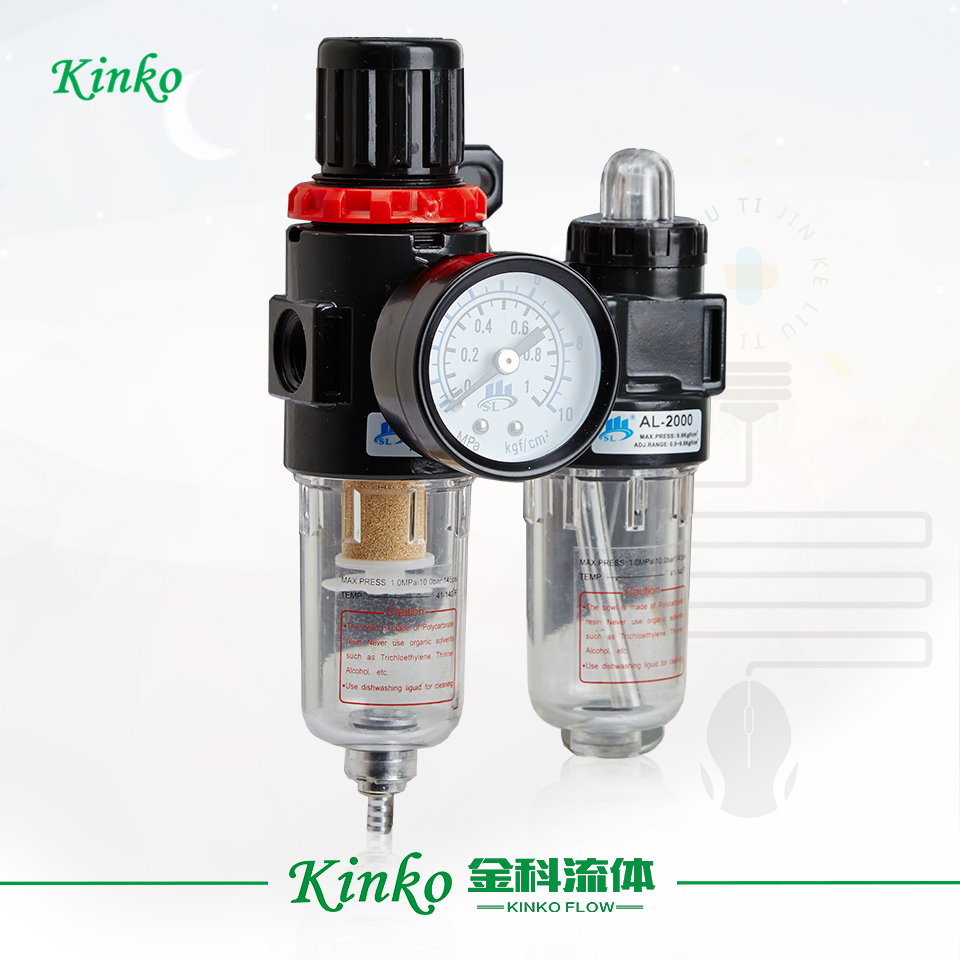
4. Lubricator Performance (Where Required)
| Parameter | Standard Grade | High-Performance Grade | Why It Matters |
|---|---|---|---|
| Oil delivery method | Wick/siphon | Precision needle valve | Consistent mist at varying flows |
| Oil fill capacity | Smaller | Larger | Reduces refill frequency |
| Bowl material | Polycarbonate | Metal with sight glass | No cracking from chemicals or UV |
Important: Many modern actuators and positioners are "lubricated for life"—specify a Filter-Regulator (FR) without lubricator to avoid over-oiling and sticking.
5. Matching FRL to Application
| Application | Recommended Filtration | Regulation Precision | Lubrication Needed? |
|---|---|---|---|
| General shop air (tools, blow-off) | ~40 μm | Standard (±5%) | Yes |
| Pneumatic actuators (on-off valves) | ~5 μm | Standard (±3%) | Often no |
| Positioner-fed control valves | ~5 μm + coalescing | Precision (±1%) | No (oil damages positioner) |
| Instrument air (critical) | ~1 μm + drying | Precision (±1%) | No |
Key takeaway: One FRL grade does not fit all. Always match FRL performance to the most sensitive device in the pneumatic loop.
6. Common FRL Failure Modes and Prevention
| Failure Mode | Root Cause | Quick Fix | Permanent Solution |
|---|---|---|---|
| Pressure drops under load | Clogged filter element | Replace element | Schedule regular changes (based on ΔP) |
| Erratic pressure output | Worn regulator seat/diaphragm | Clean or rebuild | Upgrade to metal-seat type for high-cycle duty |
| Oil mist inconsistent | Wick blocked | Clean or replace wick | Use adjustable needle-valve type |
| Water downstream | Drain not opened | Manual drain immediately | Install auto-drain |
| Bowl cracking | Chemical exposure | Replace bowl | Choose metal bowl with sight glass |
7. Quick Selection Reference
| Selection Factor | Consideration | Recommended Grade |
|---|---|---|
| Environment | Clean, dry indoor | Standard bowl |
| Environment | Outdoor / wet / chemical | Metal bowl + auto-drain |
| Flow rate | Low (<20 SCFM) | Compact size |
| Flow rate | Medium–High (>20 SCFM) | Standard or large size |
| Regulation precision | General (±5%) | Standard regulator |
| Regulation precision | Critical (±1%) | Precision regulator |
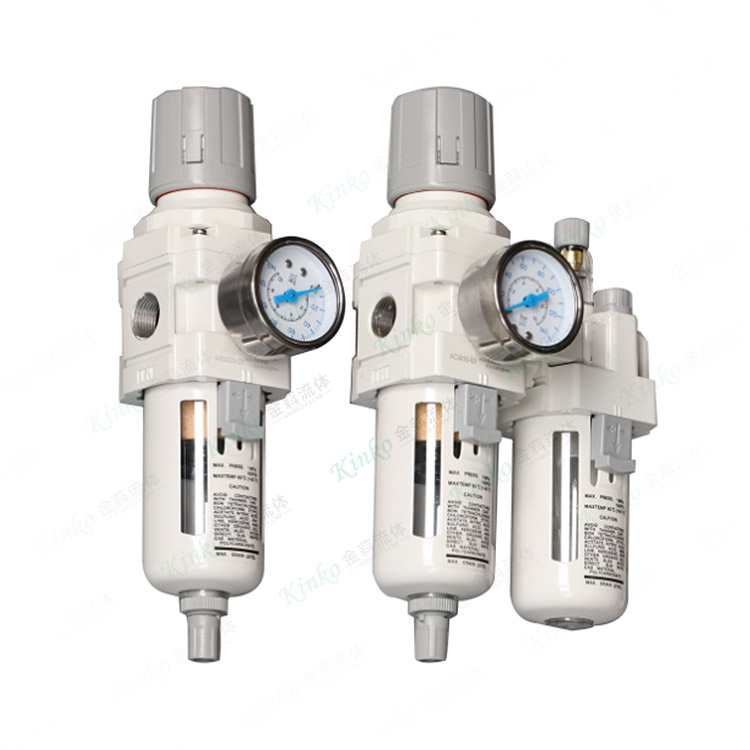
| Lubrication | Not required | FR (Filter-Regulator) only |
| Lubrication | Required | FRL (with lubricator) |
8. Maintenance Schedule
| Task | Frequency |
|---|---|
| Check filter pressure drop | Monthly |
| Drain condensate | Daily (manual) / Continuous (auto) |
| Inspect bowl for cracks | Quarterly |
| Replace filter element | Every 6 months or when ΔP > 0.5 bar |
| Clean/ replace lubricator wick | Annually |
| Verify regulator set-point | Quarterly |
| Check all fittings for leaks | Monthly |
9. Cost Impact of Poor Air Quality
| Issue | Consequence | Estimated Annual Cost (per valve) |
|---|---|---|
| Particulate abrasion | Solenoid spool wear → replacement | $200–$500 |
| Water corrosion | Actuator pitting → seal failure | $300–$800 |
| Pressure droop | Slow stroking → off-spec product | $1,000–$5,000 |
| Over-lubrication | Positioner clogging → calibration drift | $400–$900 |
A properly specified and maintained FRL unit saves $1,500–$7,000 per valve over 5 years.
10. Procurement Checklist
-
Filtration rating: 5 μm minimum for instrument/actuator applications
-
Automatic drain for high-water-load environments
-
Metal bowl for outdoor or chemical areas
-
Relieving-type regulator with minimal droop
-
Gauge ports on inlet and outlet for monitoring
-
Lubricator only if downstream devices explicitly require oil
-
Spare element kits included with initial order
Ivan (Mobile:+86-18968769287)
WhatsApp:+86-13579991606
Wechat:+86-18968769287
Website: www.kinko-flow.com
ZHEJIANG KINKO FLUID EQUIPMENT CO.,LTD
