Importance of Proper Valve Accessory Sizing
1. The Cost of Incorrect Sizing
| Sizing Error | Consequence | Typical Cost Impact |
|---|---|---|
| Actuator undersized | Fails to open/close under differential pressure | Process shutdown: $5,000–$50,000/event |
| Actuator oversized | Valve stem/bearing fatigue, seat damage | Premature valve rebuild: $2,500–$10,000 |
| Positioner mismatched | Slow response, overshoot, hunting | Off-spec product: $1,000–$5,000/day |
| Solenoid under-powered | Intermittent shifting, coil burn-out | Replacement + downtime: $500–$2,000 |
| FRL undersized | Pressure drop under load, slow stroking | Reduced throughput: variable |
| Mounting kit misaligned | Side-loading → packing leakage | Fugitive emissions + rebuild: $1,500–$4,000 |
Key takeaway: Accessory sizing is not "close enough"—it requires engineering precision.
2. Actuator Sizing – Torque and Thrust Matching
| Sizing Factor | Why It Matters | Selection Guideline |
|---|---|---|
| Breakaway torque | Initial force to unseat valve | Must exceed max seat friction + stem friction |
| Running torque | Force to maintain position | Ensure actuator has 20–30% margin above running torque |
| End-of-stroke torque | Force at fully open/closed | Prevent seat over-compression or stem bending |
| Supply pressure available | Actual plant air vs design pressure | Size based on minimum expected pressure, not nominal |
| Fail-safe requirement | Spring-return vs double-acting | Spring torque must overcome breakaway at lowest pressure |
Critical rule: Always size actuators at minimum supply pressure and maximum differential pressure—not at ideal conditions.
| Parameter | Correctly Sized | Undersized | Oversized |
|---|---|---|---|
| Torque margin | 25–30% above required | <10% | >50% |
| Stroking time | Meets process requirement | Slower than spec | Faster than needed (can cause water hammer) |
| Actuator life | Full design life | Premature stall/failure | Excessive stem/seat wear |
3. Positioner Sizing – Flow Capacity and Response
| Sizing Factor | Why It Matters | Selection Guideline |
|---|---|---|
| Air flow capacity (Cv) | Must match actuator volume and stroking time | Calculate based on actuator volume × stroke time |
| Input signal type | 4–20 mA, 0–10 V, or digital | Match to control system output |
| Hysteresis / linearity | Affects control accuracy | Specify <0.5% for critical loops |
| Environmental temperature | Internal components degrade | Match to ambient + solar radiation |
| Diagnostic needs | Predictive maintenance | Consider smart positioners for critical valves |
Common error: A positioner with insufficient air flow capacity causes slow response—even if the actuator is correctly sized.
| Symptom | Root Cause in Sizing | Fix |
|---|---|---|
| Slow stroking | Positioner Cv too low for actuator volume | Upgrade to higher-flow positioner |
| Oscillation / hunting | Positioner gain too high for actuator size | Re-tune or select appropriate gain range |
| Calibration drift | Positioner not rated for ambient temperature | Select wider temperature range model |
4. Solenoid Valve Sizing – Flow, Pressure, and Electrical
| Sizing Factor | Why It Matters | Selection Guideline |
|---|---|---|
| Flow coefficient (Cv) | Must supply enough air to actuator | Match or exceed positioner/actuator flow demand |
| Operating pressure range | Pilot-operated vs direct-acting | Direct-acting for low pressure; pilot for high flow |
| Coil voltage | Field supply available | AC vs DC; must match control panel output |
| Inrush vs holding current | AC solenoids draw higher inrush | Ensure power supply can handle peak |
| Response time | On-off vs throttling service | Faster for high-cycle or safety applications |
Critical rule: Solenoid valve Cv must be equal to or greater than the positioner's air flow capacity—otherwise the positioner becomes starved.
| Sizing Error | Result | Prevention |
|---|---|---|
| Cv too low | Actuator stroking slower than design | Calculate total system Cv from FRL → solenoid → positioner → actuator |
| Coil voltage mismatch | Coil burns out or fails to shift | Verify supply voltage at solenoid terminals (under load) |
| Wrong body material | Corrosion or leakage in harsh media | Match material to environment and pilot medium |
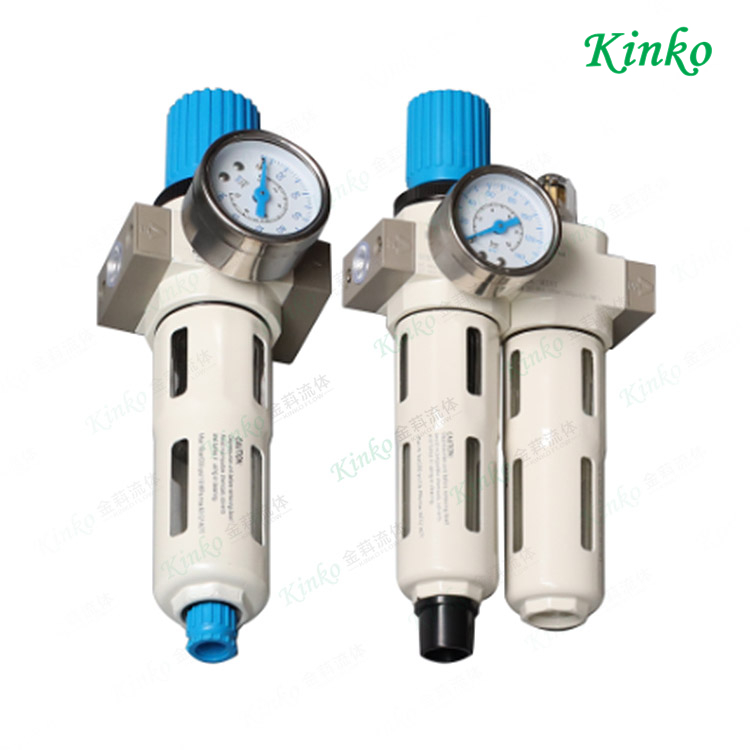
5. FRL Unit Sizing – Flow and Pressure Capacity
| Sizing Factor | Why It Matters | Selection Guideline |
|---|---|---|
| Flow rate (SCFM / L/min) | Must exceed total downstream demand | Size at 120–150% of maximum system flow |
| Pressure drop at flow | Affects actuator available torque | Keep total drop <0.5 bar at rated flow |
| Filtration grade | Matches most sensitive component | 5 μm for actuators; 1 μm + coalescing for positioners |
| Bowl / port size | Must fit pipeline and mounting | Match to main supply line; avoid reducers if possible |
Common error: Sizing FRL based on line size rather than actual flow demand. A large line with low flow may still need a properly sized regulator for precision.
| Parameter | Correctly Sized | Undersized | Oversized |
|---|---|---|---|
| Flow capacity | 1.2× max system demand | <1.0× | >3× (wasted cost) |
| Pressure drop | <0.3 bar @ max flow | >0.7 bar → torque loss | Minimal (acceptable) |
| Drain capacity | Handles actual condensate load | Overwhelmed → water carryover | Overkill but harmless |
6. Limit Switch Box Sizing – Mechanical and Electrical Match
| Sizing Factor | Why It Matters | Selection Guideline |
|---|---|---|
| Shaft size and coupling | Must fit valve stem or actuator shaft | Match diameter and keyway; zero backlash preferred |
| Switch rating (voltage/current) | Must match PLC or DCS input | Confirm minimum load current for dry contacts |
| Number of contacts | Open, closed, and intermediate signals | Specify NO/NC combinations as per control logic |
| Enclosure size and entry | Cable termination and space | Allow for easy wiring; multiple conduit entries |
Common error: A limit switch box with contacts rated for 250V AC used in a 24V DC low-current circuit—causes contact oxidation and intermittent feedback.
| Sizing Error | Symptom | Fix |
|---|---|---|
| Shaft size mismatch | Coupling slips or binds | Use correct bore size or adjustable coupling |
| Contact rating mismatch | False feedback / no signal | Specify gold-plated or low-energy contacts for 24V DC |
| Insufficient cable entry | Difficulty wiring; strain on cables | Specify box with 2+ entries |
7. Mounting Kit Sizing – Brackets, Couplings, and Hardware
| Sizing Factor | Why It Matters | Selection Guideline |
|---|---|---|
| Bracket hole pattern | Must align with actuator and valve | Use standard ISO 5211 or customized to interface |
| Coupling backlash | Affects positioning repeatability | Specify <0.1° for rotary control valves |
| Stem extension length | Allows for thermal expansion and maintenance | Match valve stem height with actuator yoke |
| Bolt grade and material | Corrosion and vibration resistance | Use stainless steel for outdoor; high-grade for high torque |
Critical rule: A perfectly sized actuator on a misaligned bracket will fail faster than an undersized actuator on a perfect bracket. Mounting precision is non-negotiable.
8. Integrated Sizing Checklist – All Accessories
For each valve assembly, verify these cross-accessory sizing checks:
-
Actuator torque ≥ (valve torque requirement + 25%) at minimum supply pressure
-
Positioner Cv ≥ actuator air consumption at required stroking time
-
Solenoid valve Cv ≥ positioner Cv (or direct actuator Cv for on-off)
-
FRL flow capacity ≥ solenoid Cv × 1.2 (at minimum inlet pressure)
-
FRL pressure drop + regulator droop + line losses < 15% of total supply
-
Limit switch contact rating matches control circuit (voltage, current, AC/DC)
-
Mounting bracket alignment tolerance ≤ ±0.2 mm
-
Coupling backlash ≤ 0.1° for control valves; ≤ 0.5° for on-off
-
All threaded fittings match (NPT vs BSP) to avoid cross-threading
9. Financial Impact Summary
| Sizing Scenario | 5-Year Cost (Parts + Labor + Downtime) | vs Optimally Sized |
|---|---|---|
| All accessories optimally sized | Baseline ($X) | – |
| Actuator undersized | 3.5× baseline | +250% |
| Positioner under-sized (flow) | 2.2× baseline | +120% |
| FRL undersized (droop) | 1.8× baseline | +80% |
| Mounting kit misaligned | 2.0× baseline | +100% |
| Solenoid mismatched (electrical) | 1.6× baseline | +60% |
Ivan (Mobile:+86-18968769287)
WhatsApp:+86-13579991606
Wechat:+86-18968769287
Website: www.kinko-flow.com
ZHEJIANG KINKO FLUID EQUIPMENT CO.,LTD
