How Does a YTC Positioner Improve 4-20mA Valve Control?
1. Accurate Stroke Positioning Beyond Standard I/P Converters
A standard I/P (current-to-pressure) converter translates the 4-20mA signal into a pneumatic pressure, but it cannot correct for valve hysteresis, seat friction, or spring wear. A YTC positioner (electro-pneumatic smart positioner) closes the loop by continuously comparing the setpoint (mA signal) with the actual valve stem position via a built-in position sensor.
-
Without positioner: Output pressure is fixed; valve position drifts due to packing friction or process load changes.
-
With YTC positioner: Microprocessor adjusts output pressure in real-time until the stem reaches the exact target position.
Result: Positioning accuracy up to ±0.5% of full stroke (vs. ±2~3% for open-loop I/P systems).
2. Fast Dynamic Response for Critical Loops
In flow and pressure control loops, lag time directly affects product quality and energy consumption. YTC positioners feature high-flow pilot valves that deliver rapid air delivery, minimizing dead time and settling time.
| Performance Parameter | Without Positioner | With YTC Positioner |
|---|---|---|
| Dead band | >2% | <0.5% |
| Settling time (full stroke) | 3~5 seconds | <1.5 seconds |
| Linearity error | ±2% | ±0.5% |
| Hysteresis | ±1.5% | ±0.3% |
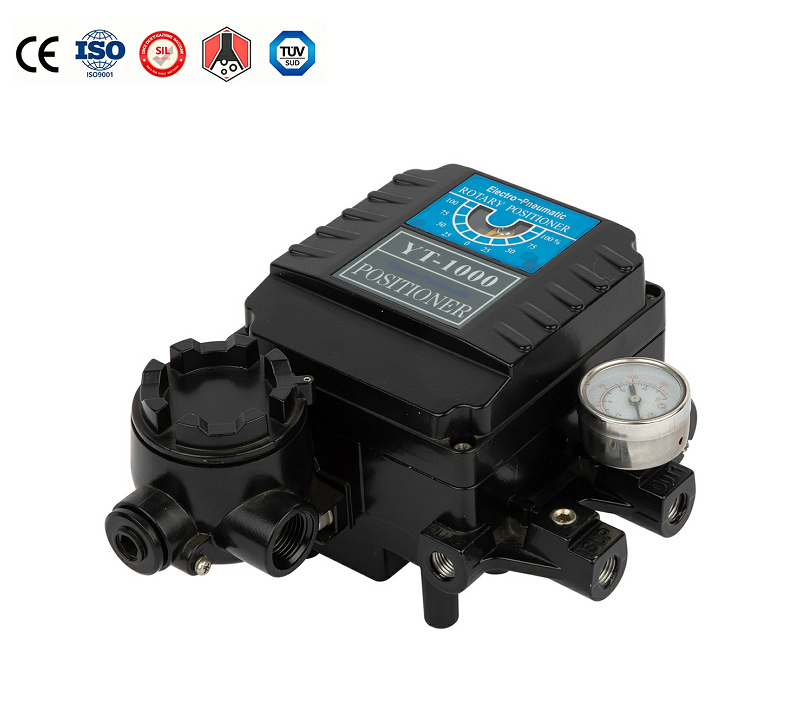
3. Self-Calibration & Auto-Tune for Easy Commissioning
YTC positioners (e.g., YT-1000L, YT-2500 series) come with one-touch auto-calibration. During startup, the positioner performs a full stroke self-test to:
-
Detect travel range (0~90° for rotary, 0~100% for linear).
-
Optimize PID gain for the specific actuator volume.
-
Set zero and span without manual potentiometer adjustments.
Time saved: Commissioning reduced from ~20 minutes (manual) to under 3 minutes per valve.
4. Low Air Consumption & Energy Efficiency
Unlike old-style force-balance positioners that constantly bleed air, YTC's smart positioners use a spool-type or piezo valve design that only consumes air during actuation.
-
Steady-state air consumption: as low as 0.3 Nm³/h (vs. 1.5~2.0 Nm³/h for conventional positioners).
-
Significant savings on instrument air compressor load in plants with hundreds of valves.
5. Diagnostics & Predictive Maintenance (HART/Profibus Optional)
Advanced YTC models support HART 7 or Profibus PA communication protocols, enabling:
-
Real-time valve signature monitoring (stiction, friction trend).
-
Cycle count logging for preventive maintenance scheduling.
-
Deviation alarms when actual position differs from setpoint beyond a user-defined threshold.
This data helps maintenance teams replace packing or seals before a valve fails, reducing unplanned downtime.
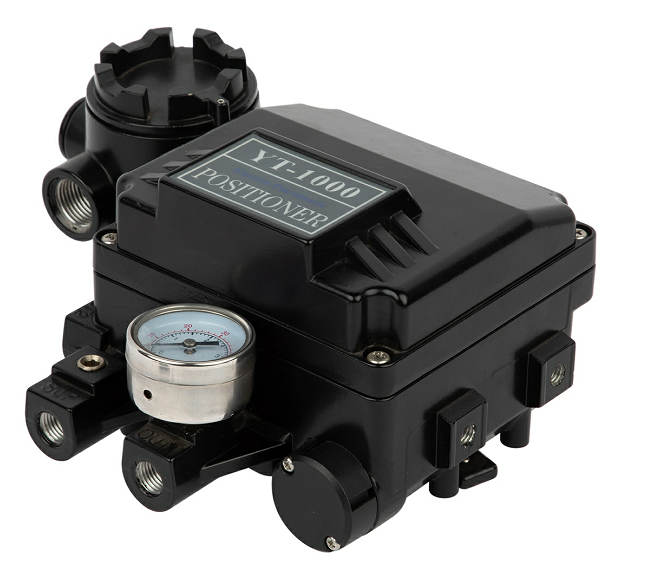
6. Robust Design for Harsh Environments
YTC positioners are built with:
-
Die-cast aluminum or stainless steel housing (IP66/NEMA 4X).
-
Wide temperature range: -40°C ~ +85°C (with low-temp options).
-
Ex-proof certifications: ATEX / IECEx / KOSHA for Zone 1, Zone 2, and Class I Div 1 applications.
Quick Technical Specification Table (YTC Positioner Typical Model)
| Parameter | Specification |
|---|---|
| Input signal | 4-20mA DC (2-wire / 4-wire) |
| Supply pressure | 1.4 ~ 7 bar (20 ~ 100 psi) |
| Stroke range | Linear: 10~150mm / Rotary: 0~90° |
| Accuracy | ±0.5% F.S. |
| Hysteresis | <0.3% F.S. |
| Linearity | <0.5% F.S. |
| Air consumption | ≤0.3 Nm³/h (steady state) |
| Flow capacity (Cv) | Up to 0.8 (pilot valve) |
| Communication options | 4-20mA, HART, Profibus PA, Foundation Fieldbus |
| Enclosure rating | IP66 / NEMA 4X |
| Ex certification | ATEX II 2G Ex db IIC T6 / IECEx / KOSHA |
| Ambient temp. range | -40°C ~ +85°C |
Ivan (Mobile:+86-18968769287)
WhatsApp:+86-13579991606
Wechat:+86-18968769287
Website: www.kinko-flow.com
ZHEJIANG KINKO FLUID EQUIPMENT CO.,LTD
