Angle Seat Valve Sizing Guide for Industrial Pipelines
1. The Most Important Concept: Cv (Flow Coefficient)
Cv is the number of US gallons of water at 60°F that will flow through a valve in one minute with a pressure drop of 1 psi.
| Cv Value | Meaning |
|---|---|
| Higher Cv | More flow capacity |
| Lower Cv | Less flow capacity |
Rule: Select a valve with a Cv equal to or slightly higher than your required Cv.
2. Kinko Angle Seat Valve – Cv Values by Size
| Valve Size (DN) | Valve Size (inch) | Port Size (mm) | Cv (Water) | Kvs (m³/h) |
|---|---|---|---|---|
| DN10 | 3/8″ | 10 mm | 4.5 | 3.9 |
| DN15 | 1/2″ | 15 mm | 9.0 | 7.8 |
| DN20 | 3/4″ | 20 mm | 14.0 | 12.1 |
| DN25 | 1″ | 25 mm | 22.0 | 19.0 |
| DN32 | 1‑1/4″ | 32 mm | 35.0 | 30.2 |
| DN40 | 1‑1/2″ | 40 mm | 45.0 | 38.8 |
| DN50 | 2″ | 50 mm | 70.0 | 60.4 |
| DN65 | 2‑1/2″ | 65 mm | 110.0 | 95.0 |
Note: Kvs = m³/h of water at 1 bar pressure drop. Cv ≈ 1.16 × Kvs.
3. Step‑by‑Step Sizing for Liquids
Step 1: Gather Required Data
| Parameter | Symbol | Unit | Example |
|---|---|---|---|
| Maximum flow rate | Q | L/min or m³/h | 150 L/min |
| Inlet pressure | P1 | bar | 6 bar |
| Outlet pressure | P2 | bar | 5 bar |
| Pressure drop allowed | ΔP | bar | 1 bar |
| Specific gravity | G | (water = 1) | 0.85 (oil) |
Step 2: Calculate Required Cv
Formula (liquids):
Cv = Q × √(G / ΔP)
Where:
-
Q = flow rate in US gallons per minute (GPM)
-
G = specific gravity (water = 1)
-
ΔP = pressure drop in psi
Quick conversion:
-
L/min to GPM: divide by 3.785
-
bar to psi: multiply by 14.5
Step 3: Example Calculation
Given:
-
Flow rate = 150 L/min → 150 ÷ 3.785 = 39.6 GPM
-
Pressure drop allowed = 1 bar → 1 × 14.5 = 14.5 psi
-
Specific gravity = 1 (water)
Calculation:
Cv = 39.6 × √(1 / 14.5) = 39.6 × √(0.069) = 39.6 × 0.263 = 10.4
Step 4: Select Valve Size
From Kinko Cv table:
-
DN15: Cv = 9.0 (too low — not enough flow)
-
DN20: Cv = 14.0 (sufficient — 14.0 > 10.4)
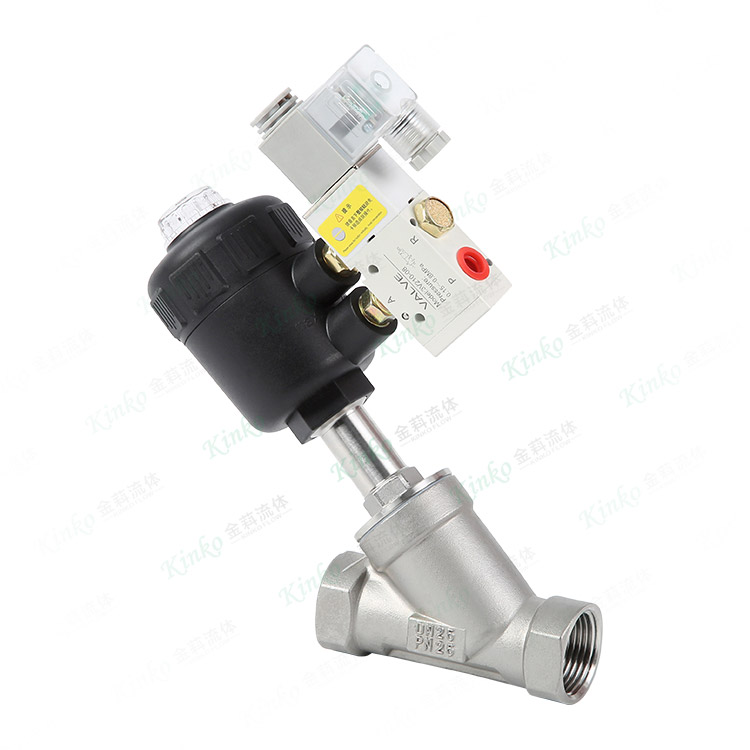
Select: DN20 (3/4″)
4. Step‑by‑Step Sizing for Gases (Compressed Air, Nitrogen)
Gas sizing is different because gases are compressible.
Step 1: Gather Required Data
| Parameter | Symbol | Unit | Example |
|---|---|---|---|
| Flow rate (standard conditions) | Q | m³/h or SCFM | 50 m³/h |
| Inlet pressure (absolute) | P1 | bar(a) | 7 bar(g) + 1 = 8 bar(a) |
| Outlet pressure (absolute) | P2 | bar(a) | 6 bar(g) + 1 = 7 bar(a) |
| Pressure drop | ΔP | bar | 1 bar |
| Gas specific gravity (air=1) | G | — | 1 (air) |
Step 2: Simplified Rule of Thumb
For compressed air at 6–8 bar, the required Cv is approximately:
Cv ≈ (m³/h at standard conditions) ÷ 20
Example: 50 m³/h ÷ 20 = 2.5 Cv
Step 3: Select Valve Size
From Kinko Cv table:
-
DN10: Cv = 4.5 (sufficient for 2.5)
-
Any larger size also works but may be oversized
Select: DN10 (3/8″) or DN15 (1/2″) for margin
5. Step‑by‑Step Sizing for Steam
Steam sizing requires special consideration due to high temperature and condensate.
Step 1: Gather Required Data
| Parameter | Symbol | Unit | Example |
|---|---|---|---|
| Steam flow rate | W | kg/h | 200 kg/h |
| Inlet pressure (absolute) | P1 | bar(a) | 6 bar(g) + 1 = 7 bar(a) |
| Pressure drop allowed | ΔP | bar | 0.5 bar |
Step 2: Simplified Sizing Table for Steam (Saturated)
| Valve Size | Max Steam Flow (kg/h) at 6 bar, 0.5 bar drop |
|---|---|
| DN10 | 50 kg/h |
| DN15 | 100 kg/h |
| DN20 | 180 kg/h |
| DN25 | 300 kg/h |
| DN32 | 500 kg/h |
| DN40 | 700 kg/h |
| DN50 | 1100 kg/h |
Step 3: Example
Flow required = 200 kg/h → DN25 (300 kg/h capacity) is appropriate.
Select: DN25 (1″)
6. Pressure Drop Verification
After selecting a valve size, verify that the actual pressure drop is acceptable.
Formula (liquids):
ΔP = G × (Q / Cv)²
Example:
-
Q = 39.6 GPM
-
Cv of DN20 = 14.0
-
G = 1
ΔP = 1 × (39.6 / 14.0)² = (2.83)² = 8.0 psi (0.55 bar)
This is less than the allowed 1 bar — acceptable.
7. Velocity Check (Important for Liquids)
High velocity can cause erosion, noise, and cavitation.
| Velocity | Recommendation |
|---|---|
| < 3 m/s | Safe for most liquids |
| 3 – 5 m/s | Acceptable for clean liquids |
| > 5 m/s | Risk of erosion, cavitation — upsize valve |
Formula: Velocity (m/s) = (Q in m³/s) ÷ (Port area in m²)
Simplified rule: For water, if your flow rate in m³/h is more than 20 × (DN in inches), consider upsizing.
8. Sizing for Viscous Liquids
Viscous liquids (oil, syrup, glue) require larger valves because flow is restricted.
| Viscosity (cSt) | Correction Factor |
|---|---|
| < 50 cSt | No correction |
| 50 – 200 cSt | Multiply required Cv by 1.2 |
| 200 – 500 cSt | Multiply required Cv by 1.5 |
| > 500 cSt | Multiply required Cv by 2.0+ (consult Kinko) |
Example: Required Cv = 10, viscosity = 300 cSt → 10 × 1.5 = 15 Cv → choose DN25 (Cv 22) instead of DN20 (Cv 14).
9. Sizing Quick Reference Table (Water)
| Required Flow (L/min) | Pressure Drop (bar) | Recommended Kinko Size |
|---|---|---|
| 20 | 0.5 | DN10 |
| 50 | 0.5 | DN15 |
| 100 | 0.5 | DN20 |
| 200 | 0.5 | DN25 |
| 350 | 0.5 | DN32 |
| 500 | 0.5 | DN40 |
| 800 | 0.5 | DN50 |
| 1200 | 0.5 | DN65 |
*Assumes water at 20°C, specific gravity = 1.*
10. Common Sizing Mistakes
| Mistake | Consequence | Correction |
|---|---|---|
| Using pipe size as valve size | Valve may be oversized or undersized | Calculate required Cv |
| Ignoring pressure drop | Pump may be undersized | Include ΔP in calculation |
| Sizing for maximum flow only | Poor control at low flow | Check turndown ratio |
| Forgetting viscosity | Valve too small for thick liquids | Apply correction factor |
| Using standard Cv for steam | Inaccurate | Use steam sizing table |
| Oversizing "to be safe" | Slower response, higher cost | Size correctly |
11. Kinko Sizing Service
Not sure which size to choose? Kinko offers free sizing assistance.
| Provide This Information | We Will Recommend |
|---|---|
| Media (water, oil, air, steam, etc.) | Valve size |
| Flow rate (L/min, m³/h, GPM, kg/h) | Cv requirement |
| Inlet pressure | Pressure drop |
| Outlet pressure (or allowed ΔP) | Specific model |
| Temperature | Seal material |
| Viscosity (if not water) | Body material |
Contact Kinko with your application data — we will size the valve for you.
12. Summary – Key Takeaways
✅ Cv is the key metric — higher Cv = more flow capacity
✅ Use the formula Cv = Q × √(G/ΔP) for liquids
✅ Use simplified tables for air and steam
✅ Check velocity — avoid >5 m/s for liquids
✅ Apply viscosity correction for thick fluids
✅ Don't assume pipe size = valve size — calculate first
✅ Kinko offers free sizing support — just ask
Proper sizing saves money, improves performance, and extends valve life.
13. Need Help Sizing Your Angle Seat Valve?
Kinko provides:
-
complete Cv tables for all sizes
-
free sizing consultation
-
sample valves for testing
Contact Kinko with your flow, pressure, and media — we will recommend the right size.
Ivan (Mobile:+86-18968769287)
WhatsApp:+86-13579991606
Wechat:+86-18968769287
Website:www.kinko-flow.com
ZHEJIANG KINKO FLUID EQUIPMENT CO.,LTD