Spring Return (JAT-SR) vs Double Acting (JAT-SR) Pneumatic Actuators: A Complete Comparison
For procurement managers and plant engineers, selecting the right pneumatic actuator is more than just matching torque specs. It is about understanding how your valve will behave when things go wrong. Will it shut down to protect the line? Or will it stay put, ready to resume production?
In the world of pneumatic actuation, this decision comes down to two distinct configurations: Spring Return (Single-Acting) and Double Acting. At KINKO, our JAT-SR Series Pneumatic Actuators are engineered to deliver excellence in both formats. This guide will walk you through the critical differences, helping you decide which "JAT-SR" variant is the perfect fit for your facility.
1. The Basics: Understanding the Mechanisms
Before we compare, it is vital to understand how each system generates motion.
What is a Spring Return (Single-Acting) Actuator?
A Spring Return actuator, like the KINKO JAT-SR Series in its single-acting configuration, uses air pressure to move the valve in one direction only. The return stroke is powered by a set of integrated mechanical springs.
-
Operation: Air enters the actuator to compress the springs and stroke the valve. When air pressure is released (or lost), the springs decompress, automatically returning the valve to its "fail-safe" position (either open or closed).
-
Key Feature: Built-in fail-safe.
What is a Double Acting Actuator?
A Double Acting actuator uses air pressure to both open and close the valve. It has no internal springs.
-
Operation: Air is applied to Port A to stroke the valve in one direction. To reverse the stroke, Port A is exhausted while air is applied to Port B.
-
Key Feature: Equal power in both directions.
-
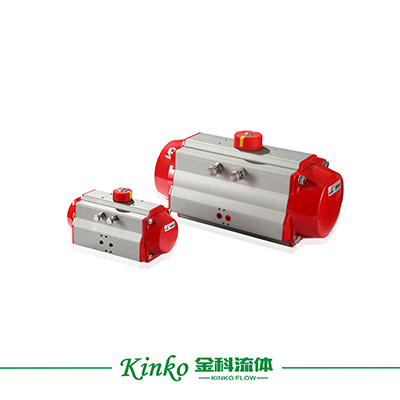
2. KINKO JAT-SR Series: Technical Specifications
The KINKO JAT-SR Series is a rack-and-pinion, opposed-piston actuator designed for reliability and efficiency. It is available in both Spring Return and Double Acting configurations to suit your exact needs.
| Feature | KINKO JAT-SR Series (Pneumatic) |
|---|---|
| Design | Rack and pinion, opposed piston |
| Available Action | Spring Return (Single-Acting) / Double Acting |
| Torque Range | 15 Nm to 4,000 Nm+ (depending on model/size) |
| Operating Pressure | 2 bar to 8 bar (30 to 116 psi) |
| Operating Temp. | Standard: -20°C to +80°C (Special ranges available) |
| Rotation | 90° (Quarter-turn) with +/- 5° adjustment |
| Body Material | Extruded Anodized Aluminum Alloy |
| Shaft/Pinion | Hardened Alloy Steel / Stainless Steel (optional) |
| Solenoid Interface | Namur standard (Direct mount) |
| Safety Certification | SIL 3 Capable, ATEX options available |
3. Head-to-Head: Spring Return vs. Double Acting
Here is how the two configurations of the JAT-SR series compare across the criteria that matter most to B2B buyers.
A. Fail-Safe Operation (The Deciding Factor)
-
Spring Return (JAT-SR): This is the primary reason to choose spring return. Fail-safe is inherent. If you lose air pressure, the springs automatically drive the valve to a predetermined position (e.g., valve closed to protect a furnace or open to maintain flow). This mechanical action does not require electricity, batteries, or complex logic.
-
Double Acting (JAT-SR): Double acting actuators have no inherent fail-safe. If air pressure is lost, the actuator simply stops. The valve remains in its last position ("fail-last"). To achieve fail-safe with a double acting actuator, you must add an expensive accessory: a solenoid valve with a spring return function or a large air tank (accumulator) .
B. Torque and Force
-
Double Acting (JAT-SR): Double acting actuators provide torque on both the forward and return strokes. They are generally more efficient because you are not fighting spring compression. For very high-torque requirements, a double acting actuator is often more compact and economical than a massive spring return model.
-
Spring Return (JAT-SR): The torque output is asymmetric. The "air stroke" is strong (using full supply pressure), but the "spring stroke" torque is variable. As the spring compresses or decompresses, the output torque changes. You must ensure the spring torque is sufficient to overcome the valve's resistance at the very end of the stroke.
-
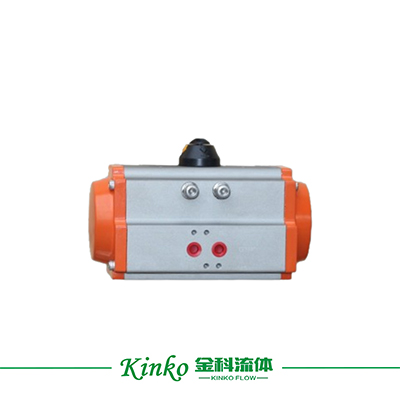
C. Cost Analysis (Initial vs. Long-Term)
-
Double Acting (JAT-SR): The actuator itself has a lower initial purchase price because it contains fewer parts (no springs, no complex spring cartridge). However, if fail-safe is required, the cost of external valves and accumulators quickly closes the gap.
-
Spring Return (JAT-SR): Higher initial cost due to the engineering and materials required for the spring cartridge. However, for Emergency Shutdown (ESD) systems, this upfront cost is justified by the simple, reliable safety mechanism.
D. Size and Weight
-
Double Acting (JAT-SR): More compact for a given torque output. Because there are no springs, the actuator end caps are smaller, and the overall length is reduced.
-
Spring Return (JAT-SR): Longer and heavier than their double acting counterparts. The spring housing adds significant length to the actuator body. This extra space must be accounted for in your piping layout.
| Feature | KINKO JAT-SR (Spring Return) | KINKO JAT-SR (Double Acting) |
|---|---|---|
| Fail-Safe Mode | Built-in (Mechanical) - Moves to pre-set position on air loss. | None (Fail-Last) - Stays in position unless accessories added. |
| Air Consumption | Lower (Uses air only in one direction) | Higher (Uses air to move both directions) |
| Torque Output | High in air direction; Variable in spring direction. | Consistent, high torque in both directions. |
| Actuator Size | Longer (due to spring housing) | Compact / Shorter |
| Initial Cost | Higher (Spring assembly included) | Lower (Simpler mechanism) |
| Best For | Safety-critical applications, ESD valves, remote sites. | On/Off control, modulating duty, high-cycle applications. |
4. Application Guide: Which JAT-SR Do You Need?
Still unsure? Use this simple guide to match the actuator to your project.
Choose KINKO JAT-SR (Spring Return) if:
-
✅ Safety is Priority #1: You need the valve to close (or open) automatically in a power outage or plant emergency.
-
✅ Remote Locations: You cannot rely on a consistent air supply or complex electrical fail-safe systems.
-
✅ Standard Safety Functions: You are automating burners, fuel lines, or cooling water systems where a specific "safe" state is defined.
Choose KINKO JAT-SR (Double Acting) if:
-
✅ You Need Maximum Torque: You are automating a large, sticky valve that requires high force to open and close.
-
✅ Space is Limited: You have a tight valve skid and cannot accommodate the extra length of a spring housing.
-
✅ Position Holding is Desired: You want the valve to remain in its current position during an air failure (Fail-Last), with the intention of restoring air pressure to continue.
-
✅ Cost Sensitivity (No Safety Need): Your application does not have strict safety integrity level (SIL) requirements, and you want the most economical actuation solution.
Conclusion
Both Spring Return and Double Acting pneumatic actuators have a vital place in industrial automation. The KINKO JAT-SR Series offers the flexibility to serve both needs with the same high standard of engineering.
By choosing KINKO, you are not just buying an actuator; you are investing in a modular system that can be configured for safety, power, or efficiency depending on your mission-critical requirements.
Need help calculating the exact torque for your valve?
Contact our KINKO engineers for a free actuator sizing and selection consultation.
Ivan (Mobile:+86-18968769287)
WhatsApp:+86-13579991606
Wechat:+86-18968769287
Website:www.kinko-flow.com
ZHEJIANG KINKO FLUID EQUIPMENT CO.,LTD