Sanitary Ball Valves for Food, Dairy & Pharma Industry
Introduction
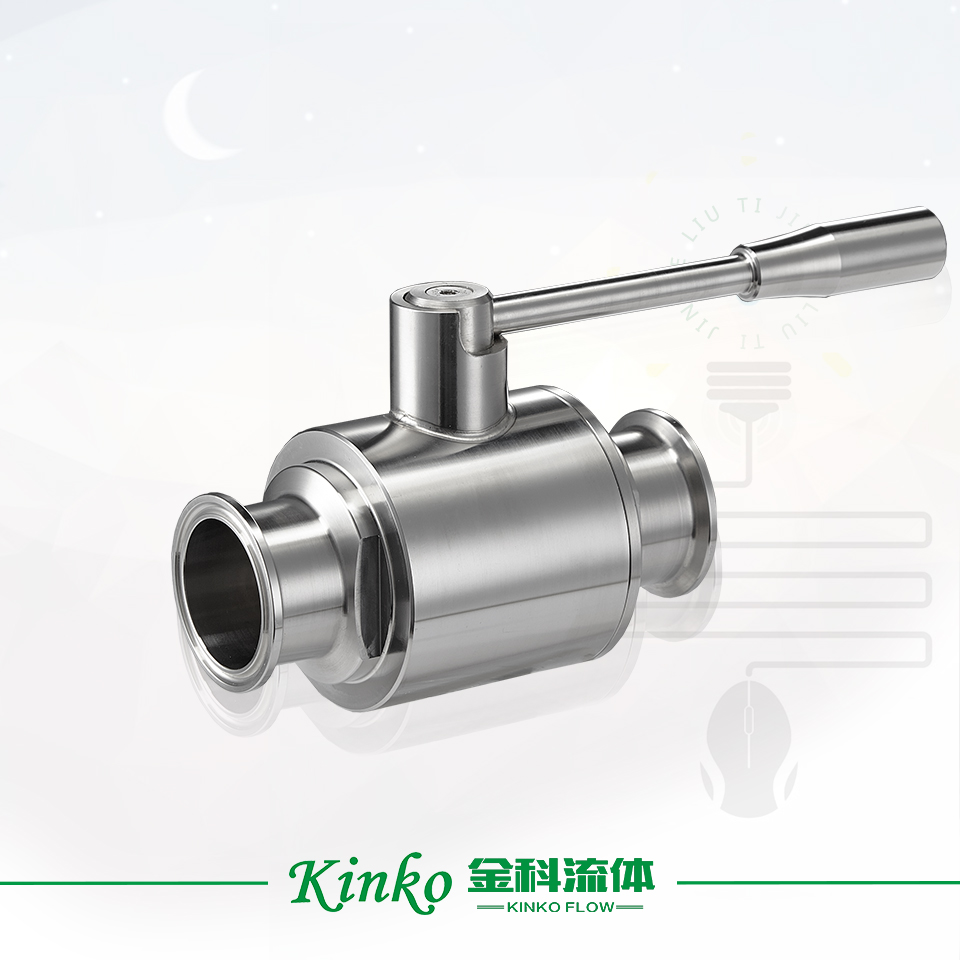
Food, dairy, and pharmaceutical processing have zero tolerance for contamination. A standard industrial ball valve has cracks, threads, and crevices where bacteria grow. Sanitary ball valves eliminate these hazards with polished surfaces, crevice-free design, and quick-clean connections.
This guide explains the specific requirements for hygienic ball valves, the certification standards B2B buyers must specify, and how to select the right valve for your processing line.
What Makes a Ball Valve "Sanitary"?
A standard ball valve is not sanitary. A sanitary ball valve must meet four design requirements:
| Requirement | Standard valve | Sanitary valve |
|---|---|---|
| Surface finish | As-cast or machined (Ra > 32µin) | Polished (Ra ≤ 32µin / 0.8µm) |
| Internal geometry | Threads, sharp corners, recesses | Smooth radii, crevice-free |
| Drainability | Traps fluid horizontally | Self-draining (15° minimum slope) |
| Connections | Threaded, flanged, welded | Tri-clamp, butt weld, or flanged with sanitary gasket |
| Cleanability | Difficult to clean-in-place | Full CIP/SIP compatible |
Kinko standard: All sanitary ball valves ship with 180 grit electropolished finish (Ra ≤ 0.8µm / 32µin) on all wetted surfaces.
Key Industry Standards (What Certifications to Request)
B2B buyers must specify the correct standards for their market.
| Standard | Region | Requirement |
|---|---|---|
| 3-A Sanitary Standard 85-07 | USA | Most common for dairy and food. Requires crevice-free design, Ra ≤ 32µin, full drainability. |
| FDA Title 21 CFR 177.1550 | USA | Material compliance for PTFE and other polymeric components. |
| EHEDG (European Hygienic Engineering & Design Group) | Europe | Doc 8 (valves) and Doc 10 (CIP). Comparable to 3-A. |
| ASME BPE (Bioprocessing Equipment) | USA (Pharma) | Stricter than 3-A. Requires Ra ≤ 20µin (0.5µm) for pharma. |
| USP Class VI | Global | Biocompatibility and cytotoxicity testing for pharmaceutical use. |
| ISO 2037 | International | Dimensions for sanitary tubes and fittings. |
Kinko guidance:
-
Dairy and food: 3-A and FDA compliant.
-
Pharmaceutical: ASME BPE and USP Class VI.
-
Export to Europe: EHEDG certification.
Surface Finish Requirements (The Critical Difference)
Surface finish is measured in Ra (Roughness Average) in microinches (µin) or micrometers (µm).
| Application | Ra requirement | Standard equivalent |
|---|---|---|
| Non-critical (brewery, beverage) | ≤ 32µin (0.8µm) | Basic sanitary |
| Dairy (milk, yogurt, cheese) | ≤ 28µin (0.7µm) | 3-A minimum |
| Food with particulates | ≤ 25µin (0.64µm) | EHEDG |
| Pharmaceutical (biotech, sterile) | ≤ 20µin (0.5µm) | ASME BPE SF1 |
| High-purity pharma (WFI, injectables) | ≤ 15µin (0.38µm) | ASME BPE SF4 (electropolished) |
Why finish matters: Bacteria adhere to and grow in microscopic scratches. A 32µin finish has 3x less surface area for biofilm than a 125µin finish.
Tri-Clamp Connections (The Sanitary Standard)
Tri-clamp (also called Tri-clover or sanitary clamp) is the dominant connection in hygienic processing.
| Component | Description |
|---|---|
| Ferrules | Welded or machined onto valve ends and pipe. Create flat sealing surface. |
| Gasket | PTFE, EPDM, or silicone. Seals between ferrule faces. |
| Clamp | Stainless steel hinged clamp. Compresses gasket between ferrules. |
Tri-clamp sizes for sanitary ball valves:
| Tube OD (inches) | Nominal size | Ferrule type | Best for |
|---|---|---|---|
| 0.5" | 1/4" | Mini | Lab, small sample lines |
| 1" | 1/2" | Standard | Pilot plants |
| 1.5" | 3/4" – 1" | Standard | Dairy, food lines (most common) |
| 2" | 1-1/2" | Standard | Process lines |
| 2.5" | 2" | Standard | Main supply lines |
| 3" | 2-1/2" – 3" | Standard | High flow |
| 4" | 4" | Standard | Very high flow |
Procurement note: Always specify tube OD, not nominal pipe size. A "2-inch sanitary valve" typically means 2" tube OD (50.8mm), not 2" NPT.
Sanitary Valve Configurations
| Configuration | Best for | Operation |
|---|---|---|
| 2-way (inline) | On/off control of a single line | Standard ball valve |
| 3-way (L-port) | Divert flow between two outlets | 90° rotation |
| 3-way (T-port) | Mix two inlets or divert with all ports open | 180° rotation |
| 4-way | Reverse pump flow or complex diverting | Multiple positions |
| Multi-port (tank outlet) | Bottom-of-tank draining with flush port | Specialized |
Gasket and Seal Materials (FDA Compliance Required)
Every wetted elastomer must be FDA-compliant or USP Class VI.
| Material | Max temp | Best for | FDA status |
|---|---|---|---|
| EPDM | 150°C (302°F) | Water, mild chemicals, CIP (alkaline) | 21 CFR 177.2600 |
| PTFE | 230°C (446°F) | Aggressive chemicals, high temp, steam | 21 CFR 177.1550 |
| Silicone | 200°C (392°F) | Pharmaceutical, biotech, WFI | USP Class VI |
| Viton (FKM) | 200°C (392°F) | Oils, fuels, acids | Limited FDA acceptance |
| FEP encapsulated | 200°C (392°F) | Aggressive chemicals with PTFE-like surface | 21 CFR 177.1550 |
Kinko standard: EPDM for general dairy/food, PTFE for chemical resistance, Silicone for pharmaceutical.
CIP and SIP Compatibility (Clean-in-Place / Steam-in-Place)
Sanitary ball valves must withstand automated cleaning cycles without damage.
CIP (Clean-in-Place):
-
Typically 65-85°C (149-185°F) at 15-30 PSI.
-
Alkaline (caustic) followed by acid rinse.
-
Valve must have no dead legs or trapped volumes.
SIP (Steam-in-Place):
-
Typically 121-140°C (250-284°F) saturated steam.
-
20-45 minute hold time.
-
Requires all seals (including stem) rated for steam.
Sanitary valve features for CIP/SIP:
| Feature | Purpose |
|---|---|
| Cavity-filled design | No product entrapment in ball cavity |
| Blow-out proof stem | Steam pressure cannot eject stem |
| High-temperature seats | PEEK or reinforced PTFE for SIP |
| Condensate drain | Prevents pooling after steam cycle |
Technical Specifications Table (Kinko 2-Way Sanitary Ball Valve)
| Parameter | Standard offering | Upgrade option |
|---|---|---|
| Body material | 316L stainless steel | Hastelloy, Alloy 20 |
| Surface finish | Ra ≤ 32µin (0.8µm) mechanically polished | Ra ≤ 20µin (0.5µm) electropolished |
| Connections | Tri-clamp (both ends) | Butt weld, male thread, female thread |
| Port type | Full port (standard) | Reduced port |
| Seat material | PTFE (FDA) | EPDM, Silicone, PEEK |
| Stem seals | PTFE + Viton (backup) | FEP encapsulated |
| Temperature range | -20°C to 180°C | Up to 230°C (PEEK seats) |
| Pressure rating | 500 PSI (WOG) | 1000 PSI |
| Sizes (tube OD) | 0.5" to 4" | Larger custom |
| Certifications stock | FDA, 3-A (on request) | ASME BPE, USP Class VI |
| Actuator mounting | ISO 5211 pad standard | Custom |
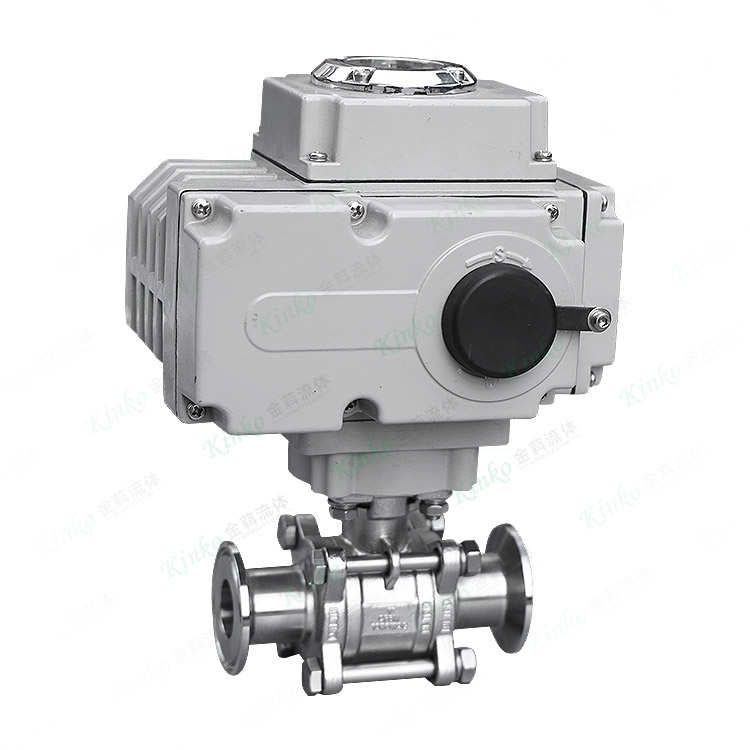
Sanitary vs Industrial Ball Valve (Visual Comparison)
| Feature | Industrial ball valve | Sanitary ball valve |
|---|---|---|
| Exterior finish | Cast, may have tool marks | Polished, smooth |
| Threads | NPT or BSP (standard) | None – Tri-clamp only |
| Internal crevices | Present (thread roots, sharp corners) | None (radiused, honed) |
| Drain port | No | Yes (optional for tank bottom) |
| Identification | Material stamp only | Lot traceable, certification included |
| Gaskets | Paper or rubber (unknown composition) | FDA-certified elastomer with cert |
Selection Tables by Application
Dairy (milk, cream, yogurt):
| Requirement | Specification |
|---|---|
| Material | 316L SS |
| Finish | Ra ≤ 28µin |
| Seats | EPDM or PTFE |
| Connection | Tri-clamp 1.5" or 2" |
| Certification | 3-A, FDA |
Food (sauces, syrups, particulates):
| Requirement | Specification |
|---|---|
| Material | 316L SS |
| Finish | Ra ≤ 32µin |
| Seats | PTFE (full port for particulates) |
| Connection | Tri-clamp 2" or 3" |
| Certification | FDA |
Beverage (beer, wine, juice, soft drinks):
| Requirement | Specification |
|---|---|
| Material | 304 or 316 SS |
| Finish | Ra ≤ 32µin |
| Seats | EPDM (better for CO₂ and cleaning) |
| Connection | Tri-clamp or DIN 11851 |
| Certification | FDA |
Pharmaceutical (buffer, WFI, bioreactor):
| Requirement | Specification |
|---|---|
| Material | 316L SS (low carbon) |
| Finish | Ra ≤ 20µin electropolished |
| Seats | Silicone or PTFE |
| Connection | Tri-clamp or sanitary butt weld |
| Certification | USP Class VI, ASME BPE |
Installation Best Practices for Sanitary Valves
Step 1 – Verify certification
-
Confirm traceable material certs (3.1 or 3.2) are included.
-
Check surface finish report if specified.
Step 2 – Unpack carefully
-
Keep valve bagged until installation.
-
Never touch wetted surfaces with bare hands (oils contaminate).
Step 3 – Install Tri-clamp connections
-
Center gasket exactly between ferrule faces.
-
Tighten clamp hand-tight plus 1/4 turn with wrench.
-
Do not over-torque – gasket extrusion occurs.
Step 4 – Inspect drainability
-
Mount valve with handle vertical or horizontal per design.
-
Ensure no low pockets trap liquid.
Step 5 – Passivate before first use (stainless steel)
-
Required for all new sanitary SS equipment.
-
Citric or nitric acid passivation removes free iron.
-
Improves corrosion resistance dramatically.
Common Sanitary Valve Problems and Solutions
| Problem | Likely cause | Solution |
|---|---|---|
| Leak at Tri-clamp | Worn or pinched gasket | Replace gasket |
| Valve difficult to turn | Product buildup in ball cavity | Switch to cavity-filled design |
| Contamination in product | Worn stem seals | Replace seals, upgrade to live-loaded stem |
| Valve fails SIP cycle | Wrong seat material | Upgrade to PEEK or reinforced PTFE |
| Surface shows rust spots | Free iron from fabrication | Passivate valve |
Cost Considerations for Sanitary Ball Valves
| Factor | Cost impact vs. standard industrial valve |
|---|---|
| Base sanitary valve (1.5" Tri-clamp, 316L) | +150% to +250% |
| Electropolish (Ra ≤ 20µin) | +30% to +50% |
| 3-A certification documentation | +10% to +20% |
| ASME BPE (pharma grade) | +50% to +100% |
| Material certs (3.2 vs 3.1) | +5% to +10% |
| Cavity-filled design | +20% to +30% |
Kinko note: Lower price often means missing certifications. Always request documentation.
Ivan (Mobile:+86-18968769287)
WhatsApp:+86-13579991606
Wechat:+86-18968769287
Website:www.kinko-flow.com
ZHEJIANG KINKO FLUID EQUIPMENT CO.,LTD
