How to Prevent Ball Valve Leakage in Pipelines
Introduction
Ball valve leakage is a preventable problem. In most industrial sites, 80% of valve leaks come from three sources: stem seals, seat seals, or body joints. Each has a distinct cause and solution.
This guide helps B2B engineers and maintenance teams identify the leak location, understand the root cause, and implement permanent fixes. Prevent unplanned downtime, product loss, and safety hazards.
The Three Leak Paths in a Ball Valve
Every ball valve has three potential leak paths:
| Leak location | Path | Visible as |
|---|---|---|
| Stem | Through stem packing or O-rings | Drip from handle nut area |
| Seat | Past the ball-seat interface | Fluid in pipeline downstream when valve is closed |
| Body joint | Between two body halves (2-piece or 3-piece) | Drip from center seam of valve body |
Diagnostic rule: Look at where the fluid appears. That tells you which seal failed.
1. Stem Leakage (Most Common)
Stem leakage occurs at the rotating shaft between the ball and the handle. Fluid escapes upward through the stem packing or O-rings.
Visual signs:
-
Fluid wetness under handle nut.
-
Crystallized residue around stem base.
-
Visible drip when valve cycles.
Root causes and solutions:
| Cause | Why it happens | Solution |
|---|---|---|
| Loose packing nut | Vibration loosens nut over time | Tighten packing nut 1/8 to 1/4 turn |
| Worn stem O-rings | Normal wear after 20,000+ cycles | Replace O-rings (requires valve disassembly) |
| Scratched stem surface | Debris or improper assembly | Polish stem or replace stem |
| Wrong seal material | Seal swells or hardens from chemical attack | Upgrade to chemical-compatible seal (e.g., FKM to PTFE) |
| Over-tightened packing | Excessive friction wears stem | Back off nut, apply light grease |
Stem packing torque guide (typical):
| Valve size | Packing nut type | Initial torque | Re-torque after |
|---|---|---|---|
| 1/4" – 1/2" | Gland nut | Finger-tight + 1/8 turn | 1000 cycles |
| 3/4" – 1" | Gland nut | 5-8 ft-lbs | 2000 cycles |
| 1-1/4" – 2" | Two-bolt gland | 8-12 ft-lbs | 5000 cycles |
Kinko rule: Never over-torque a stem packing. A leaking stem is safer than a seized valve.
2. Seat Leakage (Leakage Through Closed Valve)
Seat leakage means fluid passes the ball-seal interface when the valve is fully closed. The valve fails to shut off completely.
Visual signs:
-
Pressure drops on downstream gauge when valve closed.
-
Fluid continues flowing (partial flow).
-
Bubbles in downstream sight glass.
Root causes and solutions:
| Cause | Why it happens | Solution |
|---|---|---|
| Damaged seat (PTFE) | Scratched, cut, or deformed | Replace seat |
| Debris on seat | Particles embed in soft PTFE | Flush line, install strainer upstream |
| Ball surface scratched | Abrasive particles or cavitation | Polish ball or replace ball |
| Loose stem-to-ball connection | Stem hex or flat misaligned | Disassemble, tighten connection |
| Thermal cycling | Differential expansion changes seat compression | Use spring-loaded seats (PEEK or reinforced) |
| Over-torqued handle | Excessive force distorts ball or seat | Use proper lever length |
Seat leakage test (field method):
-
Close valve fully.
-
Pressurize upstream to working pressure.
-
Open downstream bleed valve.
-
If continuous flow observed → seat leakage confirmed.
Acceptable seat leakage per API 598 (industrial standard):
| Valve size | Max allowable leakage (bubbles/minute for gas) |
|---|---|
| ≤ 2" | 0 bubbles (tight shutoff) |
| 2-1/2" – 6" | 0 bubbles |
| > 6" | 0 bubbles |
Kinko note: API 598 requires zero visible leakage for resilient-seated ball valves (PTFE seats). Any leakage is failure.
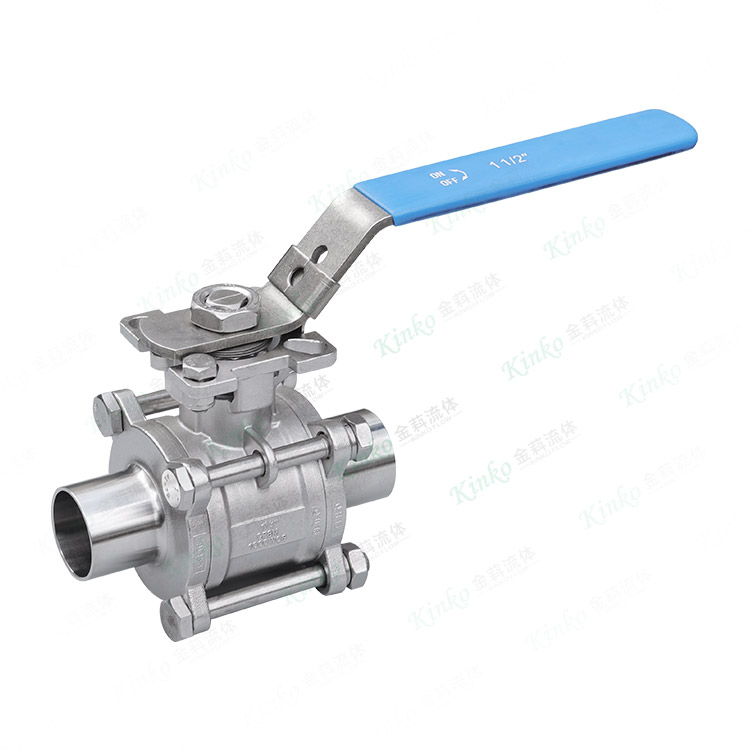
3. Body Joint Leakage (2-Piece and 3-Piece Valves)
Body joint leakage occurs between the two body halves. 1-piece valves have no body joint. 2-piece and 3-piece valves rely on a gasket or O-ring between body sections.
Visual signs:
-
Leak from the center seam of the valve body.
-
Fluid appears between the two cast body sections.
-
Worsens as pressure increases.
Root causes and solutions:
| Cause | Why it happens | Solution |
|---|---|---|
| Loose body bolts | Vibration or thermal cycling | Re-torque body bolts to spec |
| Worn body joint seal | Gasket compressed permanently | Replace gasket (requires full disassembly) |
| Over-pressured | Exceeded WOG rating | Replace with higher pressure class valve |
| Wrong gasket material | Chemical attack or temperature limit | Upgrade to compatible gasket material |
| Cross-threaded body bolts | Improper assembly | Replace bolts, chase threads |
Body bolt torque guide (typical, 2-piece 316 SS valve):
| Valve size | Bolt size | Torque (ft-lbs) | Pattern |
|---|---|---|---|
| 1/2" – 3/4" | M5 or #10 | 3-5 | Opposite pairs |
| 1" | M6 | 5-8 | Opposite pairs |
| 1-1/4" – 1-1/2" | M8 | 10-15 | Opposite pairs |
| 2" | M10 | 18-25 | Opposite pairs |
Leakage by Valve Design (1-Piece vs 2-Piece vs 3-Piece)
| Valve type | Stem leak risk | Seat leak risk | Body joint leak risk | Repairability |
|---|---|---|---|---|
| 1-piece | Medium | Medium | None (no joint) | None (discard) |
| 2-piece | Low | Low | Medium | Field repairable |
| 3-piece | Low | Low | Low (better gasket design) | Full access |
Procurement insight: For critical services where leakage cannot be tolerated, specify 3-piece design with bolted body joints and metal-to-metal seating backup.
Prevention: Correct Installation
Most leaks start at installation. Follow these rules.
Rule 1 – Do not over-torque pipe connections
-
Over-torquing a threaded valve distorts the body.
-
Distortion causes seat misalignment and leakage.
-
Use a backup wrench on the valve body, not the pipe.
Rule 2 – Install strainers upstream
-
Debris is the #1 cause of seat damage.
-
Install a Y-strainer or basket strainer before the valve.
-
Clean strainer regularly.
Rule 3 – Support heavy valves
-
A 2" flanged valve weighs 15+ lbs.
-
Unsupported weight stresses body joints.
-
Use pipe hangers or valve supports.
Rule 4 – Do not use pipe as lever
-
Extending lever length with pipe multiplies torque.
-
3 feet of pipe on a 6" lever = 6x design torque.
-
Result: distorted ball, crushed seats, stem damage.
Prevention: Correct Operation
Do:
-
Open and close fully (ball valves are not throttling valves).
-
Cycle valves weekly in standby lines to prevent seat sticking.
-
Lubricate stem annually with food-grade grease (if not PTFE).
Do not:
-
Leave valve partially open for extended periods (flow erosion cuts seats).
-
Slam valve open/closed rapidly (water hammer damages seats).
-
Exceed temperature rating (seat extrusion occurs).
Prevention: Correct Material Selection
Match seals to fluid chemistry. Wrong seal material = guaranteed leak.
| Seal material | Compatible with | Not compatible with |
|---|---|---|
| PTFE | Almost all chemicals (except molten alkali metals) | High pressure steam over 230°C |
| FKM (Viton) | Oils, fuels, acids | Ketones (acetone, MEK), brake fluid |
| EPDM | Water, steam (low pressure), alkalis | Oils, fuels, hydrocarbons |
| NBR (Buna) | Oils, fuels | High temperature, ozone |
| PEEK | High temperature, steam, chemicals | Very high cost |
Kinko rule: When in doubt, specify PTFE seats. It is inert to almost everything.
Leakage Prevention Checklist (For Maintenance Teams)
Monthly inspection:
-
Look for wetness around stem nut.
-
Check body joint for seepage.
-
Verify handle stops at fully closed position.
-
Listen for hissing gas (closed valve).
Annual maintenance (2-piece and 3-piece valves):
-
Re-torque stem packing nut.
-
Re-torque body bolts.
-
Cycle valve 10 times to redistribute grease.
-
Pressure test downstream seat seal.
Failure replacement trigger:
-
If a valve leaks after two repair attempts → replace it.
-
If body joint leaks after re-torquing → replace gasket or valve.
-
If stem leaks after tightening and new O-rings → replace stem.
Quick Troubleshooting Table
| Symptom | Most likely cause | First action |
|---|---|---|
| Drip from handle | Loose packing nut | Tighten 1/8 turn |
| Drip from body seam | Loose body bolts | Tighten to spec |
| Valve won't fully shut | Debris on seat | Cycle open/close rapidly to clear |
| Valve passes fluid when closed | Damaged seat | Replace seat |
| Stem leaks after tightening | Worn stem or O-rings | Replace stem seal kit |
| Valve hard to turn | Over-tight packing or debris | Back off nut, then flush |
| Leak appears after temperature change | Thermal expansion | Re-torque all fasteners |
When to Replace Instead of Repair
| Situation | Action |
|---|---|
| 1-piece valve leaking | Replace (cannot be repaired) |
| Body threads stripped | Replace |
| Visible crack in casting | Replace immediately |
| Ball surface deeply scratched or pitted | Replace ball or whole valve |
| Valve has leaked 3+ times in 12 months | Replace with higher quality valve |
| Replacement seals cost >50% of new valve | Replace |
Kinko ball valve features that minimize leakage:
-
Blowout-proof stem (cannot eject under pressure)
-
Live-loaded stem packing (self-adjusting)
-
Precision-machined PTFE seats (zero leakage per API 598)
-
316 stainless steel body bolts (no rust or galling)
-
100% hydrostatically tested before shipping
-
Full repair kit available (seats, stem seals, body gasket)
Contact Kinko for leak-free ball valve specifications. Pressure test reports included with every order.
Ivan (Mobile:+86-18968769287)
WhatsApp:+86-13579991606
Wechat:+86-18968769287
Website: www.kinko-flow.com
ZHEJIANG KINKO FLUID EQUIPMENT CO.,LTD
