Pneumatic Ball Valves for Automated Industrial Systems
Double-Acting vs. Spring-Return – First Decision
| Feature | Double-Acting | Spring-Return (Single-Acting) |
|---|---|---|
| Air to open | Required | Required |
| Air to close | Required | Not required (spring closes) |
| Fail-safe position | Last position (no air = stuck) | Closed or open (spring returns) |
| Air consumption | Lower | Higher (overcomes spring force) |
| Actuator size | Smaller for same torque | Larger (spring pack needs space) |
| Cost | $ – Baseline | $$ (+30–50%) |
| Best for | Continuous operation, air always available | Safety shutdown, loss-of-air scenarios |
Recommendation: Specify spring-return for emergency shutdown (ESD) or any remote site where compressed air may fail.
5 Quick Selection Criteria
1. Torque – Match to Supply Air Pressure
Actuator torque varies with supply pressure. Lower pressure = less torque.
| Valve Size | Required Torque (lb·in) | Actuator @ 80 psi | Actuator @ 60 psi | Actuator @ 40 psi |
|---|---|---|---|---|
| 1/2" | 40 | Size 1 (120 lb·in) | Size 1 (90) | Size 2 (160) |
| 1" | 90 | Size 1 (120) | Size 2 (160) | Size 2 (160) |
| 2" | 280 | Size 2 (160) | Size 3 (320) | Size 3 (320) |
| 3" | 600 | Size 3 (320) | Size 4 (600) | Size 4 (600) |
| 4" | 1,100 | Size 4 (600) | Size 5 (1,200) | Size 5 (1,200) |
Safety factor: Multiply valve torque by 1.5 for spring-return (spring loses force over time) or 1.3 for double-acting.
2. Air Supply Requirements
| Parameter | Typical Range | Kinko Recommended |
|---|---|---|
| Supply pressure | 40–120 psi | 80 psi (minimum for rated torque) |
| Air quality | ISO 8573-1 | Class 3.4.3 (dry, oil-free, filtered to 5µ) |
| Flow rate (per cycle) | 0.5–10 SCFM | Depends on actuator size (see table below) |
Air consumption per cycle (double-acting, @ 80 psi):
| Actuator Size | Air Volume (in³) per cycle | SCFM @ 10 cycles/min |
|---|---|---|
| Size 1 | 5 | 0.3 |
| Size 2 | 15 | 0.9 |
| Size 3 | 40 | 2.4 |
| Size 4 | 90 | 5.4 |
| Size 5 | 180 | 10.8 |
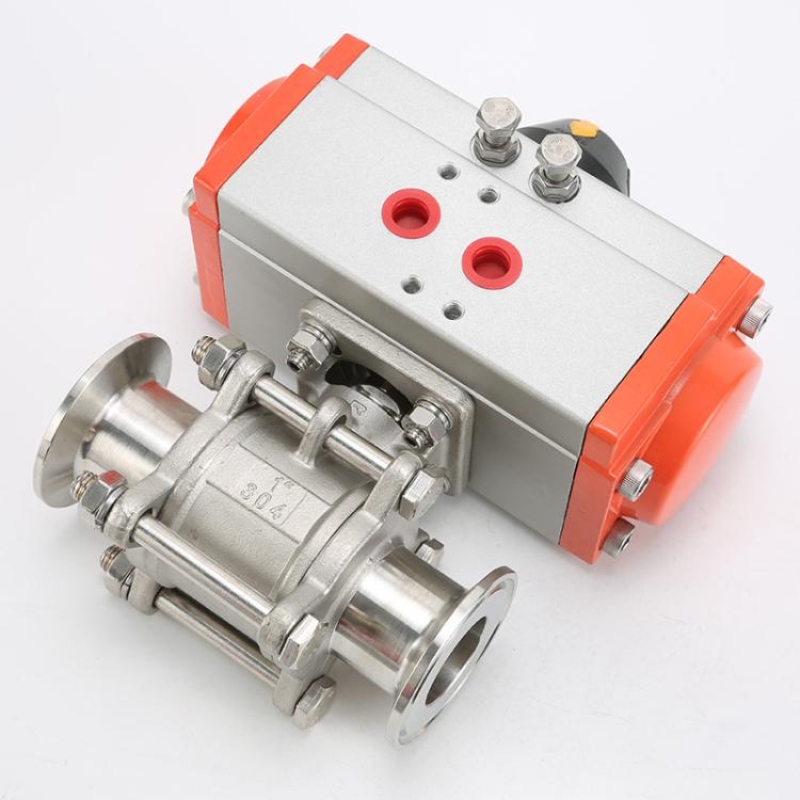
3. Solenoid Valve – The Critical Control Component
The solenoid valve directs air to open and close the actuator.
| Solenoid Type | Ports | Function | Best For |
|---|---|---|---|
| 5/2 way (single coil) | 5 ports, 2 positions | Double-acting (spring return on coil de-energized) | Most double-acting |
| 5/2 way (double coil) | 5 ports, 2 positions | Double-acting (latching – holds position without power) | Low-power or battery sites |
| 3/2 way (NC or NO) | 3 ports, 2 positions | Spring-return actuator | Single-acting cylinders |
| NAMUR direct mount | Mounts directly to actuator | No tubing | Compact, clean, leak-proof |
Voltage options: 24V DC (most common), 110V AC, 220V AC, or 12V DC.
4. Speed Control – Adjust Open/Close Time
Add flow control valves (speed controllers) at actuator ports.
| Desired Cycle Time | Flow Control Setting | Application |
|---|---|---|
| Fast (<0.5 sec) | Fully open | Emergency shutdown, batching |
| Medium (1–2 sec) | 50% open | Standard process |
| Slow (3–10 sec) | 25% open | Water hammer prevention, gentle filling |
Caution: Too fast = water hammer. Too slow = seat erosion (partial stroke).
5. Accessories for Remote Automation
| Accessory | Function | When Required |
|---|---|---|
| Position indicator (visual) | Shows open/closed from distance | All valves (recommended) |
| Proximity / limit switches | Electrical feedback to PLC | Remote monitoring, interlocking |
| Positioner (4–20 mA) | Modulating control | Flow/pressure/temp regulation |
| Boosters / quick exhaust valves | Speeds up cycle | Large actuators (>size 4) |
| Lock-out / tag-out (LOTO) | Manual isolation for maintenance | Safety compliance (OSHA) |
| Filter regulator (FRL) | Cleans and regulates air | Every pneumatic installation |
Pneumatic vs. Electric – Quick Comparison
| Criteria | Pneumatic | Electric (Motorized) |
|---|---|---|
| Cycle speed | Fast (0.2–2 sec) | Slow (2–60 sec) |
| Cycle frequency | Unlimited (with proper lube) | Limited by duty cycle (S2/S4) |
| Hazardous area (gas) | Best (no arcing) | Requires Ex d or Ex ib |
| Modulating precision | Poor (dead band >2%) | Excellent (0.1%) |
| Instrument air required | Yes | No |
| Energy cost | High (continuous leakage) | Low (only when moving) |
| Fail-safe with no utility | Spring return works | Spring return works |
| Maintenance | Lubricator, filter, seals | Capacitors, batteries, gears |
| MTBF (typical) | 200,000+ cycles | 50,000–100,000 cycles |
Kinko recommendation: Use pneumatic for high-cycle (100+ cycles/day), explosive atmospheres (Zone 1/Zone 2), or when speed matters. Use electric when air is unavailable or precision control is required.
Installation Best Practices (Concise)
Air Preparation (FRL – Filter, Regulator, Lubricator)
| Component | Setting | Maintenance |
|---|---|---|
| Filter | 5 micron (minimum), auto-drain | Check bowl weekly |
| Regulator | 80 psi (adjustable ±10 psi) | Verify with gauge monthly |
| Lubricator | ISO VG 32 oil, 1–2 drops/cycle | Refill tank quarterly |
Tubing Guidelines
| Parameter | Specification |
|---|---|
| Tubing material | Polyurethane or nylon (6mm or 8mm OD) |
| Max length (actuator to solenoid) | 10m (beyond that – use booster) |
| Fittings | Push-to-connect (brass or plastic) |
Wiring (Solenoid to PLC)
| Signal | Wire Color (IEC) | Function |
|---|---|---|
| 24V DC (+) | Brown | Power to coil |
| 24V DC (-) | Blue | Common |
| Ground | Green/Yellow | Earth |
→ Add flyback diode (suppression) for DC solenoids to protect PLC outputs.
Common Issues – Fast Fixes
| Symptom | Root Cause | Corrective Action |
|---|---|---|
| Actuator moves slowly | Low pressure or dirty filter | Check regulator; replace filter element |
| Actuator does not move | Dead solenoid, no air, or stuck spool | Check voltage; verify air supply; rebuild solenoid |
| Valve leaks from exhaust port | Worn solenoid seals or pilot | Replace solenoid or pilot assembly |
| Actuator chatters (partial stroke) | Flow control too tight or under-sized actuator | Open flow controller; upsize actuator |
| Water in exhaust | Wet compressed air | Install dryer upstream; drain filter bowl |
Maintenance Schedule (Pneumatic)
| Interval | Task |
|---|---|
| Weekly | Drain filter bowl; check lubricator oil level |
| Monthly | Verify regulator pressure (80 psi); test cycle speed |
| Quarterly | Replace filter element; lubricate valve stem (if fitting provided) |
| Annually | Rebuild solenoid valve (replace seals and spool) |
| Every 2 years | Replace actuator seals (end caps and piston) |
| Every 5 years | Full actuator overhaul (bearings, springs, body seals) |
Pneumatic Valve Sizing – Air Consumption Example
Example: 2" trunnion valve, double-acting actuator (size 3), 10 cycles per minute, 80 psi.
-
Air volume per cycle: 40 in³ (open) + 40 in³ (close) = 80 in³
-
80 in³ × 10 cycles/min = 800 in³/min
-
Convert to SCFM: 800 ÷ 1,728 = 0.46 SCFM
→ This actuator consumes ~0.5 SCFM. Add 20% for leakage: 0.6 SCFM required.
Conclusion
Select pneumatic ball valves when you need:
-
Fast cycling (<1 second open/close)
-
Hazardous area safety (no electrical arcing)
-
High reliability (MTBF >200,000 cycles)
-
Fail-safe operation (spring return works without power)
Kinko delivers:
-
Pre-assembled actuator + valve + solenoid (tested as a set)
-
NAMUR mounting eliminates tubing leaks
-
ATEX / IECEx certified options for Zone 1 and Zone 2
-
Air consumption worksheets for your compressor sizing
Ivan (Mobile:+86-18968769287)
WhatsApp:+86-13579991606
Wechat:+86-18968769287
Website:www.kinko-flow.com
ZHEJIANG KINKO FLUID EQUIPMENT CO.,LTD
