Importance of Material Selection in Angle Seat Valves
1. Two Key Material Decisions
| Component | Material Options | Impact |
|---|---|---|
| Valve body | SS304, SS316L, cast iron, brass | Corrosion resistance, strength, cost |
| Seal (seat / piston) | PTFE, FKM, EPDM, NBR | Temperature range, chemical compatibility |
Choosing the wrong combination leads to:
-
leakage
-
stuck valve
-
media contamination
-
premature failure
2. Body Material Comparison
| Material | Corrosion Resistance | Max Temp | Typical Applications | Cost |
|---|---|---|---|---|
| SS304 | Good (general purpose) | 180°C | Water, air, light chemicals, food | Medium |
| SS316L | Excellent (acid / salt / chloride) | 180°C | Seawater, aggressive chemicals, pharmaceutical | High |
| Cast iron | Poor (rusts easily) | 120°C | Low-cost water applications (not recommended) | Low |
| Brass | Fair (dezincification risk) | 100°C | Air, low-pressure water | Low |
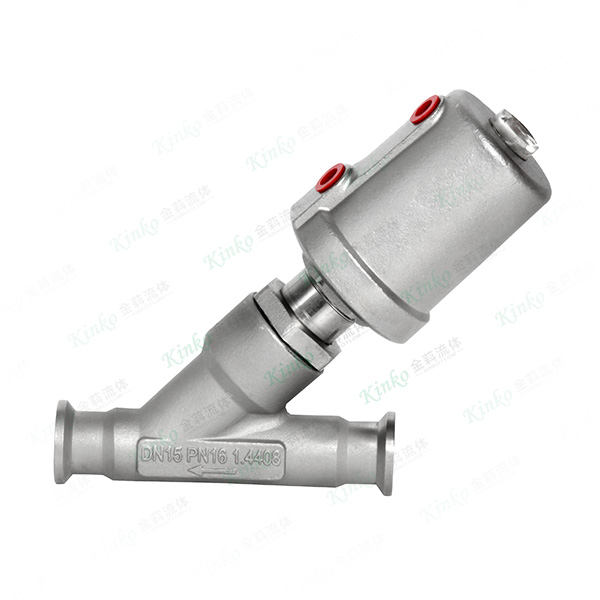
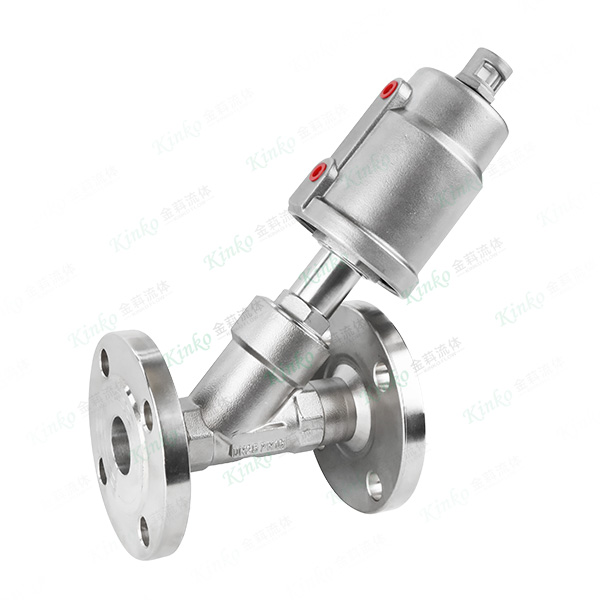
Kinko standard: SS304 and SS316L only. We do not use cast iron or brass for angle seat valves.
When to choose SS316L over SS304?
| Condition | Recommended Body |
|---|---|
| Fresh water, air, light oil | SS304 ✅ |
| Salty / coastal environment | SS316L ✅ |
| Acidic or alkaline media (pH <5 or >9) | SS316L ✅ |
| High chloride content (bleach, seawater) | SS316L ✅ |
| Pharmaceutical / sanitary applications | SS316L ✅ |
| General industrial (cost-sensitive) | SS304 ✅ |
3. Seal Material Comparison
The seal is the most wear-prone part of an angle seat valve. Wrong seal = short life.
| Seal Material | Max Temp | Best For | Avoid |
|---|---|---|---|
| PTFE (standard) | 180°C | Steam, hot water, oil, solvents, general chemicals | None (most versatile) |
| FKM (Viton) | 200°C | High-temp oil, fuels, strong acids | Steam, hot water (>150°C) |
| EPDM | 120°C | Hot water, steam, alkalis, brake fluid | Oil, gasoline, solvents |
| NBR | 90°C | Mineral oil, diesel, air | High temp, ozone, brake fluid |
Quick selection guide by media:
| Media Example | Recommended Seal |
|---|---|
| Hot water / steam (up to 180°C) | PTFE |
| Mineral oil / hydraulic oil | FKM or NBR |
| Solvents (acetone, alcohol) | PTFE |
| Caustic / NaOH solution | EPDM or PTFE |
| Compressed air (dry) | PTFE or NBR |
| Food / beverage (neutral) | PTFE or EPDM |
| Diesel / fuel | FKM or NBR |
| Acid (dilute sulfuric, hydrochloric) | PTFE or FKM |
4. Combined Selection Table – Body + Seal
Below is Kinko's standard recommendation matrix.
| Media | Body Material | Seal Material | Notes |
|---|---|---|---|
| Water (ambient) | SS304 | PTFE or EPDM | Most common |
| Hot water (80-120°C) | SS304 | PTFE or EPDM | EPDM cheaper |
| Steam (up to 180°C) | SS304 / SS316L | PTFE | PTFE required |
| Mineral oil (ambient) | SS304 | NBR or FKM | NBR is cost-effective |
| Mineral oil (high temp) | SS304 / SS316L | FKM | FKM handles heat |
| Dilute acid | SS316L | PTFE or FKM | SS316L critical |
| Caustic (NaOH) | SS316L | EPDM or PTFE | Avoid FKM |
| Seawater / brine | SS316L | PTFE | Chloride-resistant body |
| Food / dairy (CIP) | SS316L | PTFE or EPDM | Sanitary finish option |
| Air (compressed, dry) | SS304 | PTFE or NBR | Standard choice |
5. Real-World Failure Examples
| Failure | Root Cause | Correct Material |
|---|---|---|
| Valve leaked after 1 month | Cast iron body rusted | SS304 or SS316L |
| Seal swelled, valve stuck | NBR seal used with solvent | PTFE seal |
| Body pitted after 3 months | SS304 used with seawater | SS316L |
| Seal hardened and cracked | EPDM used with hot oil | FKM seal |
| Threads seized | Brass body with galvanic corrosion | SS304 with anti-seize |
Lesson: Material selection is not optional — it directly affects valve life.
6. Kinko Standard Material Offering
| Component | Standard Material | Optional Material |
|---|---|---|
| Body | SS304 | SS316L |
| Seal (seat) | PTFE | FKM, EPDM, NBR, reinforced PTFE |
| Piston seal | PTFE + O-ring (FKM) | Custom per request |
| Spring | Stainless steel | — |
| Pilot port threads | BSPP (standard), BSPT, NPT | — |
All Kinko angle seat valves use full stainless steel body construction — no cast iron, no brass.
7. How to Choose – Step by Step
Step 1: Identify the media (liquid, gas, steam, chemical)
Step 2: Check max operating temperature
Step 3: Check pH and chloride level
Step 4: Select body material (SS304 for general, SS316L for aggressive)
Step 5: Select seal material using the media guide above
Step 6 (optional): Ask Kinko — we provide free material recommendations.
8. Summary – Why Material Matters
| If you ignore material selection | Consequence |
|---|---|
| Wrong body material | Corrosion, pitting, thread failure |
| Wrong seal material | Swelling, cracking, leakage |
| Cost-cutting on materials | Frequent replacement, downtime |
The most expensive valve is the one that fails early.
Choosing the right body and seal material upfront saves money in the long run.
9. Kinko Material Selection Support
Kinko offers:
-
SS304 and SS316L bodies from stock
-
4 seal options (PTFE, FKM, EPDM, NBR)
-
Custom material combinations for special media
-
Free technical consultation
Contact Kinko with your media, temperature, and pressure — we will recommend the right material.
Ivan (Mobile:+86-18968769287)
WhatsApp:+86-13579991606
Wechat:+86-18968769287
Website:www.kinko-flow.com
ZHEJIANG KINKO FLUID EQUIPMENT CO.,LTD