Angle Seat Valves for High-Cycle Industrial Applications
1. What Is a High‑Cycle Application?
A high‑cycle application means the valve opens and closes frequently, often multiple times per second.
| Cycle Frequency | Classification | Typical Industry |
|---|---|---|
| < 10 cycles / minute | Low cycle | Manual fill, water tank |
| 10 – 60 cycles / minute | Medium cycle | Basic dosing |
| 60 – 300 cycles / minute | High cycle | Packaging, filling, sorting |
| > 300 cycles / minute | Ultra‑high cycle | High-speed bottling, aerosol filling |
For high-cycle applications, valve life is measured in total cycles, not years.
2. Why Angle Seat Valves Excel in High‑Cycle Conditions
| Requirement for High Cycle | How Angle Seat Valve Delivers |
|---|---|
| Low friction sealing | Piston design with PTFE seal — minimal wear |
| Fast response time | Short stroke, direct actuation |
| No leakage after millions of cycles | Self‑compensating seal design |
| Heat dissipation | Metal body acts as heat sink |
| Minimal maintenance | Few moving parts, robust spring |
| Consistent switching time | Pneumatic actuation unaffected by cycle count |
3. Critical Design Features for High‑Cycle Life
Not all angle seat valves are equal. For true high-cycle performance, look for these features:
| Feature | Why It Matters |
|---|---|
| PTFE or reinforced seal | Low friction, high temperature resistance |
| Stainless steel body (SS304/316L) | Corrosion resistance and heat dissipation |
| Guided piston | Reduces side load and seal wear |
| High-grade spring (stainless steel) | Maintains force after millions of cycles |
| Oversized pilot port (G1/4″ or larger) | Faster actuation at high frequency |
| Built-in flow silencer | Prevents actuator overheating in continuous use |
Kinko angle seat valves include all of the above as standard.
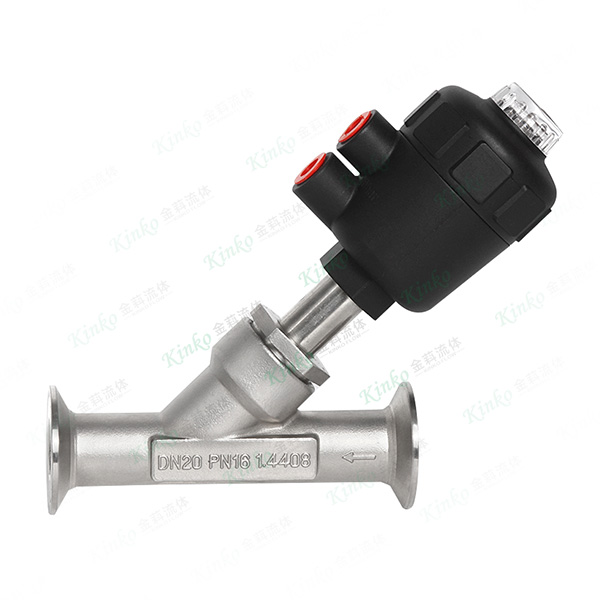
4. Performance Data – Kinko High‑Cycle Angle Seat Valve
| Parameter | Kinko High‑Cycle Specification |
|---|---|
| Cycle life (tested) | ≥ 3 million cycles (factory tested) |
| Max cycle rate | Up to 5 cycles per second (300 cpm) |
| Operating pressure | 0 – 16 bar |
| Control air pressure | 4 – 8 bar |
| Response time (open) | 30 – 80 ms (depending on size) |
| Response time (close) | 30 – 80 ms |
| Seal material | PTFE (standard), reinforced PTFE (option) |
| Body material | SS304, SS316L |
| Ambient temperature | -10°C to +80°C (high-cycle range) |
Actual cycle life depends on media, pressure, and operating conditions.
5. Typical High‑Cycle Industrial Applications
| Industry | Application | Cycle Rate | Why Angle Seat Valve |
|---|---|---|---|
| Beverage filling | Bottle filling nozzle | 120 – 240 cpm | Fast, clean cut-off |
| Aerosol filling | Propellant dosing | 60 – 150 cpm | Leak-tight, high pressure |
| Pharmaceutical | Vial filling | 100 – 200 cpm | Sterile, smooth operation |
| Food packaging | Pouch filling (sauce/oil) | 60 – 120 cpm | No clogging, self-draining |
| Industrial parts washer | Solvent / rinse spray | 30 – 60 cpm | Chemical resistant, long life |
| Pneumatic conveying | Material diverting | 20 – 40 cpm | High flow, low pressure drop |
6. Comparison: Angle Seat Valve vs Other Valves in High‑Cycle Use
| Valve Type | Max Typical Cycles | High‑Cycle Suitability | Maintenance |
|---|---|---|---|
| Angle seat valve (Kinko) | 3 – 5 million | ⭐⭐⭐⭐⭐ Excellent | Low |
| Ball valve (electric) | 100,000 – 200,000 | ⭐⭐ Poor | High (seal wear) |
| Ball valve (pneumatic) | 200,000 – 500,000 | ⭐⭐ Fair | Medium |
| Solenoid valve (direct acting) | 10 – 20 million | ⭐⭐⭐⭐ Good | Low (but smaller flow) |
| Butterfly valve | 100,000 – 300,000 | ⭐ Fair | High |
Takeaway: For high flow + high cycle, angle seat valves offer the best balance.
7. Factors That Reduce Cycle Life (Avoid These)
| Factor | Effect | Solution |
|---|---|---|
| Dirty / wet compressed air | Premature piston wear | Install air filter + dryer |
| Oversized valve | Slower response, more wear | Use correctly sized valve |
| Incorrect flow direction | Hammering, seal damage | Follow body arrow |
| Media with solids | Abrasive wear | Use strainer upstream |
| Too low control pressure | Slow stroking, partial opening | Maintain 5 – 8 bar |
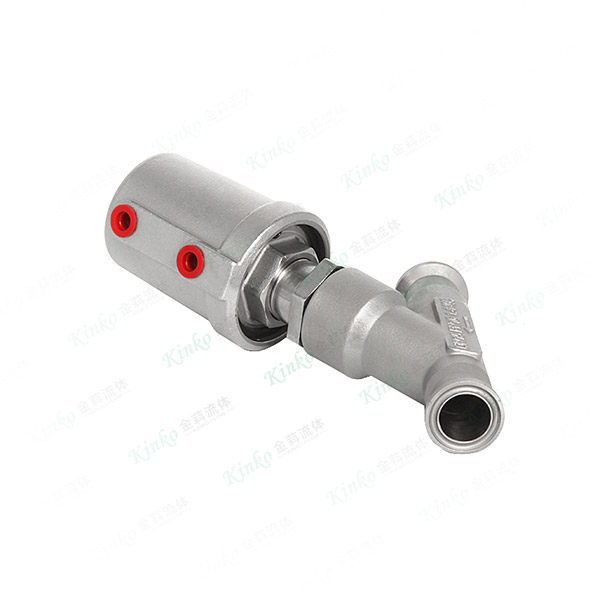
8. NC or NO for High‑Cycle Applications?
| Normal operating state | Recommended | Reason |
|---|---|---|
| Valve closed most of time | NC | Air only applied to open → less wear on spring |
| Valve open most of time | NO | Air only applied to close → less wear on spring |
For true high-cycle (over 100 cpm), NC is more common because most filling/dosing cycles are "closed at rest".
9. Summary – Key Takeaways
✅ Angle seat valves are purpose‑built for high-cycle industrial use
✅ Kinko valves are tested to ≥3 million cycles
✅ Key features: PTFE seal, stainless steel body, guided piston
✅ Perfect for: filling, dosing, spraying, pneumatic conveying
✅ Choose NC for closed-at-rest applications, NO for open-at-rest
If your application runs fast and often, don't use a standard valve — use a high-cycle angle seat valve from Kinko.
10. Need a High‑Cycle Valve for Your Production Line?
Kinko supplies angle seat valves for 24/7 industrial operations.
Contact Kinko for:
-
cycle life testing data
-
sample evaluation
-
OEM / bulk pricing
Ivan (Mobile:+86-18968769287)
WhatsApp:+86-13579991606
Wechat:+86-18968769287
Website:www.kinko-flow.com
ZHEJIANG KINKO FLUID EQUIPMENT CO.,LTD