How Do Pneumatic Actuators Work in Flow Control Systems?
1. The Basics: Pneumatic Actuators in Flow Control
A pneumatic actuator converts energy from compressed air into mechanical motion to operate a flow control device—typically a valve.
Two Primary Functions in Flow Control:
| Function | Description | Example |
|---|---|---|
| On/Off Isolation | Valve is either fully open (100% flow) or fully closed (0% flow) | Emergency shutdown, tank filling |
| Modulating Control | Valve positioned at any point between open and closed to regulate flow rate | Temperature control, pressure regulation, mixing |
The KINKO JAT-SR Advantage:
The JAT-SR Series rack-and-pinion pneumatic actuators are designed for both applications. With the right accessories, they can handle simple on/off duties or precise modulating control.
2. How Pneumatic Actuators Work: The Mechanism
The Rack-and-Pinion Principle (JAT-SR Series)
The KINKO JAT-SR Series uses a rack-and-pinion design—a simple, reliable, and powerful mechanism.
Components:
-
Pistons: Two opposed pistons inside the actuator body.
-
Rack Gears: Teeth machined into the pistons.
-
Pinion Gear: A central gear that meshes with the piston racks.
-
Drive Shaft: Connected to the pinion, extends to mount the valve.
Operation:
-
Air Introduction: Compressed air enters the actuator through the center chamber, pushing the pistons outward.
-
Linear to Rotary Conversion: As the pistons move, their rack gears drive the pinion gear to rotate.
-
Valve Movement: The rotating pinion shaft turns the valve stem 90 degrees (quarter-turn).
For Double Acting (JAT-SR DA):
-
Air to Port A pushes pistons outward → valve opens.
-
Air to Port B pushes pistons inward → valve closes.
For Spring Return (JAT-SR SR):
-
Air pressure compresses springs → valve opens.
-
Air pressure released → springs decompress → valve closes (fail-safe).
3. On/Off Flow Control: Simple and Fast
The most common application for pneumatic actuators is simple on/off control.
How It Works:
-
Open Command: Solenoid valve energizes, directing air pressure to the actuator.
-
Actuator Strokes: Valve moves to full open position.
-
Flow Occurs: Media flows through the valve at maximum rate.
-
Close Command: Solenoid valve de-energizes (or opposite port energized), air exhausts, and actuator returns valve to closed position.
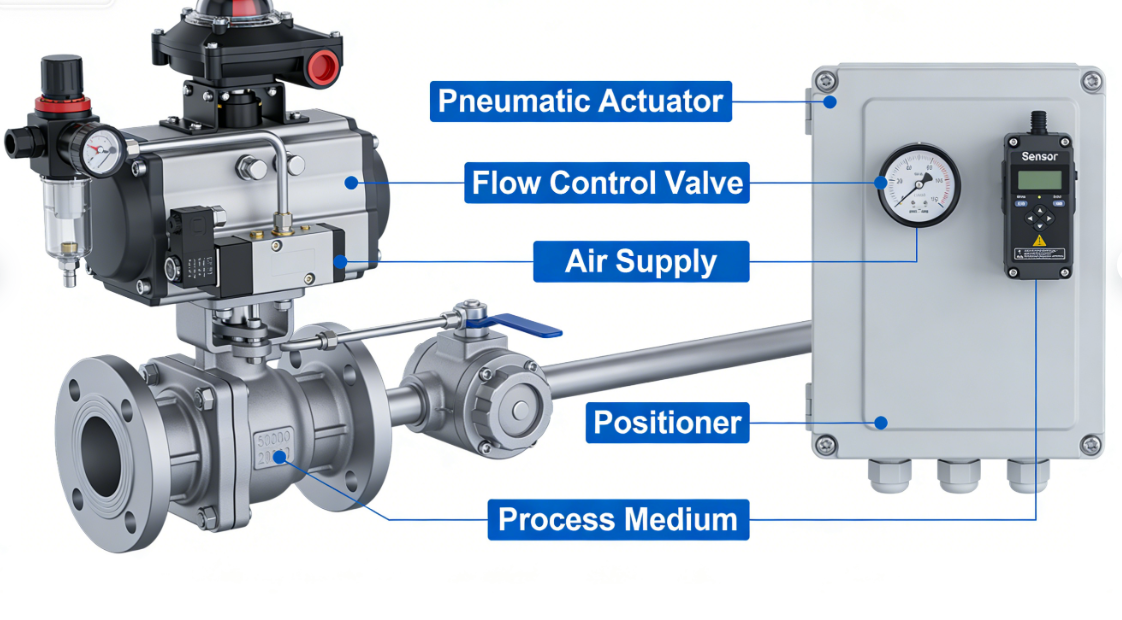
Key Components for On/Off Control:
| Component | Function |
|---|---|
| Solenoid Valve | Electrically controls air flow to the actuator |
| Filter/Regulator | Ensures clean, pressure-regulated air supply |
| Speed Control Valves | Adjust opening and closing speed |
| Limit Switch Box | Provides position feedback (open/closed signals) |
KINKO JAT-SR On/Off Applications:
-
Tank filling: Quick open/close to control batch quantities.
-
Conveyor diverters: Directing product flow between lines.
-
Emergency isolation: Rapid closure during safety events.
-
Compressor unloading: Controlling air flow in compressed air systems.
4. Modulating Flow Control: Precision Positioning
For processes requiring variable flow rates, modulating control is essential.
What Is Modulating Control?
Modulating control means positioning the valve at any point between 0% and 100% open to achieve a desired flow rate, pressure, or temperature.
Example: A heat exchanger requires exactly 45% hot water flow to maintain 75°C outlet temperature. The actuator must hold the valve at 45% open, adjusting continuously as conditions change.
How Pneumatic Modulating Works:
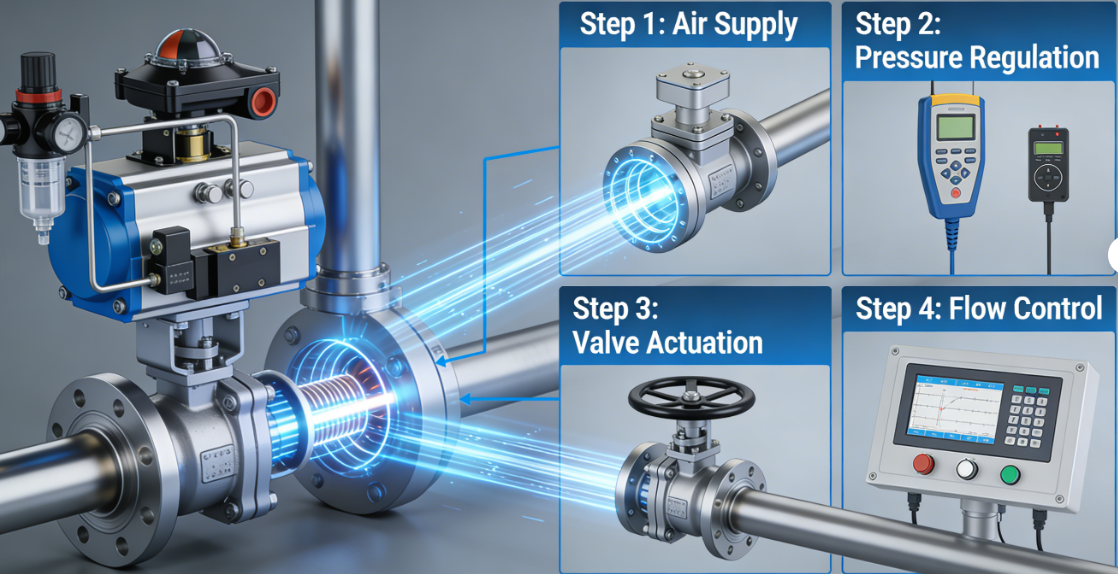
Instead of a simple on/off solenoid, modulating control requires a positioner.
The Positioner's Role:
-
Receive Signal: Positioner receives a control signal (typically 4-20 mA or 3-15 psi) from a PLC or controller.
-
Compare Position: Positioner compares the signal to the actual valve position (feedback from a linked mechanism).
-
Adjust Air: If there is a difference, the positioner sends more or less air pressure to the actuator to move the valve to the correct position.
-
Hold Position: Once the target position is reached, the positioner traps air in the actuator to hold the valve steady.
Modulating Control Loop:
Controller → Signal (4-20mA) → Positioner → Air Pressure → Actuator → Valve Position
                                             ↑                          |
                                             └───── Feedback ──────────┘
5. Key Components for Modulating Flow Control
A. Valve Positioner
The positioner is the brain of modulating control.
Types:
| Type | How It Works | Best For |
|---|---|---|
| Pneumatic Positioner | Uses air signal (3-15 psi) as input | Simple systems, hazardous areas |
| Electropneumatic Positioner | Uses electrical signal (4-20 mA), outputs air pressure | Modern PLC control, precise applications |
| Smart Positioner | Microprocessor-based, digital communication, self-calibration | Critical loops, IIoT integration, diagnostics |
Mounted on JAT-SR: Positioners mount directly to the JAT-SR actuator via Namur interface (VDI/VDE 3845).
B. Position Feedback
For modulating control, the controller must know the actual valve position.
Feedback Methods:
-
Mechanical Linkage: Connected to positioner.
-
Potentiometer: Variable resistance indicates position.
-
Hall Effect Sensor: Non-contact position sensing.
-
4-20 mA Feedback: Transmits position back to PLC.
C. I/P Converter (Current to Pressure)
Converts the electrical signal (4-20 mA) to a proportional air pressure (3-15 psi) that the pneumatic positioner understands.
D. Air Supply Quality
Modulating control demands clean, dry, regulated air. Contaminants cause:
-
Sticky positioners
-
Erratic valve movement
-
Worn components
6. Flow Control Characteristics
Not all valves respond linearly to actuator position. Understanding valve characteristics helps in selecting the right actuator and positioner setup.
Common Valve Characteristics:
| Characteristic | Flow vs. Stroke | Application |
|---|---|---|
| Linear | Flow proportional to valve position | Liquid flow control, general service |
| Equal Percentage | Small changes at low flow, large changes at high flow | Pressure control, temperature control |
| Quick Opening | Maximum flow with minimal stroke | On/off service, relief valves |
Actuator's Role:
The actuator must provide precise positioning regardless of the valve's characteristic. With a good positioner, the JAT-SR can accurately position any valve type.
7. Control Modes in Flow Systems
Pneumatic actuators with positioners participate in various control strategies.
A. PID Control (Proportional-Integral-Derivative)
The most common control algorithm:
-
Proportional: Responds to current error.
-
Integral: Corrects accumulated past error.
-
Derivative: Anticipates future error based on rate of change.
The controller sends a varying 4-20 mA signal to the positioner, which moves the JAT-SR actuator to the required position.
B. Cascade Control
Two controllers work together:
-
Primary controller (e.g., temperature) sets the setpoint for a secondary controller (e.g., flow).
-
Secondary controller positions the valve faster than the primary could alone.
C. Split-Range Control
One controller signal controls two or more valves:
-
4-12 mA: Valve A modulates 0-100%
-
12-20 mA: Valve B modulates 0-100%
Common in temperature control (heating vs. cooling) or pressure control (inlet vs. bypass).
8. KINKO JAT-SR for Flow Control Applications
On/Off Configuration (JAT-SR with Solenoid)
| Component | Specification |
|---|---|
| Actuator | JAT-SR Double Acting or Spring Return |
| Control | 3/2 or 5/2 solenoid valve |
| Speed Control | Flow control valves on air ports |
| Feedback | Mechanical limit switch box |
| Best For | Isolation, diverting, emergency shutdown |
Modulating Configuration (JAT-SR with Positioner)
| Component | Specification |
|---|---|
| Actuator | JAT-SR Double Acting (preferred) or Spring Return |
| Positioner | Electropneumatic or smart positioner |
| Input Signal | 4-20 mA (standard) |
| Feedback | 4-20 mA position feedback (optional) |
| Air Supply | Clean, dry, regulated (5-7 bar) |
| Best For | Flow control, pressure regulation, temperature control |
9. Applications Across Industries
Chemical Processing
-
Reactor feed control: Precise chemical addition.
-
pH control: Modulating acid/caustic valves.
-
Distillation: Reflux and product draw-off control.
Why JAT-SR: Corrosion-resistant options, precise positioning with smart positioners.
Water Treatment
-
Filter flow control: Maintaining constant flow through filters.
-
Chemical dosing: Coagulant, polymer, and chlorine addition.
-
Backwash sequencing: Automated filter cleaning cycles.
Why JAT-SR: Reliable operation in wet environments, cost-effective for large valve counts.
Oil & Gas
-
Wellhead flow control: Choking production.
-
Separator level control: Liquid outlet modulation.
-
Gas blending: Precise mixing of fuel gases.
Why JAT-SR: SIL-capable for safety loops, ATEX options for hazardous areas.
Power Generation
-
Boiler feedwater control: Maintaining drum level.
-
Fuel gas control: Modulating burner flow.
-
Cooling water regulation: Temperature control.
Why JAT-SR: Fast response, reliable in high-temperature environments.
HVAC
-
Hot water control: Modulating valves for space temperature.
-
Chilled water regulation: Cooling coil control.
-
Air handler mixing: Outside air dampers.
Why JAT-SR: Cost-effective for large building automation systems.
10. Advantages of Pneumatic Actuators in Flow Control
| Advantage | Why It Matters |
|---|---|
| Inherently Safe | No electrical sparks—ideal for hazardous areas |
| High Force | Handles high-pressure drops across valves |
| Fast Response | Milliseconds for on/off, seconds for modulating |
| Simple Construction | Easy to maintain and repair |
| Fail-Safe Options | Spring return provides safety without power |
| Cost-Effective | Lower installed cost than electric for large systems |
| Proven Technology | Decades of reliable service worldwide |
Key Takeaways:
-
JAT-SR rack-and-pinion design converts air pressure to rotary motion.
-
On/off control uses solenoid valves for simple isolation.
-
Modulating control requires positioners for precise valve positioning.
-
Applications span every industry that moves fluids.
-
Pneumatic actuation remains the preferred choice for hazardous areas and high-force requirements.
Ivan (Mobile:+86-18968769287)
WhatsApp:+86-13579991606
Wechat:+86-18968769287
Website:www.kinko-flow.com
ZHEJIANG KINKO FLUID EQUIPMENT CO.,LTD