High-Pressure Ball Valves: Selection and Usage Guide
What Defines a "High-Pressure" Ball Valve?
Industry thresholds vary by standard:
| Standard | High-Pressure Threshold | Typical Applications |
|---|---|---|
| ASME B16.34 | Class 900 and above (2,220 psi @ 100°F) | Power generation, refineries |
| API 6D | Class 600 and above (1,480 psi) | Pipeline transmission |
| API 6A | 5,000 psi – 20,000 psi | Wellhead, frac, subsea |
| ISO 9393 | PN 250 and above (3,625 psi) | Hydraulic systems, chemical injection |
For this guide, Kinko defines high-pressure as >1,500 psi (PN100) . Our high-pressure line extends to 20,000 psi API 6A.
5 Critical Selection Criteria for High-Pressure Ball Valves
Criterion 1: Pressure Class vs. Temperature De-rating
ASME B16.34 requires pressure de-rating as temperature increases. Never select a valve based on room-temperature pressure alone.
Example – Kinko Class 1500 Carbon Steel Valve:
| Temperature (°F) | Pressure (psi) | De-rating Factor |
|---|---|---|
| 100 | 3,705 | 1.00 (baseline) |
| 400 | 3,060 | 0.826 |
| 650 | 2,620 | 0.707 |
| 850 | 2,125 | 0.574 |
→ For 600°F steam at 2,800 psi, Class 1500 is insufficient. Select Class 2500.
Criterion 2: Body & Trim Material for High-Pressure Service
High pressure magnifies corrosion and erosion effects. Use this material selector:
| Media | Recommended Body | Recommended Ball & Stem | Max Pressure (psi) |
|---|---|---|---|
| Natural gas (dry) | Carbon steel (A105) | 13Cr stainless + ENP | 6,000 |
| Sour gas (H₂S) | Low-temp carbon steel (A350 LF2) | Inconel 625 cladding | 10,000 |
| Hydraulic oil | Carbon steel | Hard chrome plated (≥70 HRC) | 15,000 |
| Seawater injection | Duplex (F51) or Super Duplex (F55) | Duplex + tungsten carbide coating | 10,000 |
| Chemical (high-corrosion) | Hastelloy C276 | C276 | 6,000 |
| Sand-laden frac fluid | Precipitation hardened (17-4PH) | Tungsten carbide or ceramic | 20,000 |
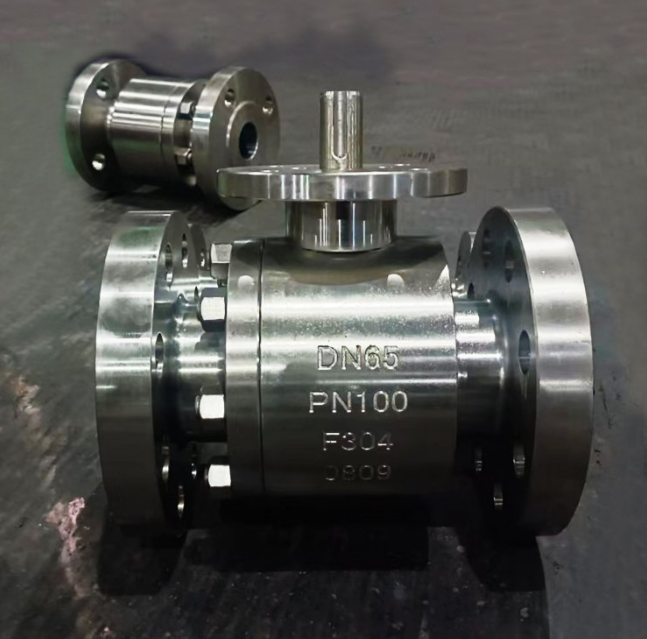
Criterion 3: Trunnion vs. Floating Design
| Feature | Floating Ball Valve | Trunnion Ball Valve |
|---|---|---|
| Ball support | Floats between seats | Fixed top & bottom bearings |
| Torque requirement | Higher (ball presses seats) | Lower (bearings absorb thrust) |
| Max pressure rating | Class 600 (≤1,480 psi) | Class 4500+ (≤7,500+ psi) |
| Seat design | Pressure-energized | Independent spring-energized |
| Recommended for >1,500 psi | ❌ No | ✅ Yes |
Kinko recommendation: Above 1,500 psi, specify trunnion ball valves only.
Criterion 4: Seat Material for High Differential Pressure
High pressure across a partially open seat causes rapid extrusion and failure.
| Seat Material | Max ΔP (psi) | Temperature Range | Best For |
|---|---|---|---|
| Virgin PTFE | 1,500 | -20°F to 400°F | Clean gas/liquid |
| 15% GF PTFE | 2,500 | -20°F to 450°F | Moderate cycling |
| PEEK (unfilled) | 5,000 | -100°F to 480°F | High-cycle, chemical |
| PEEK + 30% carbon | 7,500 | -100°F to 480°F | Abrasive media |
| Metal seat (316SS) | 10,000+ | -100°F to 1,200°F | High-temp, fire-safe |
| Tungsten carbide | 15,000+ | -300°F to 800°F | Extreme abrasion (sand, slurry) |
Criterion 5: End Connections for High-Pressure Integrity
Threaded or flanged? The wrong connection fails first.
| Connection Type | Max Pressure Rating | Recommended Use | Common Failure Mode |
|---|---|---|---|
| NPT threaded (1/4"–2") | 6,000 psi (schedule 160) | Low-cycle, small bore | Thread galling (stainless) |
| RTJ flange (Ring Type Joint) | 15,000 psi | All high-pressure gas | Gasket extrusion |
| Lapped flanges (metal-to-metal) | 20,000 psi | Subsea, critical service | Surface scratching |
| Grayloc / clamp connector | 20,000+ psi | Wellhead, frac iron | Hydrogen embrittlement |
| Welded ends | Full pipe rating | Permanent installations | Weld cracking (H₂S service) |
Kinko recommendation: For >10,000 psi, specify RTJ flanges with soft iron or stainless steel gaskets only. Never use spiral wound gaskets above Class 1500.
High-Pressure Ball Valve Usage Guide – Best Practices
Proper Installation for High-Pressure Systems
-
Verify direction arrow – High-pressure valves often have asymmetric seat designs. Reverse flow exceeds seat pressure capability.
-
Use concentric flange alignment pins – Misalignment creates bending stress on the valve body.
-
Torque flange bolts in 3 incremental passes – 30% → 70% → 100% of target torque.
-
Hydrotest at 1.5× working pressure – Hold for 15 minutes minimum. Record any pressure drop.
Operational Best Practices
| Practice | Why It Matters |
|---|---|
| Always open fully or close fully | Partially open high-pressure valves cause seat erosion and vibration (chatter) |
| Cycle slowly (≥10 seconds per 90°) | Prevents pressure surge (water hammer) and seat damage |
| Install bypass valves for ΔP > 2,000 psi | Reduces seat extrusion risk; equalizes pressure before main valve opens |
| Monitor stem torque daily | Sudden torque increase indicates seat or bearing failure |
High-Cycle Automation Considerations
If your high-pressure ball valve cycles >10 times per hour:
-
Actuator sizing: Add 30% safety margin for unknown pressure spikes
-
Stem bearings: Specify carbon-filled PTFE or bronze (not virgin PTFE)
-
Cycle counting: Install proximity switches for maintenance tracking
-
Lubrication: Apply high-pressure grease every 10,000 cycles (Kluber Syntheso GLEP 1)
Troubleshooting Common High-Pressure Valve Failures
| Symptom | Root Cause | Corrective Action |
|---|---|---|
| External leakage at stem | Packing extruded under high pressure | Replace with high-density PTFE + anti-extrusion rings |
| Cannot open (torque > spec) | High differential pressure across ball | Install equalizing bypass line |
| Seat leakage (bubble test fails) | Seat cold flowed under sustained pressure | Upgrade to PEEK or metal seats |
| Body weep at flange | Gasket crushed unevenly | Replace with RTJ gasket; re-torque in sequence |
| Ball surface scoring | Hard particles trapped during operation | Install upstream y-strainer (40 mesh minimum) |
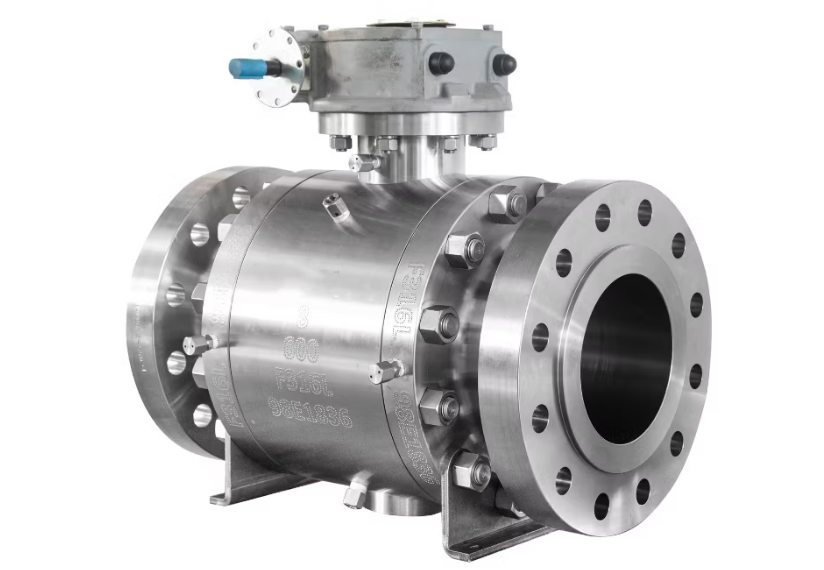
Kinko High-Pressure Ball Valve Series – Selection Table
| Series | Body Material | Pressure Rating | Design Type | Seat Standard | Connection Type | Max Temp | Bore Type |
|---|---|---|---|---|---|---|---|
| KINKO-HP600 | A105 Carbon Steel | Class 600 (1,480 psi) | Floating | PTFE / PEEK | RF flange / NPT | 400°F | Full or Reduced |
| KINKO-HP900 | F22 Alloy Steel | Class 900 (2,220 psi) | Trunnion | 15% GF PTFE | RTJ flange | 650°F | Reduced bore |
| KINKO-HP1500 | F316 Stainless | Class 1500 (3,705 psi) | Trunnion | PEEK + carbon | RTJ or welded | 480°F | Full bore (1–4") |
| KINKO-HP2500 | F51 Duplex | Class 2500 (6,170 psi) | Trunnion | Metal seat (316SS) | RTJ only | 800°F | Reduced bore |
| KINKO-API6A-5K | 17-4PH (H1150) | 5,000 psi (API 6A) | Trunnion | PEEK + tungsten | Flanged or clamp | 350°F | Full (≤2") |
| KINKO-API6A-10K | Inconel 718 | 10,000 psi (API 6A) | Trunnion | Tungsten carbide | Clamp connector | 450°F | Full (≤1.5") |
| KINKO-API6A-15K | F22 + Inconel clad | 15,000 psi | Trunnion | Metal + carbide | Threaded / clamp | 400°F | Reduced |
| KINKO-API6A-20K | Precipitation hardened | 20,000 psi | Trunnion | Custom ceramic | Grayloc / clamp | 300°F | Reduced (≤1") |
High-Pressure Valve Sizing Quick Reference
For quick estimation before detailed engineering:
| Nominal Size (inch) | Full Bore Area (in²) – Reduced 60% | Approx. Operating Torque @ 5,000 psi (lb·in) | Recommended Actuator (min) |
|---|---|---|---|
| 1/2" | 0.20 (0.12) | 450 | Double-acting pneumatic |
| 1" | 0.79 (0.47) | 1,200 | Double-acting or spring-return |
| 2" | 3.14 (1.88) | 3,500 | Hydraulic or high-torque pneumatic |
| 3" | 7.07 (4.24) | 8,000 | Hydraulic + manual override |
| 4" | 12.57 (7.54) | 15,000 | Hydraulic only (gear required) |
*Reduced bore assumes 60% of full bore area – typical for high-pressure trunnion valves.*
When to Specify a High-Pressure Ball Valve vs. Other Types
| Application | High-Pressure Ball Valve | Alternative | When to Choose Alternative |
|---|---|---|---|
| On/off isolation (clean media) | ✅ Best | Gate valve | If pressure drop irrelevant |
| Frequent cycling (10+ cycles/day) | ✅ Best | Butterfly valve | Only if <1,000 psi |
| Throttling / flow control | ❌ Poor | Globe or needle valve | Always for >30% open time |
| Slurry service (particles) | ⚠️ Special coating required | Knife gate or pinch valve | If particles >5% by volume |
| Extreme high-cycle (>100/day) | ✅ Trunnion with bearings | Ball valve only | No alternative |
Conclusion: Safety and Reliability Above All
High-pressure ball valve selection is not about price – it is about risk mitigation. A valve failure at 10,000 psi releases energy equivalent to a small explosion. Kinko designs every high-pressure valve with:
-
Finite Element Analysis (FEA) validated burst pressure (4× working pressure)
-
API 6A PR2 performance testing (including gas testing at full rated pressure)
-
Full material traceability (EN 10204 3.2 certification available)
-
Hydrostatic and gas seat testing before shipment
For your next high-pressure specification: Download Kinko's high-pressure valve sizing worksheet and torque calculation template. Contact our engineering team with your pressure, temperature, media, and cycle frequency – we provide stamped calculations within 24 hours.
Recommended internal resources (no links – search on site):
-
Kinko API 6A product catalog (5,000–20,000 psi)
-
Seat material pressure-temperature rating charts
-
Actuator sizing guide for high-pressure valves
-
Flange bolt torque specification sheet (Class 600–2500)
Ivan (Mobile:+86-18968769287)
WhatsApp:+86-13579991606
Wechat:+86-18968769287
Website:www.kinko-flow.com
ZHEJIANG KINKO FLUID EQUIPMENT CO.,LTD
