Can a Compact Pneumatic Control Valve Deliver Precise Modulating Control?
What Is Modulating Control?
Before evaluating performance, let's define what we mean by modulating control.
In a modulating control loop, the valve position is continuously adjusted to maintain a process variable—such as flow rate, pressure, temperature, or level—at a desired setpoint. The control system sends a varying signal (typically 4-20mA) to the valve, and the valve responds by positioning itself anywhere between fully open and fully closed.
Key requirements for precise modulation:
-
Accurate positioning (repeatability within ±0.5% or better)
-
Fast response to signal changes
-
Minimal hysteresis and deadband
-
Stable operation without oscillation
-
Consistent performance across varying process conditions
The Anatomy of a Compact Pneumatic Control Valve
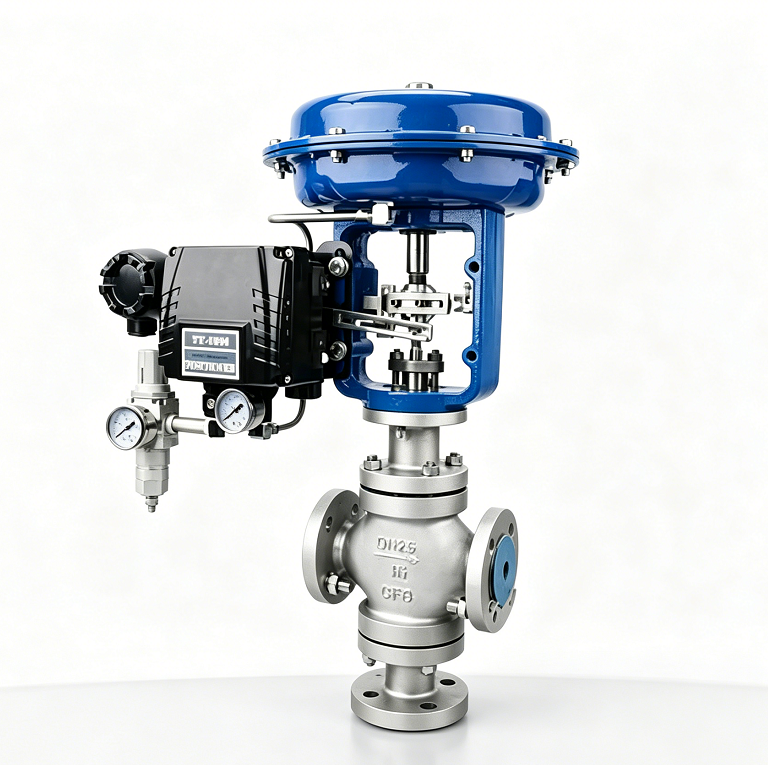
A control valve assembly consists of three primary components:
| Component | Function | Impact on Modulating Performance |
|---|---|---|
| Valve Body | Provides the flow path and seating interface. | Determines flow capacity (Cv) and characteristic curve. |
| Actuator | Provides the force to position the valve stem. | Must provide sufficient thrust with precise control. |
| Positioner | Receives the control signal and adjusts the actuator to achieve the correct valve position. | The most critical component for modulating accuracy. |
Compact designs achieve space savings through:
-
Smaller actuator footprints
-
Integrated positioner mounting
-
Streamlined body design
-
Reduced face-to-face dimensions
These space-saving measures must not compromise the performance of any of the three critical components.
Key Factors Influencing Modulating Precision
1. Positioner Performance
The positioner is the "brain" of the control valve. For precise modulation, the positioner must accurately translate the control signal into valve position.
Smart positioners offer significant advantages over analog positioners:
-
Auto-calibration: Automatically adjusts to actuator characteristics.
-
Low deadband: Responds to very small signal changes (as low as 0.1%).
-
High repeatability: Returns to the same position consistently.
-
Diagnostics: Monitors and reports performance issues.
-
Custom characterization: Allows adjustment of flow curve.
Selection tip: For modulating applications, a smart positioner is strongly recommended, even on compact assemblies. The improvement in accuracy and stability is well worth the investment.
2. Actuator Responsiveness
The actuator must move smoothly and quickly in response to positioner commands.
Key actuator attributes for modulating control:
| Attribute | Why It Matters |
|---|---|
| Low friction | Reduces stick-slip behavior, improving position accuracy. |
| High stiffness | Maintains position despite process forces acting on the valve. |
| Quick response | Moves to the new position without lag. |
| Accurate positioning | Stops precisely at the commanded position. |
Pneumatic actuators with rolling diaphragms or low-friction piston seals are preferred for modulating applications. Spring-return and double-acting configurations are both available, though double-acting actuators often offer faster response for modulating service.
3. Valve Flow Characteristics
The relationship between valve position and flow rate—the flow characteristic—is fundamental to modulating performance.
Inherent flow characteristics:
-
Linear: Flow increases proportionally with valve opening. Useful where pressure drop is constant.
-
Equal-percentage: Flow increases slowly at low openings and more rapidly at high openings. Preferred where pressure drop varies.
-
Quick-opening: Flow increases rapidly at low openings. Rarely used for modulating control.
Selection tip: The equal-percentage characteristic is the most common choice for modulating applications because it compensates for varying pressure drops in the system, providing stable control across the operating range.
4. Trim Design and Sealing
For accurate modulating control, the valve trim (plug, seat, and guide) must be designed for smooth, stable operation.
Important trim features:
-
Balanced design: Reduces the force required from the actuator, improving responsiveness.
-
Low-leakage sealing: Allows the valve to provide tight shut-off when fully closed.
-
Stable guiding: Prevents vibration and chatter at low flow rates.
5. System Integration
A control valve does not work in isolation. The entire loop—including controller, positioner, valve, and actuator—must work together harmoniously.
System factors affecting precision:
-
Control signal quality: Noise-free, stable 4-20mA signal.
-
Supply air quality: Clean, dry, regulated air at stable pressure.
-
Process stability: Fluctuating upstream pressure or flow affects performance.
-
Loop tuning: Properly tuned PID controllers prevent oscillation and overshoot.
Can Compact Valves Match Standard Valves in Performance?
| Performance Metric | Standard Control Valve | Compact Control Valve | Can Compact Match? |
|---|---|---|---|
| Accuracy (Positioning) | ±0.5% | ±0.5-1.0% | Yes, with smart positioner |
| Response Time | Fast | Slightly slower | May be acceptable |
| Hysteresis | Low | Low to moderate | Yes, with high-quality components |
| Thrust Capacity | Higher | Lower | May be limiting |
| Pressure Rating | Higher | Moderate | May be limiting |
| Maintenance Access | Easy | Moderate | Requires proper planning |
| Space Required | Large | Small | Significant advantage |
Verdict: Compact pneumatic control valves can deliver precise modulating control for the vast majority of applications. The key is selecting the right combination of valve body, actuator, and positioner, and ensuring the valve is properly sized for the application.
However, for extremely high-pressure, high-temperature, or severe service applications, traditional larger control valves may still be necessary.
Comparison: Valve Types for Modulating Control
| Valve Type | Modulating Performance | Compact Options | Typical Applications |
|---|---|---|---|
| Globe Valve | Excellent (best) | Limited | General process control |
| Angle Seat Valve | Good | Excellent (very compact) | Sterile, corrosive, high-flow |
| Butterfly Valve | Moderate to Good | Good | Large diameter, low-pressure |
| Ball Valve (V-port) | Moderate to Good | Good | Slurry, viscous media |
| Ball Valve (Standard) | Poor (not recommended) | Good | Not for modulating |
| Gate Valve | Not suitable | Not applicable | Isolation only |
Ivan (Mobile:+86-18968769287)
WhatsApp:+86-13579991606
Wechat:+86-18968769287
Website:www.kinko-flow.com
ZHEJIANG KINKO FLUID EQUIPMENT CO.,LTD
