Butterfly Valves with Pneumatic Actuators: Setup Guide for On/Off & Modulating Control
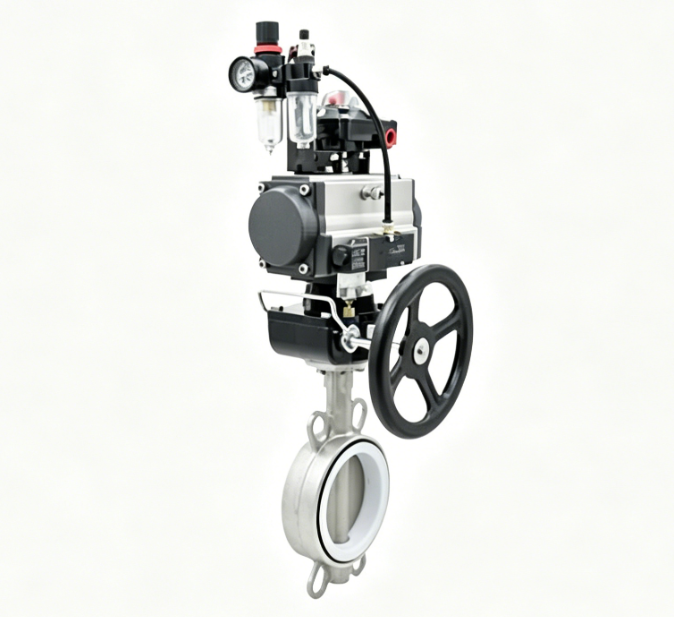
1. Component Overview
| Component | Typical Specification |
|---|---|
| Butterfly valve | Wafer/lug, DN50–DN600, EPDM/PTFE seat |
| Pneumatic actuator | Rack & pinion, double-acting or spring-return |
| Solenoid valve | 5/2 (DA) or 3/2 (SR), 24V DC / 110V AC |
| Limit switch box | 2x SPDT mechanical or proximity |
| Air regulator | 5μm filter, 0–8 bar |
2. Mechanical Mounting (5 Steps)
| Step | Action | Critical Check |
|---|---|---|
| 1 | Close valve disc (0°) | Parallel to flow |
| 2 | Set actuator to closed position | Match valve stroke |
| 3 | Slide actuator onto stem | No force required |
| 4 | Tighten bracket bolts | 10–25 Nm per size |
| 5 | Tighten coupler bolt | Use thread locker |
ISO 5211 mounting reference:
| Valve Size | ISO Pad | Drive square (mm) |
|---|---|---|
| DN50 | F05 | 11 |
| DN80–100 | F07 | 14 |
| DN150 | F10 | 17 |
| DN200 | F12 | 22 |
| DN300 | F14 | 27 |
3. Air Supply Requirements
| Parameter | Requirement |
|---|---|
| Pressure | 5.5–6.5 bar (80–95 psi) |
| Air quality | ISO 8573-1 Class 5 (dry, <40μm particles) |
| Tube ID (up to 5m) | 4mm (for <200 Nm) / 6mm (200–600 Nm) |
4. Solenoid Valve Wiring
| Actuator Type | Solenoid Function | Ports |
|---|---|---|
| Double-acting | 5/2 way, single coil | 1(air), 2&4(actuator), 3&5(exhaust) |
| Spring-return (fail closed) | 3/2 way, NC | 1(air), 2(actuator), 3(exhaust) |
Wiring (24V DC): Brown (+) → PLC output, Blue (–) → common. Add flyback diode.
5. Stroke Adjustment
| Position | Adjustment |
|---|---|
| Closed (0°) | Loosen closed stop lock nut. Turn screw: CW = less rotation, CCW = more |
| Open (90°) | Loosen open stop lock nut. Adjust for fully parallel disc |
Range: ±5° from nominal.
6. Speed Control
Install one-way flow control fittings on exhaust ports:
| Desired Effect | Fitting Location |
|---|---|
| Slow close | Close port exhaust |
| Slow open | Open port exhaust |
| Slow both | Both ports |
Starting point: 1/2 turn open from fully closed.
7. Limit Switch Setup
| Step | Action |
|---|---|
| 1 | Mount switch box on actuator top |
| 2 | Close valve → adjust cam 1 to trigger closed signal |
| 3 | Open valve → adjust cam 2 to trigger open signal |
| 4 | Cycle 3 times, verify PLC feedback |
8. Commissioning Checklist
-
Air supply at 5.5–6.5 bar, clean and dry
-
Solenoid voltage matches supply
-
Valve fully closes – no visible leakage
-
Valve fully opens – disc parallel to pipe axis
-
Stroke time adjusted (0.5–3 sec typical)
-
Limit switch feedback correct
-
No audible air leaks
-
(Spring-return) Fail-safe verified after air cut
9. Troubleshooting Table
| Problem | Likely Cause | Solution |
|---|---|---|
| Valve does not move | No air / low pressure | Supply 5.5 bar minimum |
| Moves too slowly | Flow restrictors closed | Open 1/2 turn |
| Chattering | Low solenoid voltage | Check voltage under load |
| Fails to close fully | Stop screw misadjusted | Adjust closed stop |
| Spring-return won't close | Broken spring | Replace actuator |
| Air leaks from exhaust | Worn solenoid spool | Clean or replace pilot |
10. Quick Maintenance Schedule
| Interval | Task |
|---|---|
| Monthly | Drain air filter bowl |
| Quarterly | Lubricate actuator (2–3 pumps lithium grease) |
| Annually | Replace filter element |
| 100k cycles | Rebuild actuator seals |
Ordering Specs (for Kinko Quote)
| Parameter | Your Spec |
|---|---|
| Valve size | DN____ |
| Seat material | EPDM / PTFE / Viton |
| Actuator type | Double-acting / Spring-return (fail closed/open) |
| Solenoid voltage | 24V DC / 110V AC / 220V AC |
| Feedback | Mechanical / Proximity (PNP/NPN) |
Need a pre-assembled package? Contact Kinko with the above specs – lead time 5–15 days, pressure-tested with wiring diagram included.
Ivan (Mobile:+86-18968769287)
WhatsApp:+86-13579991606
Wechat:+86-18968769287
Website:www.kinko-flow.com
ZHEJIANG KINKO FLUID EQUIPMENT CO.,LTD
