Butterfly Valves for High-Flow Industrial Applications
What Defines a High-Flow Butterfly Valve?
A high-flow butterfly valve is characterized by three key features:
-
Streamlined Disc Profile: A low-profile disc that presents minimal obstruction when fully open (ideally parallel to flow direction).
-
Full Bore (Wafer or Lug) Design: Unlike reduced-port valves, the internal diameter matches the pipeline ID with no abrupt contractions.
-
Low Pressure Drop: The valve's resistance coefficient (K-value) must be low enough to maintain system flow velocity without excessive pumping energy.
In practical terms, a well-designed butterfly valve in the fully open position has a pressure drop equivalent to a short section of straight pipe—typically 20-30% of the pressure drop of an equivalent gate or globe valve.
Key Advantages for High-Flow Systems
1. Superior Flow Coefficient (Cv) Values
Butterfly valves offer excellent Cv ratings relative to their physical size and cost. A Kinko DN200 butterfly valve can achieve Cv values exceeding 8,000, making it suitable for high-volume liquid and gas transfer where minimal restriction is critical.
2. Linear Flow Characteristics
Unlike ball valves (which offer quick-opening characteristics), butterfly valves provide near-linear flow response between 30° and 70° disc opening. This predictability is essential for modulating control in high-flow processes such as cooling water return lines or fan inlet dampers.
3. Low Pressure Drop at Full Open
When fully rotated to 90°, the disc edge aligns with the flow direction, creating a streamlined profile. The result is a pressure drop often below 0.2 bar at normal line velocities (2-4 m/s for liquids). For energy-intensive pumping systems, this translates to significant annual electricity savings.
4. Compact Face-to-Face Dimensions
Butterfly valves have the shortest face-to-face length of any quarter-turn valve family. For high-flow header systems where space is constrained (e.g., pump stations or skid-mounted equipment), this compactness allows denser piping layouts.
Critical High-Flow Applications for Butterfly Valves
| Application | Typical Line Size | Flow Velocity | Key Requirement |
|---|---|---|---|
| Cooling water intake (power plants) | DN400 - DN1200 | 2-3 m/s | Low pressure drop, corrosion resistance |
| Municipal water transmission | DN300 - DN2000 | 1.5-2.5 m/s | Bubble-tight shutoff, actuation ready |
| Pulp stock lines | DN150 - DN500 | 2-4 m/s | Abrasion resistance, full bore |
| Fan inlet / exhaust dampers | DN250 - DN1000 | 10-20 m/s (air) | Lightweight disc, low inertia |
| Firewater deluge systems | DN150 - DN300 | 4-6 m/s | Fast opening, high Cv |
| Chemical transfer (high volume) | DN200 - DN600 | 2-3 m/s | Chemical compatibility, PTFE seat |
How Disc Geometry Affects Flow
The disc is the primary flow influencer. Standard concentric butterfly valves use a symmetrical disc that creates slight flow turbulence even when fully open. For high-flow applications, consider these disc enhancements:
Offset Disc (Double Offset / High Performance)
-
Flow Advantage: The disc cams out of the seat upon opening, reducing seat interference and allowing a thinner disc profile.
-
Best For: High-cycle modulating service, elevated temperatures.
Streamlined (Low-Profile) Disc
-
Flow Advantage: Reduced frontal area and tapered edges minimize wake formation behind the disc.
-
Best For: Clean liquids and gases where Cv maximization is the priority.
Perforated or V-Notch Disc (for control)
-
Flow Advantage: Allows fine flow control at low openings while maintaining high capacity at full open.
-
Best For: Slurries and fibrous media (pulp, wastewater).
Body Configurations for High Flow
Kinko offers two primary body styles suitable for high-flow applications:
| Body Style | Flow Characteristic | Best Application |
|---|---|---|
| Wafer Type | Full bore, minimal pressure drop | Flanged between two pipe flanges. Ideal for general high-flow liquid and gas. |
| Lug Type | Full bore (slightly heavier disc due to threaded inserts) | End-of-line service or systems requiring isolation without downstream flange. |
| Double Flanged | Full bore, heaviest construction | Large diameters (DN600+) and high-pressure high-flow systems. |
Note: Wafer type offers the lowest pressure drop due to the absence of protruding lug bosses inside the flow path.
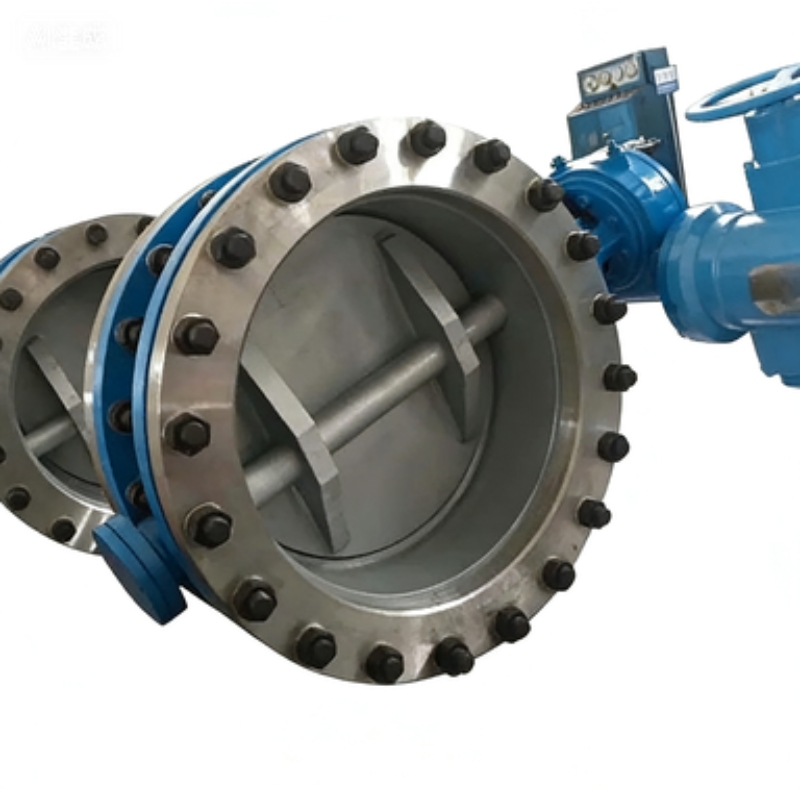
Flow Coefficient (Cv) Reference Table
Below are approximate Cv values for Kinko high-flow butterfly valves (wafer type, SS316 disc, fully open). These values are for water at 20°C with 1 bar differential pressure.
| Nominal Size (DN) | Nominal Size (inch) | Cv (US gallons/min) | Kv (m³/h) | Pressure Drop at 100 m³/h (bar) |
|---|---|---|---|---|
| DN50 | 2" | 120 | 104 | 0.92 |
| DN80 | 3" | 310 | 268 | 0.14 |
| DN100 | 4" | 550 | 475 | 0.04 |
| DN150 | 6" | 1,450 | 1,252 | 0.01 |
| DN200 | 8" | 2,800 | 2,418 | 0.003 |
| DN250 | 10" | 4,800 | 4,145 | 0.001 |
| DN300 | 12" | 7,200 | 6,218 | <0.001 |
| DN400 | 16" | 13,500 | 11,660 | <0.001 |
Cv and Kv values are theoretical maximums. Actual values depend on upstream piping, Reynolds number, and disc edge condition. Contact Kinko for certified flow curves.
Sizing Butterfly Valves for High Flow: Line Velocity Limits
Excessive flow velocity can cause cavitation, erosion, and disc flutter. Adhere to these maximum recommended velocities for Kinko butterfly valves:
| Media Type | Maximum Velocity (m/s) | Maximum Velocity (ft/s) |
|---|---|---|
| Clean water, oils, light chemicals | 5 m/s | 16 ft/s |
| Seawater, brackish water | 4 m/s | 13 ft/s |
| Air, gases (compressed) | 30 m/s | 98 ft/s |
| Steam (saturated) | 35 m/s | 115 ft/s |
| Slurries (non-abrasive) | 3 m/s | 10 ft/s |
| Abrasive slurries (sand, ore) | 2 m/s | 6.5 ft/s |
Exceeding these velocities may void warranty and requires reinforced disc edges or hardened materials.
Automation Considerations for High-Flow Valves
High-flow butterfly valves generate higher dynamic torque than standard service valves due to the fluid momentum acting on the disc face. When selecting an actuator:
-
Calculate Dynamic Torque: Use the formula
Td = C × ΔP × D³where C is a valve-specific coefficient (consult Kinko torque charts). -
Add Safety Margin: Kinko recommends 30% above calculated breakaway torque for high-flow applications.
-
Consider Fail-Safe Action: For firewater or emergency cooling lines, spring-return pneumatic actuators are preferred.
Kinko High-Flow Butterfly Valve Series Specifications
Our Kinko HF Series (High Flow) is designed specifically for applications prioritizing Cv and minimal pressure drop.
| Parameter | Kinko HF-100 (Wafer) | Kinko HF-200 (Lug) | Kinko HF-300 (Double Flanged) |
|---|---|---|---|
| Size Range | DN50 to DN600 (2" to 24") | DN50 to DN300 (2" to 12") | DN350 to DN1200 (14" to 48") |
| Max Pressure | 16 bar | 16 bar | 10 bar (DN>600) / 16 bar (DN350-600) |
| Disc Profile | Streamlined low-profile | Streamlined low-profile | Hydrodynamic airfoil design |
| Face-to-Face (ISO 5752) | Short series 20 | Short series 20 | Long series 13 |
| Standard Disc Material | Epoxy coated DI / SS316 | SS316 / Al-Bronze | SS316 / Duplex |
| Seat Material | EPDM / NBR / Viton | EPDM / PTFE | EPDM / PTFE |
| Top Flange | ISO 5211 (F05/F07/F10/F14) | ISO 5211 (F07/F10/F14) | ISO 5211 (F14/F16/F25) |
| Automation Ready | Yes (direct mount) | Yes (direct mount) | Yes (bracket or direct) |
Frequently Asked Questions (FAQ)
Q: Can a butterfly valve be used as a control valve in high-flow applications?
A: Yes. With a V-notch or characterized disc, butterfly valves offer excellent modulating control. However, for very precise control (<2% hysteresis), a high-performance double-offset butterfly valve is recommended.
Q: How does pressure drop compare between a butterfly valve and a gate valve at full open?
A: A gate valve has nearly zero pressure drop when fully open (the gate retracts completely). A butterfly valve has a small but measurable pressure drop due to the disc remaining in the flow path. However, for most industrial systems, the difference is <0.1 bar and economically negligible compared to the butterfly valve's cost and size advantages.
Q: Are butterfly valves suitable for vacuum service in high-flow lines?
A: Yes, but only lug or double-flanged designs. Wafer-type butterfly valves rely on flange compression and may leak under vacuum. Kinko lug-type valves are tested to 1 mbar absolute for vacuum service.
Q: What is the maximum flow rate for a DN300 Kinko butterfly valve?
A: At 3 m/s water velocity, a DN300 valve can flow approximately 760 m³/h (3,350 US GPM). At 5 m/s (max recommended for clean water), flow reaches 1,270 m³/h (5,600 US GPM). Contact Kinko for exact Cv-based calculations.
Ivan (Mobile:+86-18968769287)
WhatsApp:+86-13579991606
Wechat:+86-18968769287
Website:www.kinko-flow.com
ZHEJIANG KINKO FLUID EQUIPMENT CO.,LTD