Benefits of Angle Seat Valves in Steam and Gas Applications
Why Steam and Gas Are Challenging for Valves
| Challenge | Description |
|---|---|
| High temperature | Steam often exceeds 150°C; superheated steam reaches 200°C+ |
| Pressure spikes | Condensate hammer and rapid pressure changes stress components |
| Thermal cycling | Repeated heating and cooling causes seal and body fatigue |
| Leakage risk | Gas leaks are hazardous; steam leaks damage equipment and burn personnel |
| Fast flow velocity | Gas and steam can exceed 50 m/s, eroding seats and seals |
Angle seat valves address each of these challenges through their unique construction and materials.
What Makes Angle Seat Valves Suitable for Steam and Gas?
Angle seat valves combine three critical features:
-
Self-draining body design – Prevents condensate accumulation (critical for steam)
-
PTFE seat seals – Withstand high temperatures and provide tight shut-off
-
Pneumatic actuation with spring return – Provides fast, consistent closing independent of operator skill
The result is a valve that cycles millions of times on steam and gas without leakage or jamming.
Key Benefits of Angle Seat Valves for Steam Applications
Benefit 1: Self-Draining Design Prevents Condensate Hammer
Condensate hammer (water hammer in steam lines) occurs when trapped liquid condensate is accelerated by high-velocity steam, causing violent pressure spikes that can rupture pipes and valves.
Angle seat valves have a 45° or 90° angled body that allows condensate to drain naturally. There are no low pockets where water can collect.
| Valve Type | Condensate Trapping Risk |
|---|---|
| Angle seat valve | Low (self-draining) |
| Globe valve | High (horizontal body traps condensate) |
| Ball valve | Medium (cavity can trap liquid) |
Benefit 2: PTFE Seals Withstand High Steam Temperatures
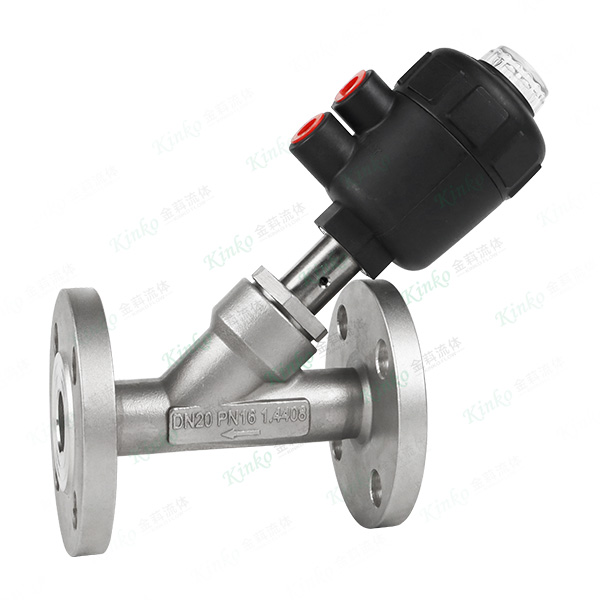
Standard angle seat valves use reinforced PTFE (polytetrafluoroethylene) for the main seat seal.
| Seal Material | Maximum Continuous Temperature | Suitable for Steam? |
|---|---|---|
| PTFE | 180°C (356°F) | Yes (saturated steam) |
| FKM (Viton) | 160°C (320°F) | Limited |
| EPDM | 120°C (248°F) | No |
| NBR | 90°C (194°F) | No |
Kinko angle seat valves with PTFE seals handle saturated steam up to 180°C. For superheated steam or higher temperatures, consult Kinko for special seal materials.
Benefit 3: Fast Cycling for Process Timing
Many steam applications require precise timing:
-
Steam injection into batch reactors
-
Sterilization cycles in autoclaves
-
Textile drying cylinders
-
Food processing kettles
Angle seat valves cycle in 0.1 to 1.0 seconds (depending on actuator size and air pressure). This repeatability allows automated process control without delay.
| Actuation Type | Typical Stroke Time (DN25) |
|---|---|
| Pneumatic angle seat (small actuator) | 0.2 – 0.4 seconds |
| Pneumatic angle seat (large actuator) | 0.5 – 1.0 seconds |
| Electric ball valve | 3 – 10 seconds |
| Solenoid valve (direct acting) | 0.05 – 0.1 seconds (but limited to small sizes) |
Benefit 4: Tight Shut-Off (Leakage Class VI)
Steam and gas applications demand minimal leakage. A leaking steam valve wastes energy and creates a safety hazard.
Angle seat valves achieve bubble-tight shut-off (ISO 5208 Rate A or FCI 70-2 Class VI) when new and maintained. The PTFE seal deforms slightly against the metal seat under spring pressure, creating a reliable seal even against high differential pressure.
| Leakage Standard | Maximum Allowable Leakage | Angle Seat Valve Typical Performance |
|---|---|---|
| ISO 5208 Rate A | Zero visible leakage | Meets |
| FCI 70-2 Class VI | 0.15 – 1.8 mL per minute (size dependent) | Meets |
| FCI 70-2 Class IV | 5 – 45 mL per minute | Exceeds |
Benefit 5: Long Cycle Life Reduces Maintenance Costs
Steam service is hard on seals. Thermal expansion, contraction, and high differential pressure cause wear.
Angle seat valves are designed for 1 to 3 million cycles before seat replacement is needed. The PTFE seal is self-lubricating and resists adhesion to the metal seat.
| Valve Type | Typical Cycle Life (Steam Service) |
|---|---|
| Angle seat valve (PTFE) | 500,000 – 2,000,000 cycles |
| Ball valve (PTFE seat) | 50,000 – 200,000 cycles |
| Globe valve (metal seat) | 20,000 – 100,000 cycles |
Key Benefits of Angle Seat Valves for Gas Applications
Benefit 1: High Flow Capacity (Cv) Reduces Pressure Drop
Gas systems require minimal pressure loss to maintain flow and reduce compressor energy.
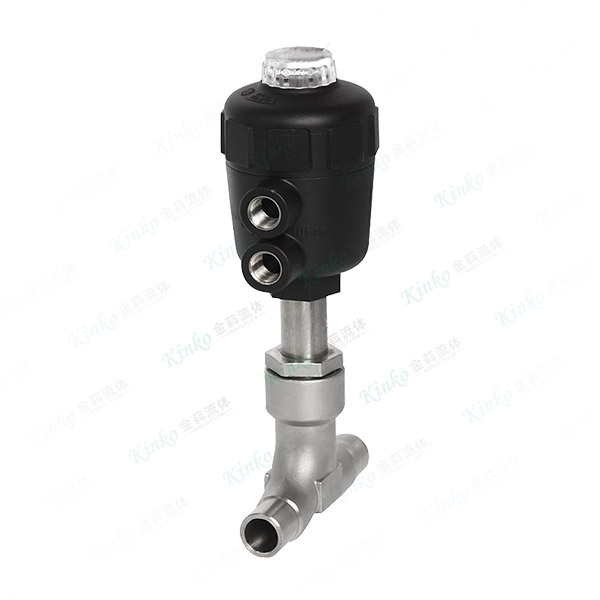
Angle seat valves offer 30–50% higher Cv than globe valves of the same pipe size. This means a smaller angle seat valve can often replace a larger globe valve.
| Valve Size (DN) | Angle Seat Valve Cv | Globe Valve Cv (Typical) | Ball Valve Cv (Full Port) |
|---|---|---|---|
| DN15 (1/2") | 4.0 – 5.5 | 2.0 – 3.0 | 8.0 – 12.0 |
| DN25 (1") | 11.0 – 14.0 | 5.0 – 7.0 | 25.0 – 35.0 |
| DN50 (2") | 40.0 – 48.0 | 18.0 – 25.0 | 90.0 – 120.0 |
Note: Ball valves have higher Cv but poor throttling and shorter cycle life.
Benefit 2: Fast Response for Safety and Control
Gas applications often require rapid shut-off for safety:
-
Burner gas supply
-
Ventilation dampers
-
Emergency isolation
Angle seat valves close in under 1 second when air is exhausted. The spring-return design ensures closure even if the pilot signal is lost.
Benefit 3: No External Leakage Paths
Gas leakage is dangerous (flammable, toxic, or asphyxiating). Angle seat valves use a dynamic PTFE stem seal that provides a reliable barrier between the process gas and the atmosphere.
The stem seal is live-loaded (constant spring pressure) to maintain sealing as the PTFE wears. This is superior to simple O-ring seals used in some solenoid valves.
Benefit 4: Suitable for Inert and Reactive Gases
Kinko angle seat valves are available with:
-
Stainless steel 316 bodies for corrosive gases (chlorine, ammonia, hydrogen sulfide)
-
EPDM or FKM seals for compatibility with specific gas chemistries
-
Clean-for-oxygen (O2) cleaning for oxygen service (special order)
Technical Specifications: Kinko Angle Seat Valves for Steam and Gas
| Parameter | Value / Range |
|---|---|
| Body material | Stainless steel 304, Stainless steel 316, Brass |
| Seat seal material | PTFE (standard for steam/gas), FKM, EPDM |
| Temperature range (PTFE) | -10°C to +180°C (14°F to 356°F) |
| Max operating pressure | 16 bar (232 PSI) for DN15–DN50; 10 bar for DN65–DN80 |
| Orifice sizes | DN15 to DN80 (1/2" to 3") |
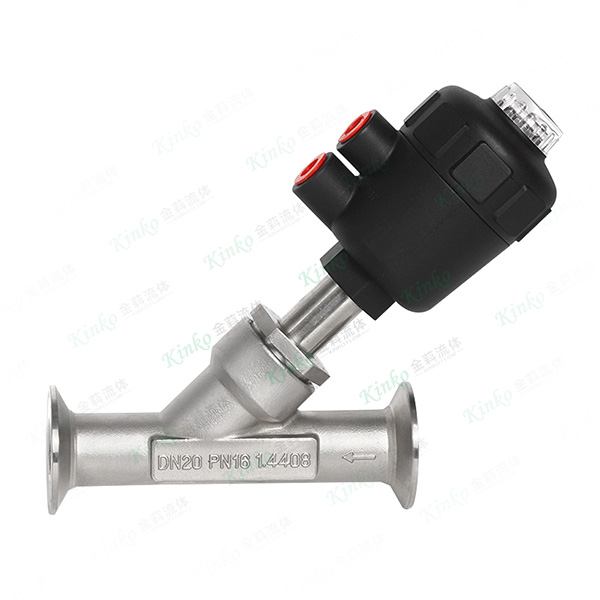
| End connections | Threaded (BSP, NPT), flanged, clamp (sanitary) |
| Actuation | Pneumatic normally closed (NC) – standard for steam/gas |
| Pilot air pressure | 4 – 8 bar (60 – 120 PSI) |
| Cycle time (DN25) | 0.2 – 0.6 seconds (open or close) |
| Leakage rating | ISO 5208 Rate A (zero visible leakage) |
| Cycle life (steam service) | 500,000 – 1,500,000 cycles typical |
Application Examples: Where Kinko Angle Seat Valves Excel
| Industry | Application | Media | Why Angle Seat Valve |
|---|---|---|---|
| Textile | Steam injection to drying cylinders | Saturated steam (8 bar, 170°C) | Fast cycling, self-draining |
| Food processing | Retort sterilization | Steam (120–130°C) | High cycle life, sanitary design |
| Pharmaceutical | Autoclave steam control | Pure steam (140°C) | Cleanable, no dead legs |
| Rubber curing | Mold steam supply | Saturated steam (10 bar) | Tight shut-off, fast response |
| Chemical | Gas blanketing | Nitrogen gas | Low pressure drop, bubble-tight |
| Power generation | Turbine seal steam | Superheated steam (180°C limit) | High temperature capability |
| HVAC | Steam humidification | Low-pressure steam | Self-draining prevents hammer |
| Industrial laundry | Steam to ironers | Saturated steam | Millions of cycles |
Comparison: Angle Seat vs. Alternative Valves for Steam and Gas
| Factor | Angle Seat Valve | Ball Valve | Globe Valve | Solenoid Valve |
|---|---|---|---|---|
| Steam temperature capability | 180°C (PTFE) | 180°C (PTFE) | 200°C+ (metal seat) | 130°C typical |
| Cycle life (steam) | 500k–2M | 50k–200k | 20k–100k | 100k–500k |
| Flow capacity (Cv) | High | Very high | Low | Medium (small sizes) |
| Self-draining | Yes | No | No | No |
| Fail-safe | Yes (spring return) | No (requires electric) | No | Yes (spring return available) |
| Max size | DN80 (3") | DN300+ | DN300+ | DN50 typical |
| Cost (relative) | Medium | Low-medium | Medium | Low (small) to high (large) |
| Best for | High-cycle steam/gas on/off | General isolation | Throttling | Small, low-power applications |
Installation Tips for Steam and Gas Service
To maximize angle seat valve life in steam and gas applications, follow these Kinko guidelines:
| Recommendation | Reason |
|---|---|
| Install with actuator between 0° and 90° (not pointing down) | Prevents condensate entering actuator |
| Allow warm-up time before full steam flow (5–10 minutes) | Reduces thermal shock to PTFE seal |
| Use a strainer upstream (40 mesh or finer) | Prevents debris from damaging seat |
| Install a steam trap before the valve if piping has low points | Removes condensate before it reaches valve |
| For gas, ensure piping is dry and clean | Moisture or debris causes seal wear |
| Use a flow control silencer on actuator exhaust | Slows closing speed, reduces water hammer |
| Do not use for throttling (partial opening) | Causes seal vibration and premature failure |
Why Kinko for Steam and Gas Angle Seat Valves?
Kinko angle seat valves are engineered specifically for demanding thermal and pressure cycling applications.
Key advantages:
-
PTFE seats tested to 180°C continuous steam
-
Stainless steel stems with double PTFE guides
-
Live-loaded stem seal for zero external leakage
-
ISO 5211 actuator mounting for easy replacement
-
Every valve pressure-tested before shipment
Ivan (Mobile:+86-18968769287)
WhatsApp:+86-13579991606
Wechat:+86-18968769287
Website: www.kinko-flow.com
ZHEJIANG KINKO FLUID EQUIPMENT CO.,LTD
