Why Use an Angle Seat Piston Valve for Steam and Hot Water?
1. Short Answer: The Optimal Choice for High-Temp On/Off Control
An angle seat piston valve (also called a "piston valve" or "angle seat valve") is the preferred solution for steam and hot water on/off control due to:
-
Self-draining angled body (no condensate pooling)
-
High flow capacity (Cv) with minimal pressure drop
-
Robust piston actuator (not diaphragm) – withstands high temperatures and frequent cycling
-
Long seat life – self-lapping, self-cleaning design
Result: Reliable, tight shut-off even with thermal expansion, condensate, and scale deposits.
2. 5 Key Advantages for Steam & Hot Water
| Advantage | Why It Matters |
|---|---|
| 1. Self-draining body (45°/90° angle) | Prevents condensate stagnation and water hammer; critical for steam lines |
| 2. High Cv / low pressure drop | Angled seat offers near-linear flow path – reduces pumping/boiler energy |
| 3. Piston actuator (not diaphragm) | Withstands >180°C without diaphragm fatigue; longer cycle life |
| 4. Self-lapping, self-cleaning seat | Linear lifting motion shears through scale and deposits – reduces maintenance |
| 5. High-temperature seat options | PTFE (200°C), PEEK (260°C), or metal seat (400°C) – cover all steam ranges |
3. Why Piston Actuator Over Diaphragm?
| Feature | Piston Actuator | Diaphragm Actuator |
|---|---|---|
| Max. temperature | Up to 400°C (with metal seat) | Limited to ~100°C (elastomer degrades) |
| Cycle life | >1,000,000 cycles (metal-to-metal seals) | 200,000~500,000 cycles (diaphragm fatigue) |
| Response speed | Fast (<1 second) | Fast |
| Maintenance | Replace piston seals (rarely) | Replace diaphragm (frequent at high temp) |
| Suitable for steam | Yes | No (diaphragm softens at >100°C) |
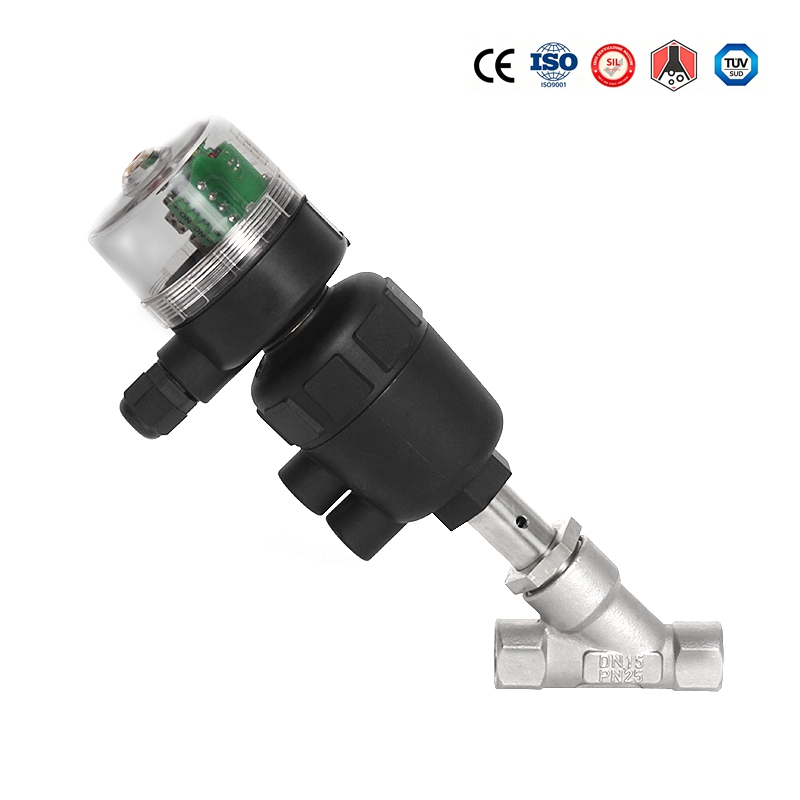
4. Key Technical Specifications
| Parameter | Recommended Option |
|---|---|
| Valve design | Angle seat (45° or 90°) – self-draining |
| Body material | CF8M (316SS) – standard for steam / CF3M (316L) – for corrosive |
| Seat material | PTFE (≤200°C) / PEEK (≤260°C) / Metal (≤400°C) |
| Piston actuator | Pneumatic (single-acting spring-return or double-acting) |
| Actuator supply | 4~8 bar instrument air |
| Size range | DN15 ~ DN100 (1/2" ~ 4") |
| Pressure rating | PN16 / PN25 / PN40 / ANSI 150 / 300 |
| End connections | Threaded (NPT/BSPP) / Flanged (ANSI/PN) / Tri-clamp (sanitary) |
| Flow direction | Under seat (closing direction) – extends seat life |
| Shut-off class | Bubble-tight (Class VI) with PTFE/PEEK; Metal-seat: Class IV |
5. Typical Applications
| Industry | Application | Why Angle Seat Wins |
|---|---|---|
| Steam generation | Boiler blowdown / drain lines | Self-draining; handles condensate + scale |
| Food processing | Sterilization (CIP/SIP) | 316L body + self-draining; meets sanitary standards |
| Pharmaceutical | Pure steam distribution | High-purity 316L + electropolished; no dead legs |
| Chemical | Reactor steam jacket control | PEEK/metal seat for high-temp aggressive media |
| HVAC | Steam-to-water heat exchangers | Fast response + tight shut-off |
| Laundry / Textile | Steam ironing lines | High cycle life for frequent on/off |
6. Comparison: Angle Seat vs. Ball Valve vs. Globe Valve for Steam
| Feature | Angle Seat Piston Valve | Ball Valve | Globe Valve |
|---|---|---|---|
| Flow capacity (Cv) | High | Highest | Low (restrictive) |
| Pressure drop | Low | Lowest | High |
| Self-draining | Yes (angled body) | No (pockets) | No |
| Suitable for condensate | Excellent | Moderate (pocket issues) | Moderate |
| Seat wear resistance | Excellent (self-lapping) | Good | Good |
| Maintenance | Low (seat & seals) | Low | Medium |
| Relative cost (DN50) | Medium | Medium | Low (manual) / High (automated) |
| Best for | Steam, hot water, condensate | General on/off | Throttling |
7. Installation Best Practices
-
Flow direction: Install with flow under the seat (arrow on body) – this uses line pressure to assist sealing and extends seat life.
-
Pitch: Install with valve body sloping slightly downward toward the outlet – aids condensate drainage.
-
Piping support: Support piping to avoid stress on the valve body – thermal expansion can distort alignment.
-
Actuator orientation: Actuator can be rotated 360°; ensure clearance for maintenance.
-
Steam trap: Install a steam trap upstream if there is a long condensate-filled header – prevents water hammer.
8. Common Failure Modes & Prevention
| Failure | Root Cause | Prevention |
|---|---|---|
| Seat leakage (PTFE) | Thermal degradation >200°C | Upgrade to PEEK or metal seat |
| Water hammer | Condensate accumulation + fast opening | Install steam trap; use slower actuation |
| Piston seal failure | High-temp steam >150°C | Use high-temp piston seals (e.g., PTFE-impregnated) |
| Threaded connection leak | Thermal cycling loosens fittings | Use appropriate thread sealant; retorque after first heat cycle |
Ivan (Mobile:+86-18968769287)
WhatsApp:+86-13579991606
Wechat:+86-18968769287
Website: www.kinko-flow.com
ZHEJIANG KINKO FLUID EQUIPMENT CO.,LTD
