Why Angle Seat Valves Are Ideal for Fast-Cycling Systems
What Is a Fast-Cycling System?
A fast-cycling system is any process where a valve opens and closes frequently—often multiple times per minute.
| Application | Typical Cycle Rate | Daily Cycles |
|---|---|---|
| Packaging filling machine | 30–60 cycles per minute | 20,000–50,000 |
| Textile drying cylinder | 10–30 cycles per minute | 10,000–20,000 |
| Sterilization autoclave | 5–15 cycles per minute | 5,000–10,000 |
| Injection molding cooling | 20–40 cycles per minute | 15,000–30,000 |
| CIP (clean-in-place) system | 5–10 cycles per minute | 3,000–5,000 |
At 30 cycles per minute, a valve operates 1,800 times per hour. Over a year, that exceeds 5 million cycles.
Why Angle Seat Valves Excel in Fast-Cycling Systems
| Advantage | Why It Matters |
|---|---|
| Short stroke length | Faster open/close times (0.1–0.5 seconds) |
| Pneumatic actuation | No motor to start/stop; immediate response |
| PTFE seat seals | Low friction, self-lubricating, millions of cycles |
| Simple design | Few moving parts; less to fail |
| Spring-return available | Consistent closing speed every cycle |
| No heat buildup | Air-powered actuators don't overheat like electric motors |
Speed Comparison: Angle Seat vs. Other Valve Types
| Valve Type | Typical Open/Close Time | Maximum Cycles per Minute |
|---|---|---|
| Angle seat valve (pneumatic) | 0.1 – 0.5 seconds | 60 – 120 |
| Ball valve (pneumatic) | 0.5 – 2.0 seconds | 30 – 60 |
| Ball valve (electric) | 3 – 10 seconds | 6 – 20 |
| Globe valve (pneumatic) | 1 – 3 seconds | 20 – 40 |
| Solenoid valve (direct acting) | 0.02 – 0.1 seconds | 300+ (but limited to small sizes) |
Note: Solenoid valves are faster but limited to small orifice sizes (typically under DN25) and lower pressure ratings.
Cycle Life Comparison
| Valve Type | Typical Cycle Life (Millions) | Best For |
|---|---|---|
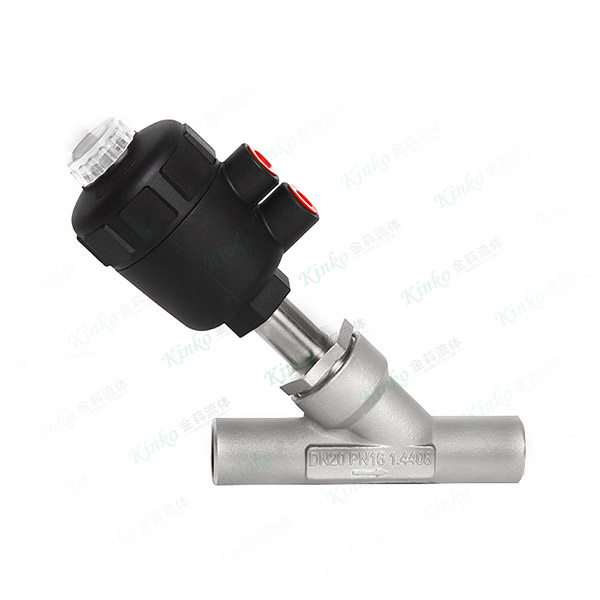
| Angle seat valve (PTFE seat) | 2 – 5 | High-cycle on/off |
| Ball valve (PTFE seat) | 0.2 – 0.5 | Moderate cycle, general isolation |
| Ball valve (metal seat) | 0.5 – 1.0 | High temperature, moderate cycle |
| Globe valve (PTFE seat) | 0.1 – 0.3 | Throttling, not high cycle |
| Solenoid valve (pilot operated) | 0.5 – 1.5 | Small lines, high cycle |
Kinko note: Angle seat valves regularly achieve 3–5 million cycles in clean steam, air, and water service with proper maintenance.
Key Design Features for Fast Cycling
Feature 1: Short Stroke
| Valve Size (DN) | Stroke Length (mm) | Typical Cycle Time |
|---|---|---|
| DN15 | 6 – 8 | 0.1 – 0.2 seconds |
| DN25 | 8 – 10 | 0.2 – 0.3 seconds |
| DN40 | 10 – 12 | 0.3 – 0.4 seconds |
| DN50 | 12 – 15 | 0.4 – 0.6 seconds |
Short stroke means less distance for the piston to travel = faster cycling.
Feature 2: Low Moving Mass
| Component | Mass (DN25 typical) |
|---|---|
| Piston and stem assembly | 50 – 100 grams |
| PTFE seat seal | 2 – 5 grams |
Low mass reduces inertia, allowing rapid acceleration and deceleration.
Feature 3: Direct Pneumatic Actuation
No electric motor to spin up or brake. Air pressure provides immediate force.
| Actuation Type | Response Delay |
|---|---|
| Pneumatic (angle seat) | 10 – 50 milliseconds |
| Electric (ball valve) | 200 – 500 milliseconds |
Actuator Selection for Fast Cycling
| Parameter | Standard Actuator | Fast-Cycling Actuator |
|---|---|---|
| Piston seal material | NBR or PU | High-wear PU or PTFE |
| Bearing material | Plastic | Bronze or PTFE-lined |
| Spring material (NC/NO) | Carbon steel | Stainless steel (fatigue resistant) |
| Air consumption | Standard | Low (smaller internal volumes) |
| Recommended cycle rate | Up to 30/min | Up to 120/min |
Kinko recommendation: For applications exceeding 30 cycles per minute, specify a fast-cycling actuator with upgraded seals and bearings.
Solenoid Valve Selection for Fast Cycling
The solenoid valve must keep pace with the actuator.
| Solenoid Feature | Why It Matters |
|---|---|
| High flow (Cv) | Fills actuator quickly for fast opening |
| Large exhaust port | Releases air quickly for fast closing |
| Direct mount (NAMUR) | Eliminates tubing; reduces volume and restriction |
| 5/2 way for double-acting | Allows fast operation in both directions |
| High cycle coil | Rated for continuous operation without overheating |
| Solenoid Type | Maximum Cycles per Minute |
|---|---|
| Standard solenoid | 30 – 60 |
| High-cycle solenoid | 120 – 300 |
| High-speed solenoid (special) | 300+ |
Kinko note: For very high cycle rates (over 60/min), use a solenoid valve specifically rated for high-frequency operation.
Flow Control Silencers for Fast Cycling
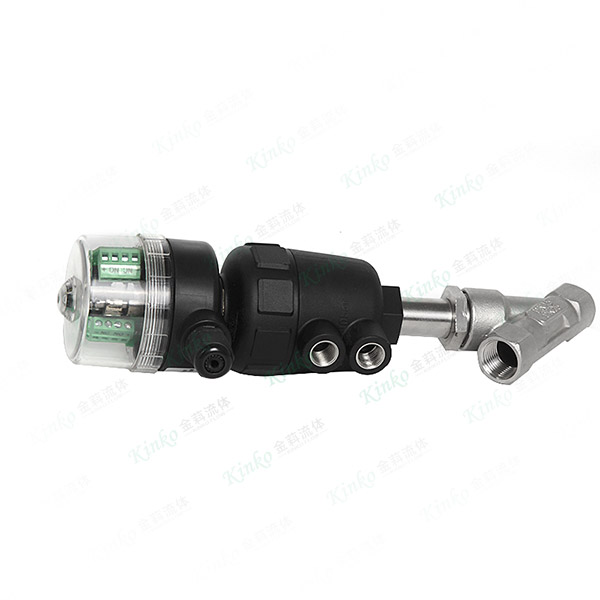
Flow control silencers adjust closing speed. For fast cycling, you want fast but controlled.
| Setting | Closing Time | Pros | Cons |
|---|---|---|---|
| Fully open | 0.05 – 0.1 seconds | Fastest cycle rate | High risk of water hammer |
| Partially open | 0.2 – 0.5 seconds | Good speed, moderate hammer | Slightly slower |
| Nearly closed | 1 – 3 seconds | No water hammer | Too slow for fast cycling |
For fast-cycling systems: Set flow control to achieve 0.2–0.5 second closing time. Test for water hammer. Adjust as needed.
Double-Acting vs. Spring-Return for Fast Cycling
| Actuation Type | How It Works | Cycle Speed | Air Consumption |
|---|---|---|---|
| Spring-return (NC/NO) | Air opens; spring closes | Fast open; slower close (spring limited) | Low (air used only one way) |
| Double-acting (DA) | Air opens; air closes | Fast both ways | High (air used both ways) |
| Application | Recommended Actuation |
|---|---|
| Fast open, any closing speed | Spring-return (NC) |
| Fast open AND fast close | Double-acting |
| Very high cycle rate (>60/min) | Double-acting |
| Fail-safe required | Spring-return |
Technical Specifications: Kinko Fast-Cycling Angle Seat Valves
| Parameter | Standard | High-Cycle Option |
|---|---|---|
| Maximum cycles per minute | 30 – 60 | 60 – 120 |
| Cycle life expectancy | 2 million | 3 – 5 million |
| Stroke time (open) | 0.2 – 0.5 seconds | 0.1 – 0.3 seconds |
| Stroke time (close) | 0.3 – 0.8 seconds (spring) | 0.1 – 0.3 seconds (DA) |
| Actuator seal material | NBR | PU or PTFE |
| Solenoid valve | Standard (30-60 cpm) | High-cycle (120+ cpm) |
| Recommended air pressure | 5 – 6 bar | 6 – 8 bar |
| Temperature range | -10°C to +180°C | Same |
Application Examples
| Application | Cycle Rate | Recommended Configuration |
|---|---|---|
| Beverage filling machine | 60–80 cpm | DN15, DA actuation, high-cycle solenoid |
| Textile drying cylinder | 20–30 cpm | DN25, NC actuation, standard solenoid |
| Sterilizer (autoclave) | 10–15 cpm | DN40, NC actuation, flow control silencer |
| Injection mold cooling | 30–50 cpm | DN20, DA actuation, stainless steel actuator |
| Parts washer | 15–25 cpm | DN25, NC actuation, epoxy-coated actuator |
| Packaging air jet | 80–120 cpm | DN15, DA actuation, high-cycle solenoid, 8 bar air |
Installation Tips for Fast-Cycling Systems
| Recommendation | Reason |
|---|---|
| Mount actuator vertically | Reduces side load on stem; faster operation |
| Use large diameter air tubing (8mm or 10mm OD) | Provides high flow for fast cylinder filling |
| Keep tubing short (under 3 meters) | Reduces pressure drop and delay |
| Install solenoid as close to actuator as possible | Direct NAMUR mount is best |
| Use regulated air pressure at 6–8 bar | Higher pressure = faster response |
| Install check valve on exhaust (if needed) | Prevents backflow from fast-cycling lines |
| Use high-cycle rated solenoid | Standard solenoids overheat at high cycle rates |
Maintenance for Fast-Cycling Valves
High cycle rates accelerate wear. Adjust maintenance intervals accordingly.
| Component | Standard Interval | Fast-Cycling Interval (60+ cpm) |
|---|---|---|
| PTFE seat seal | 2 million cycles | 1 – 1.5 million cycles |
| Stem seals | 2 million cycles | 1 – 1.5 million cycles |
| Actuator piston seal | 2 million cycles | 1 million cycles |
| Spring (NC/NO) | 3 million cycles | 1.5 – 2 million cycles |
| Solenoid valve | 3 million cycles | 1 – 2 million cycles |
| Air filter element | 6 months | 3 months |
Signs of Wear in Fast-Cycling Systems
| Sign | What It Means |
|---|---|
| Cycle time slowing | Actuator seals worn or low air pressure |
| Valve fails to open fully | Low air pressure or worn piston seal |
| Seat leakage | PTFE seat worn |
| Solenoid coil hot | Overheating from high cycle rate (upgrade coil) |
| Unusual noise | Worn bearings or loose components |
Common Problems and Solutions
| Problem | Likely Cause | Solution |
|---|---|---|
| Valve cannot keep up with cycle demand | Solenoid too slow | Upgrade to high-cycle solenoid |
| Actuator overheats (fast DA cycling) | Friction | Use PTFE piston seal; lubricate air |
| Seat wears out too quickly | High closing speed | Add flow control to slow closing slightly |
| Spring breaks | Fatigue from high cycles | Replace preventively every 1.5M cycles |
| Water hammer | Closing too fast | Adjust flow control silencer |
Why Kinko for Fast-Cycling Angle Seat Valves?
Kinko angle seat valves are engineered for high-cycle applications:
-
PTFE seats tested to 3+ million cycles
-
Fast-cycle actuators with upgraded seals and bearings
-
High-cycle solenoid valves rated for 120+ cycles per minute
-
NAMUR direct mounting for minimal air volume
-
Stainless steel springs for fatigue resistance
Conclusion
Angle seat valves are ideal for fast-cycling systems because:
| Requirement | Angle Seat Valve Advantage |
|---|---|
| Speed | 0.1 – 0.5 second cycle times |
| Cycle life | 2 – 5 million cycles |
| Reliability | Simple design, few moving parts |
| Heat tolerance | No electric motor to overheat |
| Fail-safe | Spring-return available |
| Size range | DN15 to DN80 |
For packaging, filling, textile, sterilization, and any high-cycle automated process, Kinko angle seat valves deliver reliable, fast performance.
Need a valve for a fast-cycling application? Contact Kinko with your cycle rate, media, and size requirements. We will recommend the optimal actuator, solenoid, and seal configuration.
FAQ: Angle Seat Valves for Fast-Cycling Systems
Q: How fast can an angle seat valve cycle?
A: Up to 120 cycles per minute with double-acting actuation and high-cycle solenoid. For very short stroke valves (DN15), 150+ cycles per minute is possible.
Q: What is the typical cycle life of an angle seat valve?
A: 2–3 million cycles for standard configurations. With high-cycle options and proper maintenance, 5 million cycles is achievable.
Q: Do I need a special solenoid for fast cycling?
A: Yes, for cycle rates above 60 per minute. Standard solenoids overheat and fail under continuous high-frequency operation.
Q: Is double-acting or spring-return better for fast cycling?
A: Double-acting is faster in both directions. Spring-return is slower on the closing stroke but uses less air and provides fail-safe.
Ivan (Mobile:+86-18968769287)
WhatsApp:+86-13579991606
Wechat:+86-18968769287
Website: www.kinko-flow.com
ZHEJIANG KINKO FLUID EQUIPMENT CO.,LTD
