How Pressure Affects the Performance of Angle Seat Valves
1. Two Different Pressures to Understand
| Pressure Type | Definition | Affects |
|---|---|---|
| Media pressure | Pressure of the fluid (liquid, gas, steam) flowing through the valve | Seal life, shut‑off capability, body strength |
| Control pressure | Pressure of compressed air supplied to the actuator | Opening/closing speed, actuation reliability |
Both matter. Confusing them is a common mistake.
2. Media Pressure – Maximum Ratings
Kinko angle seat valves have different maximum media pressures depending on size and configuration.
| Valve Size | Max Media Pressure (standard) | Max Media Pressure (steam) |
|---|---|---|
| DN10 – DN25 (3/8″ – 1″) | 16 bar (232 psi) | 16 bar (232 psi) |
| DN32 – DN40 (1‑1/4″ – 1‑1/2″) | 16 bar (232 psi) | 10 bar (145 psi) |
| DN50 (2″) | 16 bar (232 psi) | 10 bar (145 psi) |
| DN65 (2‑1/2″) | 10 bar (145 psi) | 6 bar (87 psi) |
Important: Higher pressure reduces seal life. For continuous operation near max pressure, expect shorter maintenance intervals.
3. How Media Pressure Affects Valve Operation
| Pressure Level | Effect on Valve | Risk |
|---|---|---|
| Very low (<0.5 bar) | May not seal fully (PTFE needs some pressure to deform) | Leakage |
| Normal range (1–10 bar) | Optimal sealing, stable cycle time | Minimal |
| High (10–16 bar) | Faster opening (pressure assists), but higher seal wear | Reduced seal life |
| Excessive (>16 bar) | Body strain, seal extrusion, actuator may not open | Catastrophic failure |
Pressure‑Assisted Sealing
Angle seat valves use the media pressure to help seal:
-
NC type (flow above seat): Media pressure pushes seal closed — good for high pressure
-
NO type (flow below seat): Media pressure pushes seal open — requires stronger spring
Kinko recommendation: For high‑pressure applications (over 10 bar), use NC type with flow above seat.
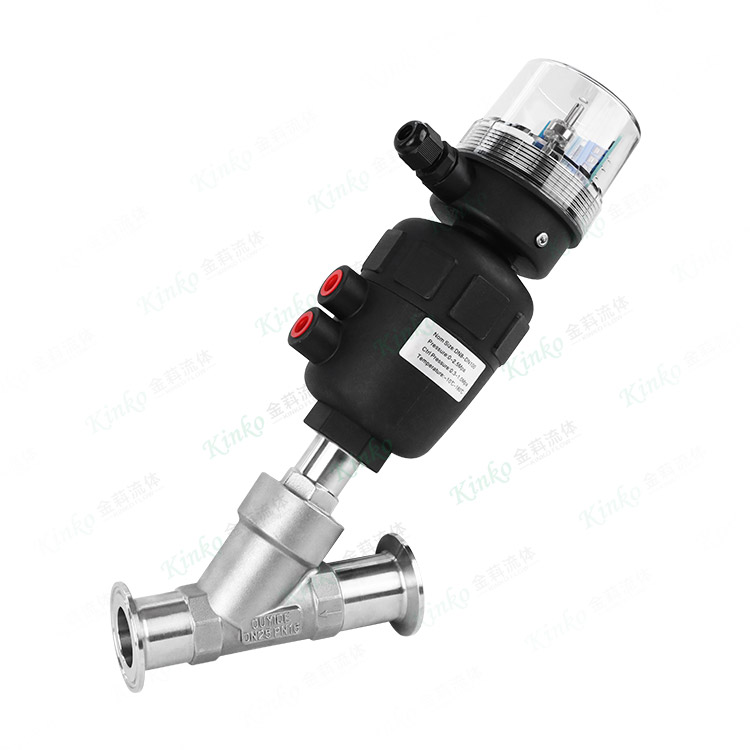
4. Control Pressure – Minimum and Maximum
The pneumatic actuator requires a specific control air pressure range.
| Parameter | Kinko Standard |
|---|---|
| Minimum control pressure | 4 bar (60 psi) |
| Recommended control pressure | 5 – 8 bar (75 – 120 psi) |
| Maximum control pressure | 10 bar (145 psi) |
Effects of Incorrect Control Pressure
| Control Pressure | Effect |
|---|---|
| Below 4 bar | Valve may not fully open or close — stuck mid‑travel |
| 4 – 5 bar | Opens slowly, may flutter |
| 5 – 8 bar | Optimal speed, full stroke |
| 8 – 10 bar | Faster, but increased seal wear |
| Above 10 bar | Risk of actuator damage, piston seal failure |
5. Relationship Between Media Pressure and Control Pressure
The actuator must generate enough force to overcome:
-
Spring force (to open NC or close NO)
-
Media pressure force (acting on the valve seat)
For NC valve (spring holds closed, air opens):
| Media Pressure | Control Pressure Needed |
|---|---|
| 0 – 5 bar | 4 – 5 bar |
| 5 – 10 bar | 5 – 6 bar |
| 10 – 16 bar | 6 – 8 bar |
Rule: Higher media pressure requires higher control pressure to open the valve.
For NO valve (spring holds open, air closes):
| Media Pressure | Control Pressure Needed |
|---|---|
| 0 – 5 bar | 4 – 5 bar |
| 5 – 10 bar | 5 – 7 bar |
| 10 – 16 bar | 7 – 9 bar |
Note: NO valves require more control pressure to close against high media pressure.
6. Pressure Drop – Why It Matters
Pressure drop is the difference between inlet and outlet pressure when the valve is open.
| Pressure Drop | Effect |
|---|---|
| Low (<0.5 bar) | Efficient system, low energy cost |
| Moderate (0.5–1.5 bar) | Acceptable |
| High (>1.5 bar) | Wasted energy, possible cavitation (liquids) |
Factors Affecting Pressure Drop
| Factor | Impact |
|---|---|
| Valve size (undersized) | High drop |
| Flow rate | Higher flow = higher drop |
| Media viscosity | Thicker media = higher drop |
| Valve condition (dirty) | Higher drop over time |
Kinko advantage: Y‑body design provides lower pressure drop than globe valves of same size.
7. Water Hammer – Pressure Spike Risk
Water hammer occurs when a valve closes quickly and the flowing liquid suddenly stops, creating a pressure spike that can be 5–10x normal pressure.
| Media | Water Hammer Risk | Consequence |
|---|---|---|
| Water (low compressibility) | High | Pipe bang, valve damage, seal extrusion |
| Oil (medium compressibility) | Medium | Less severe |
| Gas / air (high compressibility) | None | Not applicable |
| Steam (with condensate) | High (if condensate present) | Hammer damage |
How to Reduce Water Hammer
| Method | How It Helps |
|---|---|
| Increase closing time (soft close option) | Slows valve stroke |
| Install check valve upstream | Prevents backflow |
| Use NC with flow above seat | Smoother flow path |
| Add accumulator / surge tank | Absorbs pressure spike |
| Reduce fluid velocity | Lower energy in moving liquid |
Kinko option: Soft‑closing angle seat valves available for water hammer‑prone applications.
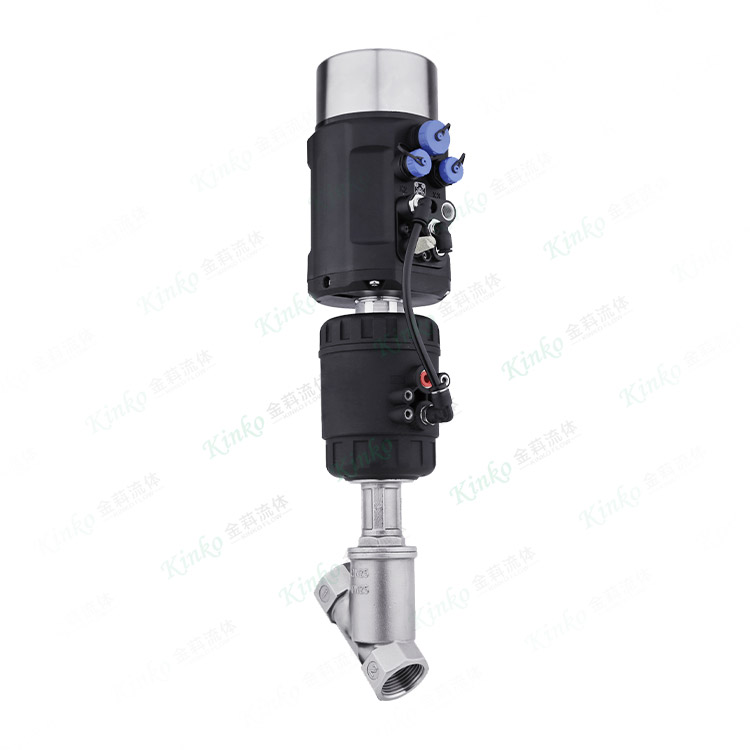
8. Pressure and Cycle Life Relationship
Higher pressure = shorter seal life. Below is typical data for Kinko angle seat valves (PTFE seal, water media, 25°C).
| Media Pressure | Expected Cycle Life (millions) |
|---|---|
| 2 – 5 bar | 4 – 5 million |
| 5 – 10 bar | 2 – 3 million |
| 10 – 16 bar | 1 – 2 million |
For steam at 5–10 bar, cycle life is typically 1–1.5 million cycles due to thermal stress in addition to pressure.
9. Low Pressure Applications – Special Considerations
Below 1 bar media pressure, PTFE seals may not seal perfectly because they rely on pressure to deform and fill gaps.
| Media Pressure | Solution |
|---|---|
| 0.5 – 1 bar | Standard PTFE usually works |
| 0.2 – 0.5 bar | Use softer seal (EPDM or FKM) |
| <0.2 bar | Consider different valve type (diaphragm valve) |
Kinko note: For vacuum or very low pressure applications, please consult us — standard angle seat valves are not designed for vacuum service.
10. Pressure Selection Quick Reference
| Application | Media Pressure | Control Pressure | Recommended Valve |
|---|---|---|---|
| Water fill (low pressure) | 2–4 bar | 5 bar | NC, SS304, PTFE |
| Industrial water (medium) | 5–8 bar | 6 bar | NC, SS304, PTFE |
| High pressure water | 10–16 bar | 7–8 bar | NC, SS304/316L, PTFE |
| Steam (low) | 2–5 bar | 5–6 bar | NC, SS316L, PTFE, remote pilot |
| Steam (high) | 8–10 bar | 6–7 bar | NC, SS316L, PTFE, heat shield |
| Compressed air | 6–8 bar | 5–6 bar | NC, SS304, PTFE, lubricated |
| Oil line | 5–10 bar | 6 bar | NC, SS304, NBR or FKM |
11. Common Pressure‑Related Mistakes
| Mistake | Consequence | Correct Action |
|---|---|---|
| Using valve above max pressure rating | Body or seal failure | Check datasheet, stay within rating |
| Control pressure too low | Valve fails to open/close fully | Maintain 5–8 bar |
| Ignoring water hammer | Premature seal failure, pipe damage | Install soft‑close or reduce velocity |
| Using NC below 0.5 bar | Leakage | Consider softer seal or different valve |
| NO valve at high pressure | Cannot close fully | Use NC instead or increase control pressure |
12. Summary – Key Takeaways
✅ Know the difference: media pressure (fluid) vs control pressure (air)
✅ Kinko angle seat valves are rated up to 16 bar (DN10–DN50)
✅ Higher pressure = shorter seal life — plan maintenance accordingly
✅ Control pressure must be 4–8 bar (5–8 bar recommended)
✅ NC type with flow above seat is best for high pressure
✅ Water hammer can cause pressure spikes — use soft‑close option
✅ Low pressure (<1 bar) may require softer seal materials
Pressure affects everything from seal life to cycle speed. Choose wisely.
13. Need Help with Pressure Selection?
Kinko offers:
-
angle seat valves for pressures from 0.5 bar to 16 bar
-
soft‑closing options for water hammer reduction
-
technical support for pressure‑related applications
Contact Kinko with your pressure, media, and cycle requirements — we will recommend the right valve.
Ivan (Mobile:+86-18968769287)
WhatsApp:+86-13579991606
Wechat:+86-18968769287
Website:www.kinko-flow.com
ZHEJIANG KINKO FLUID EQUIPMENT CO.,LTD